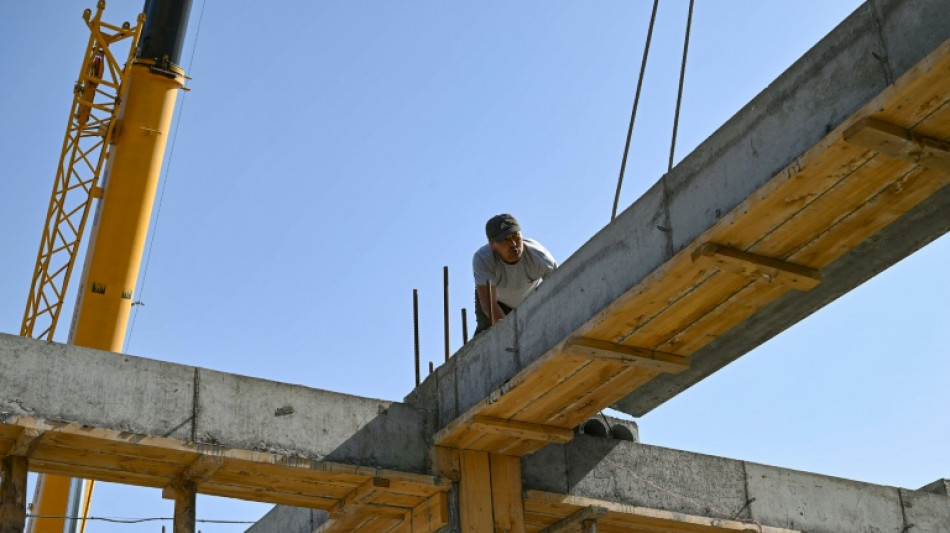
Migrant money from Russia a lifeline for Central Asia / Photo: Guliza Urustambek kyzy - AFP

 Osaka channels NBA icon Iverson to reach US Open second round

 Fast-fashion giant Shein plunges 10% on Hong Kong debut

 South Korea hire former Spain boss Moreno as interim coach
 China-Taiwan friction clouds Pacific summit

 Two dead after stabbing in New York's Times Square

 Anthropic signs $35B computing deal with startup backed by Nvidia
 Drones in Ithaca: Azov's Odyssey turns Ukraine war into modern myth
 Boat builders keep Pakistan's fishing heritage afloat

 Australia axe Labuschagne for Zimbabwe, South Africa ODI series

 Heavy rain at Grand Canyon after flood kills 2, dozen missing

 Kushner blames soccer power struggle for World Cup plan collapse

 Buoyant Alcaraz shakes off nerves to advance at US Open

 US draws European pushback with Russia G20 finance invite

 Jury begins deliberations in Tupac Shakur murder trial

 US Supreme Court allows Trump ballroom project to proceed

 Trump says US reviewing position on Falkland Islands

 Saka strikes as flawless Arsenal punish troubled Villa

 Oil prices surge on renewed fighting in US-Iran war

 Cycling superstar Pogacar has surgery after Vuelta crash
 Man City agree deal for Everton's Ndiaye

 Apple CEO Tim Cook gives nod to founder Steve Jobs in final memo

 Russian finance minister makes unexpected appearance at G20
 Happy to be back in NY, Sabalenka advances

 Naomi Watts to receive lifetime award at top Spain film fest

 Jury hears closing arguments in Tupac Shakur murder trial
In a remote town in southern Kyrgyzstan, teacher Nur Akhmatov watched workers building a library, conference hall and women's sports centre -- construction mostly funded by Kyrgyz emigrants sending money home from Russia.
The project in Batken is a snapshot of how important emigrant labour has become for economies across Central Asia.
The flow of remittances to the region came in at record amounts last year, according to World Bank data.
An all-time high of $3 billion flowed into Kyrgyzstan from migrant workers living abroad, accounting for around 25 percent of the country's gross domestic product.
In neighbouring Tajikistan, the $6 billion made-up almost half its GDP -- the highest level in the world.
Uzbekistan, the region's most populous nation, received $14.8 billion -- 14 percent of GDP.
"When I worked in Moscow, I donated 300 som ($3) a month," said Akhmatov, who is supervising the construction of the building in his home village.
He said some 1,500 migrants recently contributed to build a new school in Batken, where the average salary is around $235.
A new sports centre is a particular source of pride for teacher Abazbek Abdinabiyev.
"Children would play in the dust ... now we have this, and a pitch," he told AFP, showing off the bright blue and yellow indoor sports court.
"The contribution made by migrants has been enormous. Despite being far away, they have all helped to ensure that their children and brothers could have this opportunity," Abdinabiyev told AFP.
- 'Duty of every citizen' -
Local currencies have slipped against the Russian ruble in recent months, pushing up the spending power of what migrant workers send back.
The Kyrgyz government estimates that without remittances, the country's poverty rate would shoot up from 29 percent to 41 percent.
Unable to fund such projects alone, governments encourage the contributions.
"Beautifying the country is the duty of every citizen," reads a government banner stretched over the road in Mehrobod, northern Tajikistan.
"Each district is trying to solve its own problems: getting our children into school, keeping the streets clean and well-maintained," said villager Abdukakhor Majidov.
Around him, crews on rollers and with shovels were levelling the ground ahead of tarmacking.
A new school and bridge were already completed last year.
"As soon as one street is repaired, we move on to the next," said Majidov, who handles fundraising.
- 'Less emigration' -
But leaving for Russia has lost some of its appeal since Moscow invaded Ukraine in 2022.
While Russia's arms factories are booming and job opportunities are plenty, many fear being sent to fight in Ukraine.
Around 20,000 Central Asian migrants who received Russian citizenship are already serving in the army, Moscow said last month.
The recruitment triggered a backlash among Russia's traditional allies in the region.
Without specifying what he was referring to, Tajik President Emomali Rakhmon has expressed concern about the "hundreds of repatriated coffins" coming back from Russia, filled with those who had left "to earn bread for their families."
There has also been a surge in anti-migrant sentiment in Russia following the arrest of four Tajiks as the suspected perpetrators of the 2024 massacre at a music venue outside Moscow, Russia's deadliest terror attack in two decades.
Alongside a spike in violence and street harassment, Moscow passed laws making it easier to expel migrants.
Kadyrbek Tashimbekov, 29, is among the 300,000 Kyrgyz who have left Russia -- willingly or by force -- between 2023 and 2024, according to Bishkek's statistics.
The exodus accounts for more than half of all Kyrgyz migrants who were living in Russia.
"I was expelled after working there for eight years," he told AFP. Now he operates the crane picking up the beams for the frame of Batken's new school.
Kyrgyzstan President Sadyr Japarov has pledged to encourage labour migrants back to the country.
Meanwhile locals hope to use their funds to boost living standards at home and break the cycle of emigration.
The three former migrants that AFP spoke to -- Abdinabiyev, Akhmatov and Tashimbekov -- all said salaries were growing at home and do not plan to return to Russia.
"We are building this with the hope that if we have such centres, we will train them in the right professions, guide them," said Akhmatov.
"And maybe there will be less emigration."
T.Perez--AT