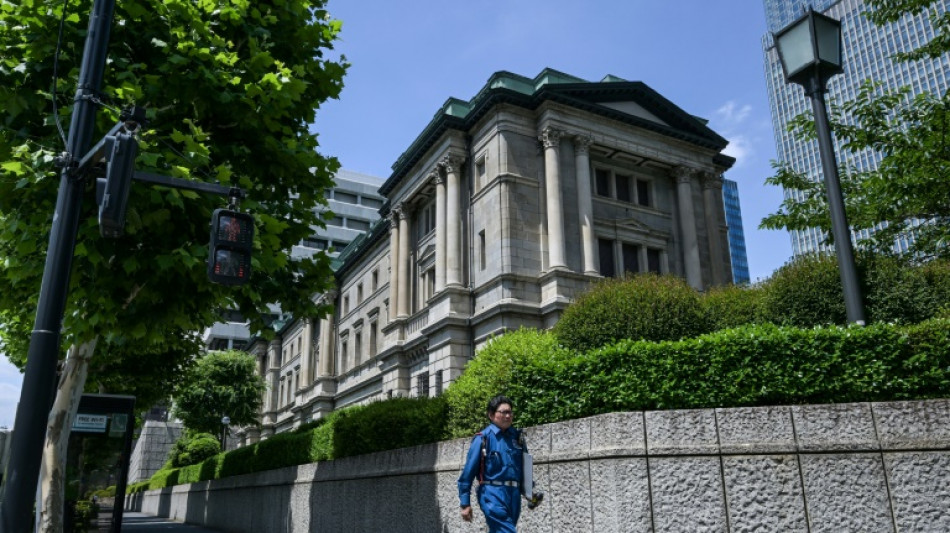
Bank of Japan holds rates, says to slow bond purchase taper / Photo: Richard A. Brooks - AFP

 Kyiv's defences, 'hybrid' threat from Moscow headline EU talks
 Oil extends gains, stocks mostly down as Trump issues fresh Iran warning

 ThinkMarkets Expands Weekend Trading Offering, Launches Weekend League Competition

 Tibet activists accuse China of downplaying floods
 Afghanistan war victims left 'without justice', UN says
 Iran president offers US olive branch before Putin meeting
 China-Nepal flood toll tops 1,000 as tunnel rescue offers last hope
 Japan to relax overtime regulation under workaholic PM

 Thwarted Niger mutiny exposes junta's Russia dependence

 Illegal mining ravages S.Africa's economic hub
 Nepal's wall of missing offers last hope after Himalayan flood
 US to press G20 on light-touch AI regulation

 2 die in Grand Canyon flash flood, only 1 person unaccounted for
 US Army Secretary Driscoll submits resignation: White House
 Oil extends gains, stocks drop as Trump issues fresh Iran warning

 Tsitsipas says Kyrgios's positive cocaine test 'kind of expected'

 In Japan's mountains, a different way to manage bears

 Middle East war a boon for UAE defence giant with global ambitions
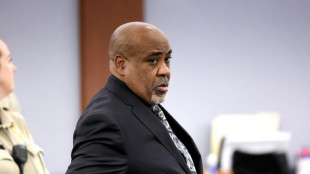 Former gang member found guilty of murdering Tupac Shakur
 CRI Merges In Morrison & Smith, Expanding Alabama Footprint

 Connecting Excellence Group PLC Announces Treasury up By 10 BTC to 72.941 & £655,999 Raised

 InterContinental Hotels Group PLC Announces Transaction in Own Shares - September 01
 Heavy rain at Grand Canyon after flood kills 2, dozen missing

 Kushner blames soccer power struggle for World Cup plan collapse

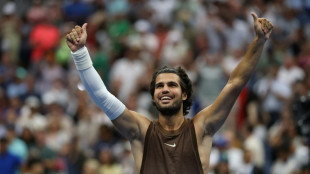 Buoyant Alcaraz shakes off nerves to advance at US Open
The Bank of Japan kept interest rates unchanged Tuesday and said it would taper its purchase of government bonds at a slower pace amid concerns about the effect of trade uncertainty on the world's number four economy.
The central bank spent years buying up Japanese Government Bonds (JGBs) to keep yields low as part of an ultra-loose monetary policy aimed at banishing stagnation and harmful deflation.
But it began moving away from that programme last year as inflation began to pick up and the yen weakened, and hiked interest rates for the first time since 2007 and began winding down its JGB purchases.
It has since then lifted borrowing costs several times to 0.5 percent, their highest level in 17 years, and continued to buy fewer bonds.
However, analysts say uncertainty sparked by US President Donald Trump's trade war has led officials to hold off more hikes, and on Tuesday they held rates again, while saying they would slow the pace of JGB reductions.
Purchases will be cut in principle "by about 200 billion yen each calendar quarter from April-June 2026" -- from around 400 billion yen ($2.8 billion) per quarter.
Carol Kong, an analyst at the Commonwealth Bank of Australia outlined the possible reasons for the decision ahead of the release of the BoJ policy statement.
"Slowing the bond taper will help keep interest rates lower than otherwise, providing support to the economy amid heightened trade uncertainty," she told AFP.
Speculation of such a move "intensified after a surge in the 'super long' Japanese Government Bond (JGB) yields in recent months", Kong added.
The yen weakened on Tuesday, with the dollar buying 144.80 yen around midday, compared with around 144.30 yen on Monday, with the BoJ's main rate much lower than the US Federal Reserve's 4.25-4.5 percent.
"The recent softening of the yen could already partly reflect expectations for a cautious policy update from the BoJ... alongside negative spillovers for Japan from the Middle East conflict," Lee Hardman of MUFG had said before the decision.
- Next rate hike? -
The BoJ also highlighted the risks ahead for the economy, saying "growth is likely to moderate, as trade and other policies in each jurisdiction lead to a slowdown in overseas economies and to a decline in domestic corporate profits and other factors".
However, "factors such as accommodative financial conditions are expected to provide support", it added.
Kong added that the bank "will likely hold off on rate hikes until there is further clarity on US trade policy".
Japan, a key US ally and its biggest investor, is subject to the same 10 percent baseline tariffs imposed on most nations plus steeper levies on cars, steel and aluminium.
Trump also announced an additional 24 percent "reciprocal" tariff on the country's goods in early April but later paused it along with similar measures on other trading partners.
Prime Minister Shigeru Ishiba said Monday there had been no breakthrough on a trade deal after talks with Trump on the sidelines of the G7 summit in Canada.
"We still believe the Bank may hike rates in the second half of the year as it remains committed to normalising monetary policy," said Katsutoshi Inadome of SuMi TRUST.
"We expect that domestic demand will remain solid and that there is a chance economic conditions will improve to the point where the BoJ can consider interest hikes," he said.
P.Smith--AT