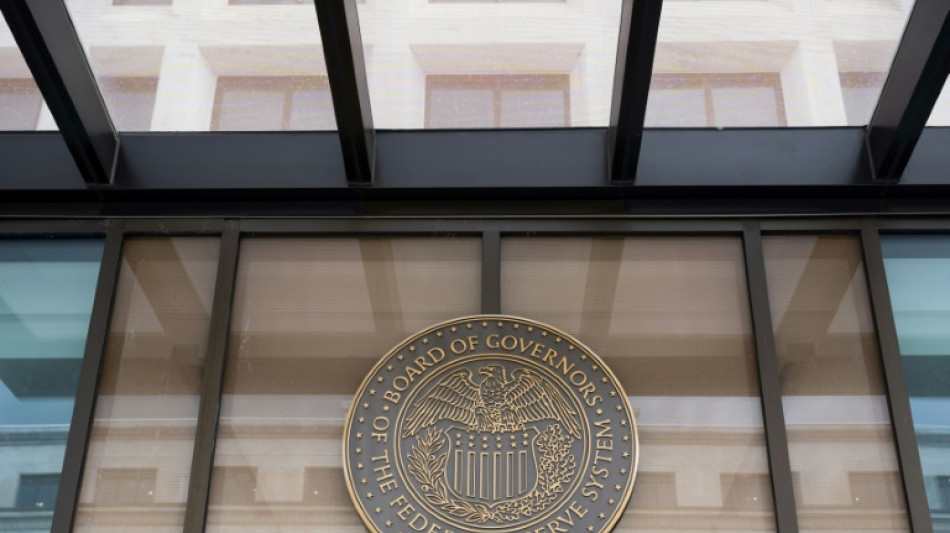
US Fed set to hold rates steady in the face of Trump pressure / Photo: SAUL LOEB - AFP/File

 Kyiv's defences, 'hybrid' threat from Moscow headline EU talks

 Oil extends gains, stocks mostly down as Trump issues fresh Iran warning

 ThinkMarkets Expands Weekend Trading Offering, Launches Weekend League Competition

 Tibet activists accuse China of downplaying floods

 Afghanistan war victims left 'without justice', UN says
 Iran president offers US olive branch before Putin meeting

 China-Nepal flood toll tops 1,000 as tunnel rescue offers last hope

 Japan to relax overtime regulation under workaholic PM

 Thwarted Niger mutiny exposes junta's Russia dependence

 Illegal mining ravages S.Africa's economic hub
 Nepal's wall of missing offers last hope after Himalayan flood

 US to press G20 on light-touch AI regulation

 2 die in Grand Canyon flash flood, only 1 person unaccounted for
 US Army Secretary Driscoll submits resignation: White House
 Oil extends gains, stocks drop as Trump issues fresh Iran warning

 Tsitsipas says Kyrgios's positive cocaine test 'kind of expected'

 In Japan's mountains, a different way to manage bears

 Middle East war a boon for UAE defence giant with global ambitions

 Former gang member found guilty of murdering Tupac Shakur

 CRI Merges In Morrison & Smith, Expanding Alabama Footprint

 Connecting Excellence Group PLC Announces Treasury up By 10 BTC to 72.941 & £655,999 Raised

 InterContinental Hotels Group PLC Announces Transaction in Own Shares - September 01

 Heavy rain at Grand Canyon after flood kills 2, dozen missing

 Kushner blames soccer power struggle for World Cup plan collapse

 Buoyant Alcaraz shakes off nerves to advance at US Open

The US central bank is expected to keep interest rates unchanged for a fourth straight policy meeting this week, despite President Donald Trump's push for rate cuts, as officials contend with uncertainty sparked by the Republican's tariffs.
While the independent Federal Reserve has started lowering rates from recent highs, officials have held the level steady this year as Trump's tariffs began rippling through the world's biggest economy.
The Fed has kept interest rates between 4.25 percent and 4.50 percent since December, while it monitors the health of the jobs market and inflation.
"The hope is to stay below the radar screen at this meeting," KPMG chief economist Diane Swonk told AFP. "Uncertainty is still very high."
"Until they know sufficiently, and convincingly that inflation is not going to pick up" either in response to tariffs or related threats, "they just can't move," she said.
Since returning to the presidency, Trump has slapped a 10 percent tariff on most US trading partners. Higher rates on dozens of economies are due to take effect in July, unless an existing pause is extended.
Trump has also engaged in a tit-for-tat tariff war with China and imposed levies on imports of steel, aluminum and automobiles, rattling financial markets and tanking consumer sentiment.
But economists expect it will take three to four months for tariff effects to show up in consumer prices.
Although hiring has cooled slightly and there was some shrinking of the labor force according to government data, the unemployment rate has stayed unchanged.
Inflation has been muted too, even as analysts noted signs of smaller business margins -- meaning companies are bearing the brunt of tariffs for now.
At the end of the Fed's two-day meeting Wednesday, analysts will be parsing through its economic projections for changes to growth and unemployment expectations -- and for signs of the number of rate cuts to come.
The Fed faces growing pressure from Trump -- citing benign inflation data -- to lower rates more quickly, a move the president argues will help the country "pay much less interest on debt coming due."
On Wednesday, Trump urged Fed Chair Jerome Powell to slash interest rates by a full percentage point, and on Thursday, he called Powell a "numbskull" for not doing so.
He said Powell could raise rates again if inflation picked up then.
But Powell has defended US central bank independence over interest rates when engaging with Trump.
- 'Cautious patience' -
For their part, Fed policymakers have signaled "little urgency" to adjust rates, said EY chief economist Gregory Daco.
He believes they are unwilling to get ahead of the net effects from Trump's trade, tax, immigration and regulation policy changes.
Powell "will likely strike a tone of cautious patience, reiterating that policy remains data dependent," Daco said.
While economists have warned that Trump's tariffs would fuel inflation and weigh on economic growth, supporters of Trump's policies argue the president's plans for tax cuts next year will boost the economy.
On the Fed's path ahead, HSBC Global Research said: "Weak labor market data could lead to larger cuts, while elevated inflation would tend to imply the opposite."
For now, analysts expect the central bank to slash rates two more times this year, beginning in September.
The Fed is likely to be eyeing data over the summer for inflationary pressures from tariffs, said Ryan Sweet, chief US economist at Oxford Economics.
"They want to make sure that they're reading the tea leaves correctly," he said.
Swonk warned the US economy is in a different place than during the Covid-19 pandemic, which could change how consumers react to price increases.
During the pandemic, government stimulus payments helped households cushion the blow from higher costs, allowing them to keep spending.
It is unclear if consumers, a key driver of the economy, will keep their dollars flowing this time, meaning demand could collapse and complicate the Fed's calculus.
"If this had been a world without tariffs, the Fed would be cutting right now. There's no question," Swonk said.
A.Clark--AT