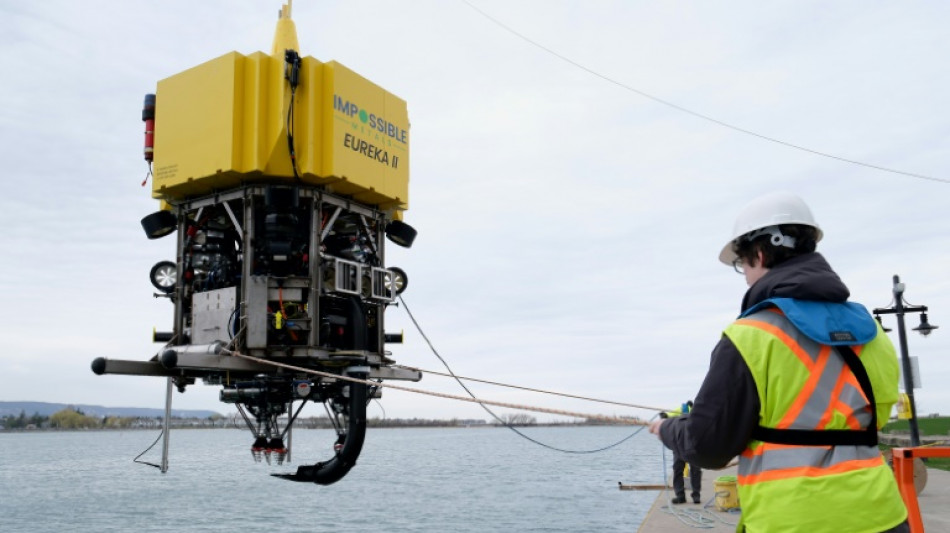
In Canada lake, robot learns to mine without disrupting marine life / Photo: John Wong - AFP

 China's Xi arrives in Egypt as US sanctions threat looms over Iran links

 Car bomb at Colombian police station kills one, injures 11

 Rain delays start of play on US Open

 Man City agree blockbuster deal to sign Chelsea star Fernandez: reports

 Alkemya Metacore Secures $50M via Tokenised Equity to Scale Nickel Energy and Security Tech

 Man City chase Fernandez, Arsenal sell Jesus on deadline day

 EU says Russian 'hybrid attacks' won't halt aid to Ukraine

 Explosives used in sabotage attack on German power lines

 Nepali families hold symbolic funerals for missing after floods

 Newcastle sign Lille forward Fernandez-Pardo

 Even at Elysee, phones are handed in, Macron tells French pupils

 Chelsea agree to sign Atalanta's Ahanor, with Palace loan for this season

 Chelsea sign Atalanta's Ahanor and loan him to Palace

 UK chalks up hottest summer on record for second year running

 China's Xi visits Egypt as US sanctions threat looms over Iran links

 RISE Robotics Awarded $100,000 MassVentures Grant to Accelerate Commercialization of Beltdraulic Technology

 Global bond sell-off deepens on inflation concerns

 Germany's far-right AfD promises 'boom' but economists fear worst

 Former England captain Stokes signs for Adelaide Strikers

 Pakistan selector and ex-captain Misbah resigns after coach sacked

 Shein flattens on Hong Kong debut facing global headwinds

 Eurozone inflation hits three-year high at 3.3% in August

 Man City chase Fernandez, Arsenal eye Alvarez on deadline day

 El Nino hammering Peru anchovy fishing: industry officials

 Mass Russian barrage kills 12 in Kyiv

Three robotic arms extended under the water in a Canadian lake, delicately selecting pebbles from the bed, before storing them back inside the machine.
The exercise was part of a series of tests the robot was undergoing before planned deployment in the ocean, where its operators hope the machine can transform the search for the world's most sought-after metals.
The robot was made by Impossible Metals, a company founded in California in 2020, which says it is trying to develop technology that allows the seabed to be harvested with limited ecological disruption.
Conventional underwater harvesting involves scooping up huge amounts of material in search of potato-sized things called poly-metallic nodules.
These nodules contain nickel, copper, cobalt, or other metals needed for electric vehicle batteries, among other key products.
Impossible Metals' co-founder Jason Gillham told AFP his company's robot looks for the nodules "in a selective way."
The prototype, being tested in the province of Ontario, remains stationary in the water, hovering over the lake bottom.
In a lab, company staff monitor the yellow robot on screens, using what looks like a video game console to direct its movements.
Using lights, cameras and artificial intelligence, the robot tries to identify the sought-after nodules while leaving aquatic life -- such as octopuses' eggs, coral, or sponges -- undisturbed.
- 'A bit like bulldozers' -
In a first for the nascent sector, Impossible Metals has requested a permit from US President Donald Trump to use its robot in American waters around Samoa, in the Pacific.
The company is hoping that its promise of limited ecological disruption will give it added appeal.
Competitors, like The Metals Company, use giant machines that roll along the seabed and suck up the nodules, a highly controversial technique.
Douglas McCauley, a marine biologist at the University of California, Santa Barbara, told AFP this method scoops up ocean floor using collectors or excavators, "a bit like bulldozers," he explained.
Everything is then brought up to ships, where the nodules are separated from waste, which is tossed back into the ocean.
This creates large plumes of sediment and toxins with a multitude of potential impacts, he said.
A less invasive approach, like that advocated by Impossible Metals, would reduce the risk of environmental damage, McCauley explained.
But he noted lighter-touch harvesting is not without risk.
The nodules themselves also harbor living organisms, and removing them even with a selective technique, involves destroying the habitat, he said.
Impossible Metals admits its technology cannot detect microscopic life, but the company claims to have a policy of leaving 60 percent of the nodules untouched.
McCauley is unconvinced, explaining "ecosystems in the deep ocean are especially fragile and sensitive."
"Life down there moves very slowly, so they reproduce very slowly, they grow very slowly."
Duncan Currie of the Deep Sea Conservation Coalition said it was impossible to assess the impact of any deep sea harvesting.
"We don't know enough yet either in terms of the biodiversity and the ecosystem down there," he told AFP.
According to the international scientific initiative Ocean Census, only 250,000 species are known, out of the two million that are estimated to populate the oceans.
- High demand -
Mining is "always going to have some impact," said Impossible Metals chief executive and co-founder Oliver Gunasekara, who has spent most of his career in the semiconductor field.
But, he added, "we need a lot more critical minerals, as we want to electrify everything."
Illustrating the global rush toward underwater mining, Impossible Metals has raised US$15 million from investors to build and test a first series of its Eureka 3 robot in 2026.
The commercial version will be the size of a shipping container and will expand from three to 16 arms, and its battery will grow from 14 to nearly 200 kilowatt-hours.
The robot will be fully autonomous and self-propel, without cables or tethers to the surface, and be equipped with sensors.
While awaiting the US green light, the company hopes to finalize its technology within two to three years, conduct ocean tests, build a fleet, and operate through partnerships elsewhere in the world.
P.Hernandez--AT