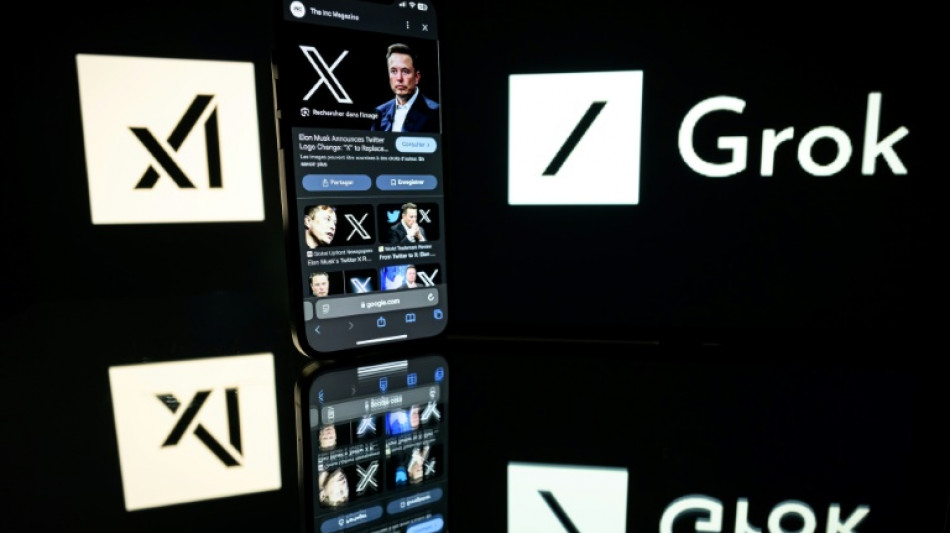
Hey chatbot, is this true? AI 'factchecks' sow misinformation / Photo: Lionel BONAVENTURE - AFP

 Syria site infrastructure 'consistent with nuclear reactor': IAEA

 Juventus sign Woltemade, Sarr on loan from Premier League

 US strikes Iran in latest tit-for-tat attacks

 China's Xi arrives in Egypt as US sanctions threat looms over Iran links

 Car bomb at Colombian police station kills one, injures 11

 Rain delays start of play on US Open

 Man City agree blockbuster deal to sign Chelsea star Fernandez: reports
 Alkemya Metacore Secures $50M via Tokenised Equity to Scale Nickel Energy and Security Tech

 Man City chase Fernandez, Arsenal sell Jesus on deadline day

 EU says Russian 'hybrid attacks' won't halt aid to Ukraine

 Explosives used in sabotage attack on German power lines

 Nepali families hold symbolic funerals for missing after floods

 Newcastle sign Lille forward Fernandez-Pardo

 Even at Elysee, phones are handed in, Macron tells French pupils

 Chelsea agree to sign Atalanta's Ahanor, with Palace loan for this season

 Chelsea sign Atalanta's Ahanor and loan him to Palace

 UK chalks up hottest summer on record for second year running

 China's Xi visits Egypt as US sanctions threat looms over Iran links

 RISE Robotics Awarded $100,000 MassVentures Grant to Accelerate Commercialization of Beltdraulic Technology

 Global bond sell-off deepens on inflation concerns

 Germany's far-right AfD promises 'boom' but economists fear worst

 Former England captain Stokes signs for Adelaide Strikers

 Pakistan selector and ex-captain Misbah resigns after coach sacked

 Shein flattens on Hong Kong debut facing global headwinds

 Eurozone inflation hits three-year high at 3.3% in August

As misinformation exploded during India's four-day conflict with Pakistan, social media users turned to an AI chatbot for verification -- only to encounter more falsehoods, underscoring its unreliability as a fact-checking tool.
With tech platforms reducing human fact-checkers, users are increasingly relying on AI-powered chatbots -- including xAI's Grok, OpenAI's ChatGPT, and Google's Gemini -- in search of reliable information.
"Hey @Grok, is this true?" has become a common query on Elon Musk's platform X, where the AI assistant is built in, reflecting the growing trend of seeking instant debunks on social media.
But the responses are often themselves riddled with misinformation.
Grok -- now under renewed scrutiny for inserting "white genocide," a far-right conspiracy theory, into unrelated queries -- wrongly identified old video footage from Sudan's Khartoum airport as a missile strike on Pakistan's Nur Khan airbase during the country's recent conflict with India.
Unrelated footage of a building on fire in Nepal was misidentified as "likely" showing Pakistan's military response to Indian strikes.
"The growing reliance on Grok as a fact-checker comes as X and other major tech companies have scaled back investments in human fact-checkers," McKenzie Sadeghi, a researcher with the disinformation watchdog NewsGuard, told AFP.
"Our research has repeatedly found that AI chatbots are not reliable sources for news and information, particularly when it comes to breaking news," she warned.
- 'Fabricated' -
NewsGuard's research found that 10 leading chatbots were prone to repeating falsehoods, including Russian disinformation narratives and false or misleading claims related to the recent Australian election.
In a recent study of eight AI search tools, the Tow Center for Digital Journalism at Columbia University found that chatbots were "generally bad at declining to answer questions they couldn't answer accurately, offering incorrect or speculative answers instead."
When AFP fact-checkers in Uruguay asked Gemini about an AI-generated image of a woman, it not only confirmed its authenticity but fabricated details about her identity and where the image was likely taken.
Grok recently labeled a purported video of a giant anaconda swimming in the Amazon River as "genuine," even citing credible-sounding scientific expeditions to support its false claim.
In reality, the video was AI-generated, AFP fact-checkers in Latin America reported, noting that many users cited Grok's assessment as evidence the clip was real.
Such findings have raised concerns as surveys show that online users are increasingly shifting from traditional search engines to AI chatbots for information gathering and verification.
The shift also comes as Meta announced earlier this year it was ending its third-party fact-checking program in the United States, turning over the task of debunking falsehoods to ordinary users under a model known as "Community Notes," popularized by X.
Researchers have repeatedly questioned the effectiveness of "Community Notes" in combating falsehoods.
- 'Biased answers' -
Human fact-checking has long been a flashpoint in a hyperpolarized political climate, particularly in the United States, where conservative advocates maintain it suppresses free speech and censors right-wing content -- something professional fact-checkers vehemently reject.
AFP currently works in 26 languages with Facebook's fact-checking program, including in Asia, Latin America, and the European Union.
The quality and accuracy of AI chatbots can vary, depending on how they are trained and programmed, prompting concerns that their output may be subject to political influence or control.
Musk's xAI recently blamed an "unauthorized modification" for causing Grok to generate unsolicited posts referencing "white genocide" in South Africa.
When AI expert David Caswell asked Grok who might have modified its system prompt, the chatbot named Musk as the "most likely" culprit.
Musk, the South African-born billionaire backer of President Donald Trump, has previously peddled the unfounded claim that South Africa's leaders were "openly pushing for genocide" of white people.
"We have seen the way AI assistants can either fabricate results or give biased answers after human coders specifically change their instructions," Angie Holan, director of the International Fact-Checking Network, told AFP.
"I am especially concerned about the way Grok has mishandled requests concerning very sensitive matters after receiving instructions to provide pre-authorized answers."
burs-ac/nl
H.Thompson--AT