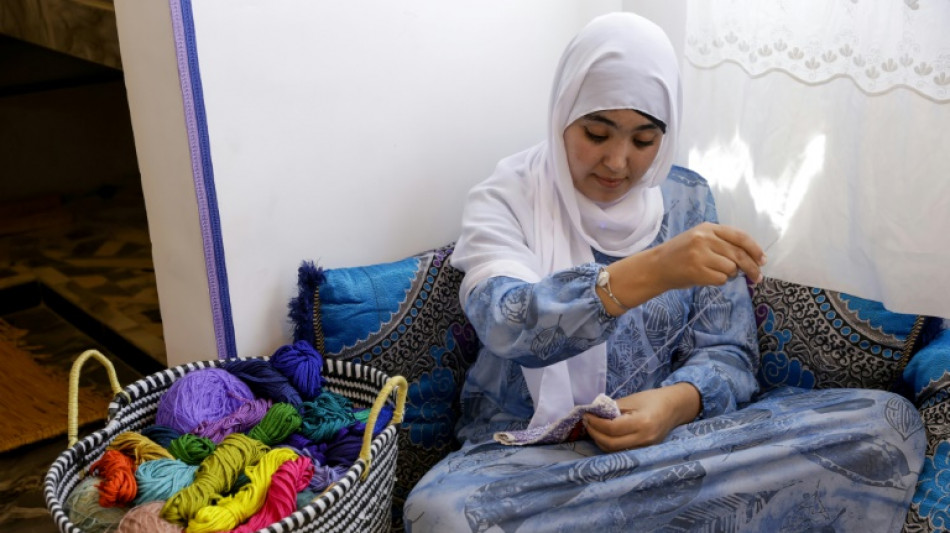
Moroccan women embroider 'art with purpose' / Photo: Abdel Majid BZIOUAT - AFP

 Syria site infrastructure 'consistent with nuclear reactor': IAEA

 Juventus sign Woltemade, Sarr on loan from Premier League

 US strikes Iran in latest tit-for-tat attacks

 China's Xi arrives in Egypt as US sanctions threat looms over Iran links
 Car bomb at Colombian police station kills one, injures 11

 Rain delays start of play on US Open

 Man City agree blockbuster deal to sign Chelsea star Fernandez: reports

 Alkemya Metacore Secures $50M via Tokenised Equity to Scale Nickel Energy and Security Tech

 Man City chase Fernandez, Arsenal sell Jesus on deadline day

 EU says Russian 'hybrid attacks' won't halt aid to Ukraine

 Explosives used in sabotage attack on German power lines

 Nepali families hold symbolic funerals for missing after floods

 Newcastle sign Lille forward Fernandez-Pardo

 Even at Elysee, phones are handed in, Macron tells French pupils
 Chelsea agree to sign Atalanta's Ahanor, with Palace loan for this season

 Chelsea sign Atalanta's Ahanor and loan him to Palace

 UK chalks up hottest summer on record for second year running

 China's Xi visits Egypt as US sanctions threat looms over Iran links

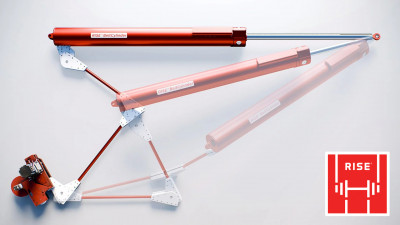 RISE Robotics Awarded $100,000 MassVentures Grant to Accelerate Commercialization of Beltdraulic Technology

 Global bond sell-off deepens on inflation concerns

 Germany's far-right AfD promises 'boom' but economists fear worst
 Former England captain Stokes signs for Adelaide Strikers

 Pakistan selector and ex-captain Misbah resigns after coach sacked
 Shein flattens on Hong Kong debut facing global headwinds

 Eurozone inflation hits three-year high at 3.3% in August

In a small village on the coast of southern Morocco, women gather in a house to create collaborative works of textile art, and also earn a living.
Several hunch over large canvasses, embroidering their latest piece at the women-only workshop, in the village of 400 people. Some of their works have been shown internationally.
"This project has changed my life," said Hanane Ichbikili, a 28-year-old former nursing student turned project creative director.
"And yet I had never held an embroidery needle before," she told AFP.
Just 19 percent of Moroccan women hold steady jobs, according to official figures, and in rural areas they are particularly affected by poverty, unpaid labour and a lack of opportunity.
An artist with roots in both Morocco and France has tried to make a difference.
Margaux Derhy founded the workshop in 2022 in her father's native village of Sidi R'bat, around 70 kilometres (45 miles) south of Agadir, to fulfil her "dream to make art with purpose".
The project uses textiles and old photographs to explore her family heritage before they left the country in the 1960s, turning sepia-toned portraits and scenes into large silk-and-linen canvases.
The North African country was a protectorate of France before gaining its independence in 1956.
- Creative process -
The project is more than just personal for Derhy -- it also provides local women in the small fishing village employment.
"I wanted to be engaged on the ground," said Derhy, adding that she hired 10 local women to work full-time for a monthly salary exceeding Morocco's private-sector minimum wage of 3,045 dirhams ($330).
The women's hands glide over frames that were once used by Paris's prestigious Maison Lesage, the world-famous embroidery house that has worked with some of the greatest names in fashion.
The creative process is collaborative, with Derhy drawing an outline and the team then gathering to choose the threads and colour palette for each section.
A canvas can take up to five months to complete.
The finished works, priced at up to $5,620, have been shown in exhibitions in Marrakesh, Paris and Brussels. Future exhibits are planned for Casablanca's L'Atelier 21 and Tabari Artspace Gallery in Dubai.
The workshop has also helped to challenge perceived ideas about women in the village.
"At first, some of the women had to hide to come because it was frowned upon," said Khadija Ahuilat, 26, who oversees operations.
- 'A blessing' -
She said some people thought the project "was nonsense, and a woman should stay at home".
"But we managed to change that. I'm very proud to have contributed to this change, even if on a small scale."
Her mother, Aicha Jout, 50, a widow who once gathered mussels and raised livestock to support her family, is now one of the embroiderers.
"It changes a lot for me to be here," she said.
"I love the idea of embroidering on pictures, but also of passing on the craft to other women."
Jout learned to embroider at the age of 12, and has trained the rest of her mostly single or widowed colleagues.
"There aren't really a lot of job opportunities here, so when the chance came I didn't hesitate for a second," said Haddia Nachit, 59, one of the workshop's most efficient embroiders.
Her nickname among the women is "TGV" -- after France's high-speed train.
Seated next to Nachit, Fadma Lachgar, also 59, said the work allowed her to help her family.
"Resuming embroidery at my age, after 20 years of stopping, is a blessing," she said.
L.Adams--AT