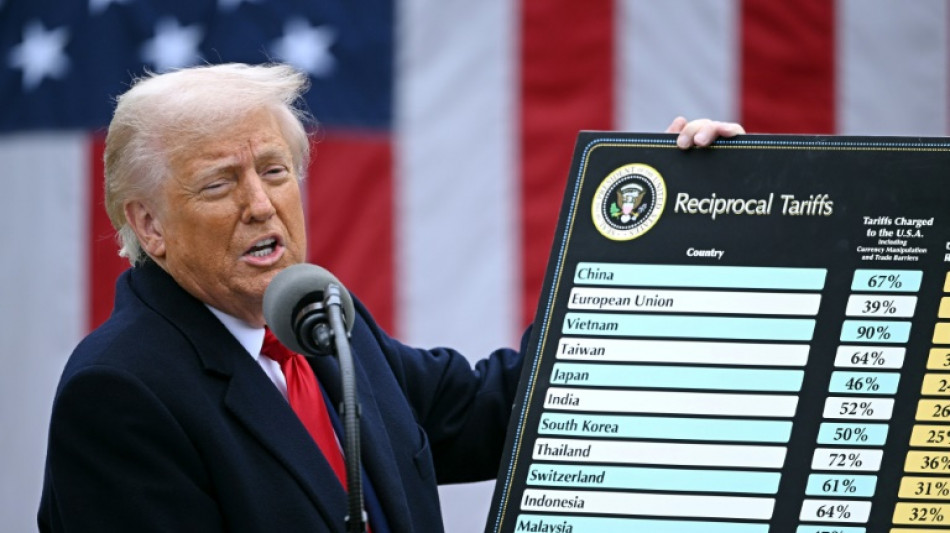
US trade court blocks tariffs in major setback for Trump / Photo: Brendan SMIALOWSKI - AFP/File

 Syria site infrastructure 'consistent with nuclear reactor': IAEA

 Juventus sign Woltemade, Sarr on loan from Premier League

 US strikes Iran in latest tit-for-tat attacks
 China's Xi arrives in Egypt as US sanctions threat looms over Iran links

 Car bomb at Colombian police station kills one, injures 11
 Rain delays start of play on US Open
 Man City agree blockbuster deal to sign Chelsea star Fernandez: reports
 Alkemya Metacore Secures $50M via Tokenised Equity to Scale Nickel Energy and Security Tech

 Man City chase Fernandez, Arsenal sell Jesus on deadline day

 EU says Russian 'hybrid attacks' won't halt aid to Ukraine
 Explosives used in sabotage attack on German power lines

 Nepali families hold symbolic funerals for missing after floods
 Newcastle sign Lille forward Fernandez-Pardo

 Even at Elysee, phones are handed in, Macron tells French pupils

 Chelsea agree to sign Atalanta's Ahanor, with Palace loan for this season

 Chelsea sign Atalanta's Ahanor and loan him to Palace

 UK chalks up hottest summer on record for second year running
 China's Xi visits Egypt as US sanctions threat looms over Iran links

 RISE Robotics Awarded $100,000 MassVentures Grant to Accelerate Commercialization of Beltdraulic Technology

 Global bond sell-off deepens on inflation concerns

 Germany's far-right AfD promises 'boom' but economists fear worst

 Former England captain Stokes signs for Adelaide Strikers

 Pakistan selector and ex-captain Misbah resigns after coach sacked

 Shein flattens on Hong Kong debut facing global headwinds

 Eurozone inflation hits three-year high at 3.3% in August

A US federal court on Wednesday blocked most of Donald Trump's sweeping import tariffs from going into effect, ruling that the president had overstepped his authority with the across-the-board global levies.
The ruling -- which is sure to be challenged -- marks a significant setback to the Republican leader as he bids to redraw the United States' trading relationship with the world by forcing foreign governments to the negotiating table through a series of tough new levies.
The court's order could spell a premature end to Trump's international trade war as it bars Trump’s most sweeping tariffs, effectively erasing most of the trade restrictions Trump has announced since taking office.
Since coming to power, Trump has upended global trade and roiled financial markets with a stop-start rollout of levies that are aimed at punishing economies that sell more to the United States than they buy.
There was no immediate response to Wednesday's ruling from the president, although one of his closest White House aides, Stephen Miller, attacked it in a social media post.
"The judicial coup is out of control," he said.
Trump unveiled sweeping tariffs on most trading partners on April 2, with a baseline 10 percent, plus steeper duties on dozens of economies, including China and the European Union.
The ruling also quashes duties that Trump imposed on Canada, Mexico and China separately using emergency powers.
Markets were thrown into turmoil but calmed after he paused the larger tariffs for 90 days. He also suspended some of the higher duties pending negotiations with individual countries and blocs.
- 'Unconstitutional' -
The three-judge Court of International Trade was ruling in two separate cases -- brought by businesses and a coalition of state governments -- arguing that the president's actions violated the power of purse given to Congress under the constitution.
"The question in the two cases before the court is whether the International Emergency Economic Powers Act of 1977 ("IEEPA") delegates these powers to the president in the form of authority to impose unlimited tariffs on goods from nearly every country in the world," the three-judge panel wrote in an unsigned opinion.
"The court does not read IEEPA to confer such unbounded authority and sets aside the challenged tariffs imposed thereunder."
The court, which adjudicates civil cases arising from trade disputes, said that any interpretation of the IEEPA that "delegates unlimited tariff authority is unconstitutional," according to court documents.
- 'Extraordinary threat' -
The IEEPA authorizes the president to impose necessary economic sanctions during an emergency "to combat an unusual and extraordinary threat," the bench said.
Trump cited the IEEPA when he said trade deficits and the threat posed by the ingress of drugs into the United States justified widespread tariffs.
The decision revoking that move gave the White House 10 days to complete the bureaucratic process of halting the tariffs, although the administration is almost certain to appeal.
The Justice Department has defended Trump's trade strategy in court, insisting that the judiciary has very limited authority over his actions and sparking criticism that the White House was attempting to usurp the power of the other branches of government.
Trump has claimed that Americans will reap the benefits of his "America First" trade posture, pointing to early successes in deals struck with Britain and with China, the world's second-largest economy.
US Treasury Secretary Scott Bessent told Bloomberg Television on Friday the lower 10 percent tariff rate was "contingent on countries or trading blocs coming and negotiating in good faith."
But Trump sent markets into a tailspin by threatening to hit EU goods with a 50 percent tariff from June 1, saying talks were "going nowhere" as negotiations with the powerful trade bloc failed to yield progress.
Brussels recently threatened to hit US goods worth nearly 100 billion euros ($113 billion) with tariffs.
Wall Street shares briefly bounced on Tuesday after Trump delayed the levies over the long holiday weekend -- although markets were down again Wednesday.
Analysts also warn that the cost of the tariffs will likely be passed on to US consumers, raising inflation and potentially leading the US central bank to hold interest rates higher for longer, further impacting financial markets.
R.Lee--AT