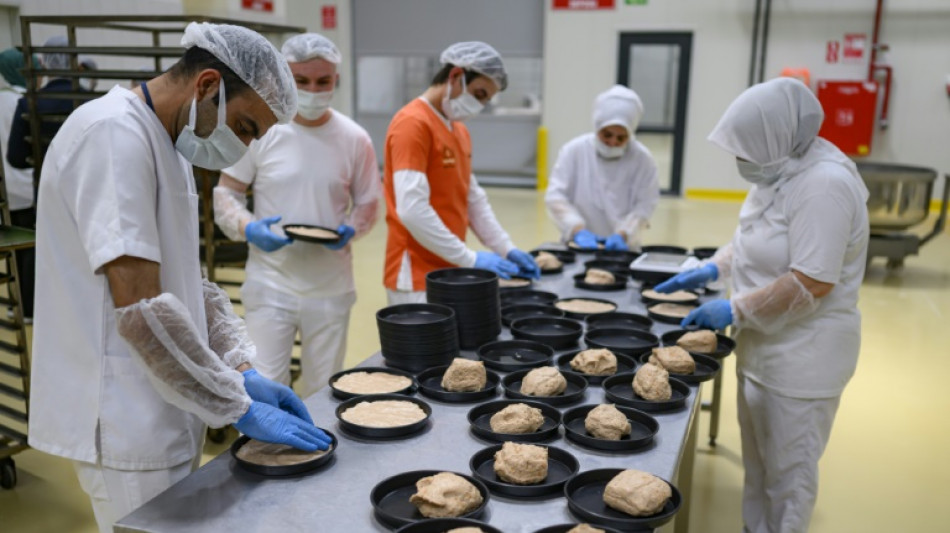
Ancient bread rises again as Turkey recreates 5,000-year-old loaf / Photo: Yasin AKGUL - AFP

 Kroenke to buy baseball's Los Angeles Angels: statement

 US defends Trump's Venezuela oil deal

 OpenAI to launch new model with 'stronger safeguards' after hack

 Fans mourn 'bittersweet' final Ariana Grande gig in London

 Norway's King Haakon VIII swears allegiance to constitution

 Syria site infrastructure 'consistent with nuclear reactor': IAEA

 Juventus sign Woltemade, Sarr on loan from Premier League

 US strikes Iran in latest tit-for-tat attacks

 China's Xi arrives in Egypt as US sanctions threat looms over Iran links
 Car bomb at Colombian police station kills one, injures 11

 Rain delays start of play on US Open

 Man City agree blockbuster deal to sign Chelsea star Fernandez: reports

 Alkemya Metacore Secures $50M via Tokenised Equity to Scale Nickel Energy and Security Tech

 Man City chase Fernandez, Arsenal sell Jesus on deadline day

 EU says Russian 'hybrid attacks' won't halt aid to Ukraine

 Explosives used in sabotage attack on German power lines
 Nepali families hold symbolic funerals for missing after floods

 Newcastle sign Lille forward Fernandez-Pardo

 Even at Elysee, phones are handed in, Macron tells French pupils
 Chelsea agree to sign Atalanta's Ahanor, with Palace loan for this season

 Chelsea sign Atalanta's Ahanor and loan him to Palace

 UK chalks up hottest summer on record for second year running

 China's Xi visits Egypt as US sanctions threat looms over Iran links

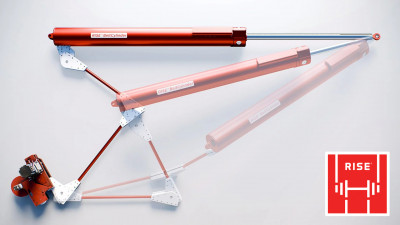 RISE Robotics Awarded $100,000 MassVentures Grant to Accelerate Commercialization of Beltdraulic Technology

 Global bond sell-off deepens on inflation concerns

In the early Bronze Age, a piece of bread was buried beneath the threshold of a newly built house in what is today central Turkey.
Now, more than 5,000 years later, archaeologists have unearthed it, and helped a local bakery to recreate the recipe -- with customers lining up to buy it.
Round and flat like a pancake, 12 centimetres (five inches) in diameter, the bread was discovered during excavations at Kulluoba, a site near the central Anatolian city of Eskisehir.
"This is the oldest baked bread to have come to light during an excavation, and it has largely been able to preserve its shape," said Murat Turkteki, archaeologist and director of the excavation.
"Bread is a rare find during an excavation. Usually, you only find crumbs," he told AFP.
"But here, it was preserved because it had been burnt and buried," he said.
The bread was charred and buried under the entrance of a dwelling built around 3,300 BC.
A piece had been torn off, before the bread was burnt, then buried when the house was built.
"It makes us think of a ritual of abundance," Turkteki said.
- 'Moved by this discovery' -
Unearthed in September 2024, the charred bread has been on display at the Eskisehir Archaeological Museum since Wednesday.
"We were very moved by this discovery. Talking to our excavation director, I wondered if we could reproduce this bread," said the city's mayor, Ayse Unluce.
Analyses showed that the bread was made with coarsely ground emmer flour, an ancient variety of wheat, and lentil seeds, with the leaf of an as yet undetermined plant used as yeast.
Ancient emmer seeds no longer exist in Turkey.
To get as close as possible to the original recipe, the municipality, after analysing the ancient bread, decided to use Kavilca wheat, a variety that is close to ancient emmer, as well as bulgur and lentils.
At the Halk Ekmek bakery (meaning "People's Bread" in Turkish), promoted by the municipality to offer low-cost bread, employees have been shaping 300 loaves of Kulluoba by hand every day.
"The combination of ancestral wheat flour, lentils and bulgur results in a rich, satiating, low-gluten, preservative-free bread," said Serap Guler, the bakery's manager.
The first Kulluoba loaves, marketed as 300-gramme (11-ounce) cakes that cost 50 Turkish lira (around $1.28), sold out within hours.
"I rushed because I was afraid there wouldn't be any left. I'm curious about the taste of this ancient bread," said customer Suzan Kuru.
- Drought resistant -
In the absence of written traces, the civilisation of Kulluoba remains largely mysterious.
In the Bronze Age, the Hattians, an Anatolian people who preceded the Hittites, lived in the Eskisehir region.
"Kulluoba was a medium-sized urban agglomeration engaged in commercial activities, crafts, agriculture and mining. There was clearly a certain family and social order," said archaeologist Deniz Sari.
The rediscovery of the bread has sparked interest in the cultivation of ancient wheats better adapted to drought.
Once rich in water sources, the province of Eskisehir is today suffering from drought.
"We're facing a climate crisis, but we're still growing corn and sunflowers, which require a lot of water," said Unluce, the local mayor.
"Our ancestors are teaching us a lesson. Like them, we should be moving towards less thirsty crops," she added.
The mayor wants to revive the cultivation of Kavilca wheat in the region, which is resistant to drought and disease.
"We need strong policies on this subject. Cultivating ancient wheat will be a symbolic step in this direction," she said.
"These lands have preserved this bread for 5,000 years and given us this gift. We have a duty to protect this heritage and pass it on."
S.Jackson--AT