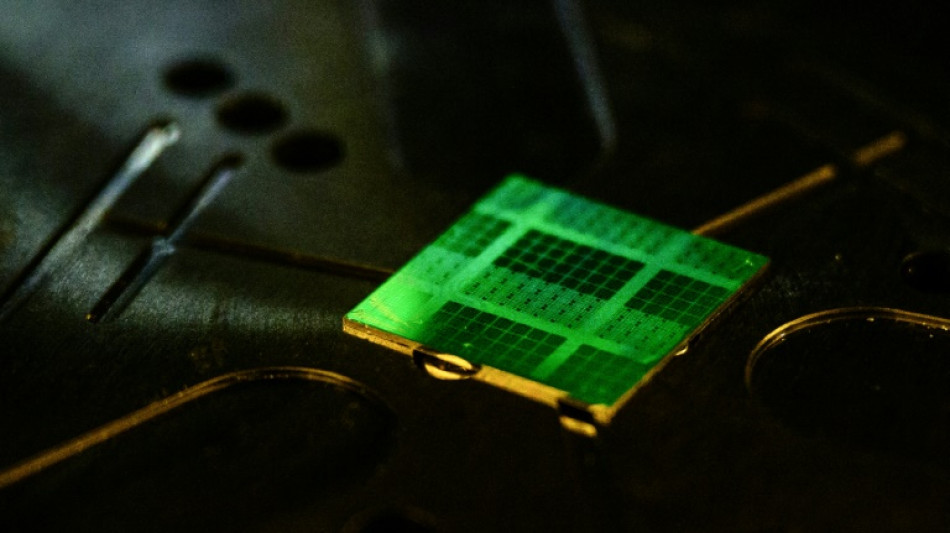
China slams US 'bullying' over new warnings on Huawei chips / Photo: ANTHONY WALLACE - AFP

 Zelensky warns airlines Russian skies not safe due to Ukraine drones

 UK vows anti-settler measures as Israel warns of retaliation

 New pro Koivun among US Presidents Cup picks
 G20 finance leaders close talks marked by US welcoming Russia

 From Hollywood to big time tennis: teen makes US Open debut

 Man City secure Premier League record deal to sign Fernandez

 Kaepernick says NFL 'blackballing me' decade after protest

 Atletico loan David from Juve, send Lemar to Elche

 Chelsea 'keeper Sanchez makes deadline-day move to Como

 Kroenke to buy baseball's Los Angeles Angels: statement

 US defends Trump's Venezuela oil deal

 OpenAI to launch new model with 'stronger safeguards' after hack
 Fans mourn 'bittersweet' final Ariana Grande gig in London
 Norway's King Haakon VIII swears allegiance to constitution
 Syria site infrastructure 'consistent with nuclear reactor': IAEA

 Juventus sign Woltemade, Sarr on loan from Premier League

 US strikes Iran in latest tit-for-tat attacks

 China's Xi arrives in Egypt as US sanctions threat looms over Iran links

 Car bomb at Colombian police station kills one, injures 11

 Rain delays start of play on US Open

 Man City agree blockbuster deal to sign Chelsea star Fernandez: reports
 Alkemya Metacore Secures $50M via Tokenised Equity to Scale Nickel Energy and Security Tech

 Man City chase Fernandez, Arsenal sell Jesus on deadline day

 EU says Russian 'hybrid attacks' won't halt aid to Ukraine
 Explosives used in sabotage attack on German power lines

Beijing condemned on Wednesday new US warnings on the use of AI chips by Chinese tech giant Huawei, vowing it would take steps against "bullying" efforts to restrict access to high-tech semiconductors and supply chains.
Washington has sought in recent years to curb exports of state-of-the-art chips to China, concerned that they could be used to advance Beijing's military systems and otherwise undermine American dominance in AI.
US President Donald Trump's administration last week rescinded some export controls on advanced computing semiconductors, answering calls by countries that said they were being shut out from crucial technology needed to develop artificial intelligence.
Some US lawmakers feared the restrictions would have incentivised countries to go to China for AI chips, spurring the superpower's development of state-of-the-art technology.
But Washington also unveiled fresh guidelines warning firms that using Chinese-made high-tech AI semiconductors, specifically tech giant Huawei's Ascend chips, would put them at risk of violating US export controls.
In a statement Wednesday, Beijing's commerce ministry described the warnings as "typical unilateral bullying and protectionism, which seriously undermine the stability of the global semiconductor industry chain and supply chain".
China accused the US of "abusing export controls to suppress and contain China".
"These actions seriously harm the legitimate rights and interests of Chinese enterprises and endanger China's development interests," the commerce ministry said.
It also warned that "any organization or individual that enforces or assists in enforcing such measures" could be in violation of Chinese law.
And it vowed to take "firm steps to safeguard its legitimate rights and interests" in response.
- Chips on the table -
The United States warned last week about the potential consequences of allowing US AI chips to be used for training Chinese AI models.
And those found using Huawei's Ascend chips without clearance from Washington, the guidance read, can face "substantial criminal and administrative penalties, up to and including imprisonment, fines, loss of export privileges, or other restriction".
The US commerce department said its policy was aimed at sharing American AI technology "with trusted foreign countries around the world, while keeping the technology out of the hands of our adversaries".
Previous US rules divided countries into three tiers, each with its own level of restrictions.
Top-tier countries like Japan and South Korea faced no export restrictions, while countries in the second tier, which included Mexico and Portugal, saw a cap on the chips they could receive.
Chipmakers including Nvidia and AMD lobbied against the tiered restrictions and saw their share prices rise when the Trump administration indicated it would rethink the rule.
Speaking at Taiwan's top tech show on Wednesday, Nvidia CEO Jensen Huang described US export controls on AI chips to China as a "failure", since companies are using locally developed technology.
"The local companies are very, very talented and very determined, and the export control gave them the spirit, the energy and the government support to accelerate their development," Huang said.
A.Ruiz--AT