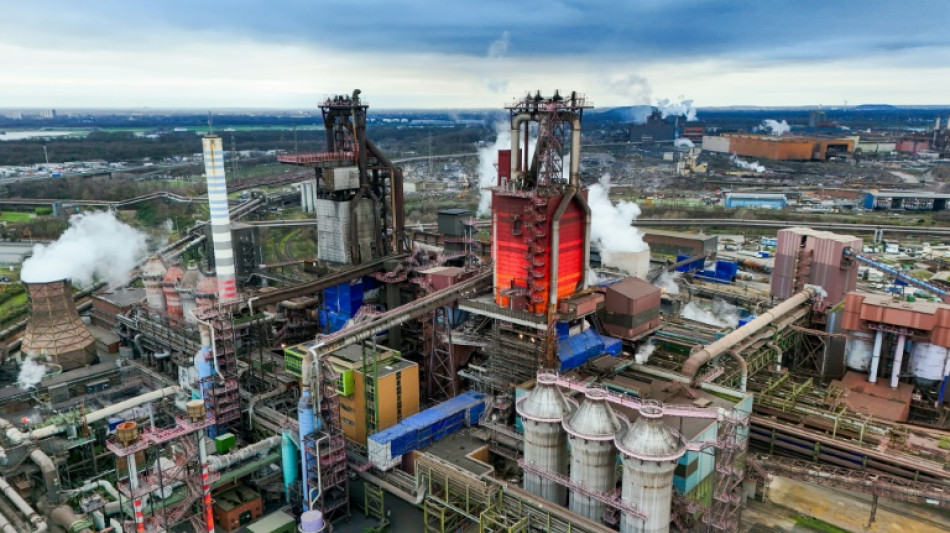
German growth better than expected but tariff turmoil looms / Photo: Ina FASSBENDER - AFP

 DNA tests and funerals in Nepal, a week after deadly floods

 Iran threatens tougher strategy after US strikes kill 4 at wedding

 Chevron unveils deal to double Venezuela venture output in 5 years

 Uganda names its oil 'Pearl Sweet' as it prepares for first exports
 Tiger Woods driver's license suspended for five years after crash

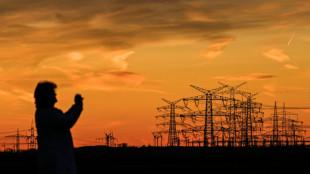 Germany probes latest sabotage attacks on power grid

 Wall Street stocks mixed as energy prices, bond yields turn lower

 Tiger Woods pleads guilty to reckless driving, license suspended
 Missing passengers likely went down with sunken ferry: N.Cyprus official

 Premier League clubs splash cash to smash transfer record
 Melting glaciers an 'immediate' climate risk: author of UN report

 Folarin Balogun's move to Everton collapses

 Pacific islands to face food shortages over global warming: scientists

 Venice jury head Maggie Gyllenhaal questions lack of women directors

 Stocks drop, bond yields rally on Mideast flare-up

 China expands Egypt investments in first Xi visit in a decade

 Messi departure leaves Argentina facing rebuild after golden era
 Ourbit SuperCEX Launches "Cosmic Wheel Season 3. Oracle Realm" on September 2 with 3M USDT Prize Pool

 Ebola death toll passes 3,000 in DR Congo: official data
 Hong Kong democracy activist Wong pleads guilty to foreign collusion

 World record prize winner Romantic Warrior retires from horse racing

 5,000 US sailors arrive in Thailand after months at sea
 Joshua Wong, Hong Kong's pro-democracy poster child

 Nepal tunnel rescuers seek trapped workers but hit dead ends

 Zverev wins wild five-setter, Rybakina and Gauff ease through at US Open

Germany's struggling economy grew faster than expected at the start of the year, data showed Wednesday, in a boost for the incoming government of conservative Friedrich Merz even as US tariffs threaten to derail the nascent recovery.
Gross domestic product (GDP) in Europe's biggest economy expanded 0.2 percent from January to March compared to the previous quarter, according to provisional figures from federal statistics agency Destatis.
The expansion, driven by improving consumption and investment, was better than analyst forecasts and meant Germany dodged a recession -- defined as two straight quarters of negative growth -- after a contraction at the end of last year.
It was rare good news for the eurozone's traditional growth engine which has been battling a manufacturing slowdown, rising costs and weak demand in key overseas markets, prompting the economy to shrink in both 2024 and 2023.
The improving picture will come as a relief for incoming chancellor Merz as he prepares to take office next week, with the dire state of the economy one of his most pressing challenges.
Still, any celebrations are likely to be short-lived, with economists predicting that Germany will be hit hard later in the year by US President Donald Trump's tariff blitz.
"This should not be interpreted as the beginning of a sustainable recovery," said Dirk Schumacher, chief economist at German public lender KfW, warning of "uncertainty regarding American economic policy".
The Ifo institute said that the economy likely benefited in the first quarter as companies in the United States -- Germany's top trading partner last year -- rushed to import goods before tariffs kicked in this month, and the levies would weigh on growth later in 2025.
The European Union is currently facing a 10-percent tariff on its exports to the United States as part of Trump's hardball trade agenda. He earlier announced a 20-percent rate on the bloc but then paused the higher levies -- on the EU and many other trading partners -- to allow for talks.
- Deep-rooted problems -
In a further sign of economic weakness for Germany, data released Wednesday showed unemployment edging up to 6.3 percent in April -- the second straight monthly increase.
Following two years of contraction driven by surging energy prices after Russia invaded Ukraine and post-pandemic supply chain woes, the German economy was expected to start making a modest recovery this year.
But the government last week downgraded its growth forecast for 2025 to zero, blaming Trump's sweeping tariffs, in line with economic institutes who have also been slashing their estimates.
Highlighting the economy's woes, Volkswagen and Mercedes-Benz -- two major players in Germany's flagship auto industry -- reported sharp falls in first-quarter profits Wednesday, and warned of the impact of US tariffs.
Merz has vowed a barrage of measures to boost the economy, ranging from vastly increasing public spending to lowering corporate taxes and energy costs.
He has already succeeded in leading efforts to push changes to Germany's restrictive debt rules through parliament, paving the way for massive extra outlays on defence and infrastructure, which economists say should boost the economy.
But it is expected to take some time before these measures are implemented and have any kind of impact.
And ING economist Carsten Brzeski warned the spending plans, "impressive as they might be, will do very little to improve the economy's competitiveness".
"Modern infrastructure is essential for one of the world's largest economies, but it doesn't inherently drive innovation, sector transformation, or new growth opportunities."
T.Sanchez--AT