
Eurozone economy grows more than expected despite US tariff turmoil / Photo: Kirill KUDRYAVTSEV - AFP/File

 DNA tests and funerals in Nepal, a week after deadly floods

 Iran threatens tougher strategy after US strikes kill 4 at wedding

 Chevron unveils deal to double Venezuela venture output in 5 years

 Uganda names its oil 'Pearl Sweet' as it prepares for first exports
 Tiger Woods driver's license suspended for five years after crash

 Germany probes latest sabotage attacks on power grid

 Wall Street stocks mixed as energy prices, bond yields turn lower

 Tiger Woods pleads guilty to reckless driving, license suspended
 Missing passengers likely went down with sunken ferry: N.Cyprus official

 Premier League clubs splash cash to smash transfer record
 Melting glaciers an 'immediate' climate risk: author of UN report

 Folarin Balogun's move to Everton collapses

 Pacific islands to face food shortages over global warming: scientists

 Venice jury head Maggie Gyllenhaal questions lack of women directors

 Stocks drop, bond yields rally on Mideast flare-up

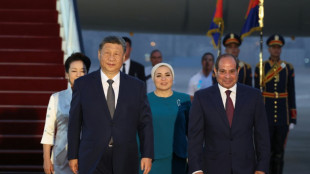 China expands Egypt investments in first Xi visit in a decade

 Messi departure leaves Argentina facing rebuild after golden era

 Ourbit SuperCEX Launches "Cosmic Wheel Season 3. Oracle Realm" on September 2 with 3M USDT Prize Pool

 Ebola death toll passes 3,000 in DR Congo: official data

 Hong Kong democracy activist Wong pleads guilty to foreign collusion

 World record prize winner Romantic Warrior retires from horse racing

 5,000 US sailors arrive in Thailand after months at sea

 Joshua Wong, Hong Kong's pro-democracy poster child

 Nepal tunnel rescuers seek trapped workers but hit dead ends

 Zverev wins wild five-setter, Rybakina and Gauff ease through at US Open

The eurozone economy expanded more than expected at the start of the year, official data showed on Wednesday, despite US President Donald Trump's tariffs but global trade tensions threaten more pain and near stagnation in 2025.
The EU's official data agency said the 20-country single currency area recorded growth of 0.4 percent over the January-March period from the previous quarter.
The figure was higher than the 0.2 percent forecast by analysts for Bloomberg, and comes after the eurozone economy grew by 0.2 percent in the final quarter of 2024.
The 27-country European Union economy expanded by 0.3 percent, after 0.4 percent between October and December.
The better-than-expected data appears to be linked to advance purchases in the United States, before Trump's tariffs came into effect.
But for the year as a whole, the outlook remains lacklustre, according to experts.
Trump on April 2 slapped sweeping 20 percent levies on a majority of European goods before announcing a 90-day pause, but a worldwide 10-percent levy rate remains.
If Brussels and Washington fail to reach an agreement, the higher tariffs will kick in, unleashing chaos and a painful trade war for Europe.
But Trump's 25-percent tariffs on steel, aluminium and auto imports also remain.
"The economy started the year on a stronger footing than we expected and activity surveys suggested," said Franziska Palmas, senior Europe economist at London-based Capital Economics.
"Nevertheless, we still expect growth to slow sharply in the next six months as the US tariffs introduced in April will hit activity and any boost from German fiscal stimulus will mostly be felt next year," Palmas added.
- Faster German expansion -
Several European companies shipped a larger number of goods at the start of the year to avoid Trump's higher tariffs.
For example, Ireland's exports to the United States jumped 210 percent in February to nearly 13 billion euros ($14.8 billion), with 90 percent of those being pharmaceutical products and chemical ingredients.
The eurozone's strong performance in the first quarter "is partly due to the 3.2 percent q/q increase in GDP in Ireland, where GDP tends to be very volatile and the boost from front-running of US tariffs is likely to have been quite big", Palmas said.
Europe has been mired in stagnation for two years, held back especially by soaring energy costs following Russia's invasion of Ukraine in 2022.
The International Monetary Fund this month cut its annual growth forecast for the eurozone by 0.2 percentage points to 0.8 percent in 2025, as it expects trade tensions with the United States to hurt Europe.
Among the major economies, Spain stood out with growth of 0.6 percent in the first quarter compared to the previous three-month period.
But France, hampered by political instability and a planned austerity programme, weighed down the eurozone, with growth of only 0.1 percent between January and March.
Germany, Europe's biggest economy, also grew more than expected, by 0.2 percent in the first quarter of the year compared to the previous quarter.
E.Rodriguez--AT