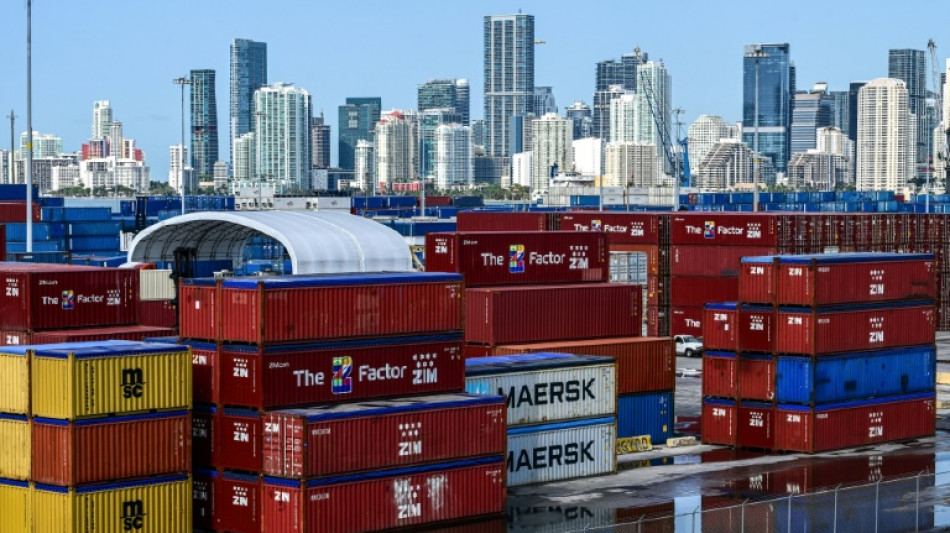
Trump trade war pushes firms to consider stockpiling / Photo: Giorgio VIERA - AFP

 Third-ranked Pegula powers into US Open third round

 Uber says laying off 'about 10%' of workforce worldwide

 US judge rejects bid to break up Google's ad business

 Rupert Murdoch 'very happy' to be played by Guy Pearce in new film

 Wall Street stocks rise despite bond yields, oil rising

 Brennan claims third Vuelta victory in stage 11 sprint

 Nepal flood survivors cling to zipline to cross treacherous river

 US Treasury issues $1 coin with Trump's face on it

 Fernandez 'didn't hesitate' over record Man City move

 Dutch shift 86 tonnes of gold from US, Canada to UK

 Nepal floods should mobilise climate action: UN green fund chief
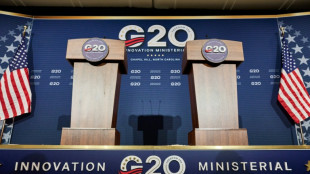 Nvidia boss presses G20 ministers to build AI infrastructure

 Liminal Launches Liminal Prime for Institutional OTC and Stablecoin Liquidity

 10 missing as cargo ship sinks after collision off Istanbul

 30 years on, 'Tomb Raider' reboot sees Lara Croft through a 'modern lens'

 King Charles, Macron to view Bayeux Tapestry as French leader starts UK visit

 George Clooney says US run by 'least qualified people'

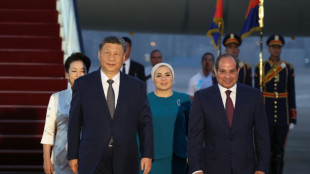 China's Xi urges against Mideast interference in rare Egypt visit

 Venice to roll out red carpet for 'lucky' Clooney on opening night

 'Humiliated' Aubameyang quits Gabon national team

 France sees limited economic hit from drought, heatwaves

 Bus crash in Egypt's Sinai kills 22, including 10 Jordanians

 UN says world must navigate 'reality' of 1.5C overshoot
 Taliban govt defends ban on protest, citing Islamic law

 10 missing as Turkish cargo ship sinks after collision off Istanbul

Stockpiling is the reflex response by firms to the imposition of tariffs, but with the rapidly-changing position of the Trump administration, companies are finding that it isn't so straightforward this time around.
Whether it's the luxury, electronics or pharmaceutical sectors, US President Donald Trump's unpredictability complicates the calculations of firms.
Some companies didn't wait for Trump's April 2 announcement of massive "reciprocal" trade tariffs: they had already begun shipping more of their goods to the United States.
In the end, Trump backed down quickly on the "reciprocal" tariffs, pausing them for 90 days except for China.
That still left the global 10 percent tariff in place, as well as the 25 percent tariffs on European steel, aluminium and cars.
French cosmetics firm Clarins didn't hesitate and stepped up shipments to the United States at the beginning of the year.
"We've built up three months of stocks, which represents $2 million in goods," said Lionel Uzan, the head of Clarins's US operations.
With all of its products made in France, Clarins had few other options to mitigate the tariffs.
- Discreet stockpiling -
Even if they don't all acknowledge it so openly, firms in many different sectors are stockpiling their products in the United States.
In March, exports of Swiss watches to the United States jumped nearly 14 percent compared to the same month last year.
More striking is Ireland, which plays host to a number of international pharmaceutical firms.
Its exports to the United States jumped 210 percent in February to nearly 13 billion euros ($14.8 billion), with 90 percent of those being pharmaceutical products and chemical ingredients.
Fermob, a French manufacturer of metal garden furniture that sells around 10 percent of its products in the United States, said it began planning for US tariffs once the result of the presidential election became known in November.
It stepped up production in January and February.
"We've sent around 30 percent of our extra stock to the United States," said the company's chief executive, Baptiste Reybier.
That extra production has benefitted transportation firms.
Lufthansa Cargo said it has seen in recent weeks "an increase in demand for shipments to the United States".
The trade war "has incited companies to accelerate certain stages in their supply chains", it told AFP.
"A similar trend was seen for the delivery of cars from the EU to the United States," it said.
The phenomenon also concerns US-made goods.
The Japanese newspaper Nikkei reported recently that Chinese tech firms were snapping up billions of dollars of artificial intelligence chips made by US firm Nvidia in anticipation of Washington imposing export restrictions.
- 'Short-term approach' -
Stockpiling is not a solution, however, said analysts.
Matt Jochim, a partner at consulting firm McKinsey who helps companies with supply chain issues, called stockpiling "a very short-term opportunistic" move.
He said the practice has limits as tariffs are constantly changing and it isn't always practicable.
"In a lot of the electronics space, it's also hard to do, because the technology changes so quickly, you don't want to get stuck with inventory of chipsets or devices that are the prior version," he said.
Fermob said it was taking a measured approach to stockpiling.
"Otherwise you're replacing one risk with another," the manufacturer's Reybier said.
"You have to finance stocks and there is also the risk of not having sent the right product."
Having a local subsidiary with warehouses also helped, Reybier added.
"It's too early to say whether we should have sent more or not."
S.Jackson--AT