Chinese tea hub branches into coffee as tastes change / Photo: GREG BAKER - AFP

 Third-ranked Pegula powers into US Open third round

 Uber says laying off 'about 10%' of workforce worldwide

 US judge rejects bid to break up Google's ad business

 Rupert Murdoch 'very happy' to be played by Guy Pearce in new film

 Wall Street stocks rise despite bond yields, oil rising

 Brennan claims third Vuelta victory in stage 11 sprint

 Nepal flood survivors cling to zipline to cross treacherous river

 US Treasury issues $1 coin with Trump's face on it

 Fernandez 'didn't hesitate' over record Man City move

 Dutch shift 86 tonnes of gold from US, Canada to UK

 Nepal floods should mobilise climate action: UN green fund chief

 Nvidia boss presses G20 ministers to build AI infrastructure

 Liminal Launches Liminal Prime for Institutional OTC and Stablecoin Liquidity

 10 missing as cargo ship sinks after collision off Istanbul

 30 years on, 'Tomb Raider' reboot sees Lara Croft through a 'modern lens'

 King Charles, Macron to view Bayeux Tapestry as French leader starts UK visit

 George Clooney says US run by 'least qualified people'

 China's Xi urges against Mideast interference in rare Egypt visit

 Venice to roll out red carpet for 'lucky' Clooney on opening night

 'Humiliated' Aubameyang quits Gabon national team

 France sees limited economic hit from drought, heatwaves

 Bus crash in Egypt's Sinai kills 22, including 10 Jordanians

 UN says world must navigate 'reality' of 1.5C overshoot

 Taliban govt defends ban on protest, citing Islamic law

 10 missing as Turkish cargo ship sinks after collision off Istanbul

At a mountainside cafe in southwestern China, Liao Shihao brews handfuls of locally grown beans into steaming cups of coffee, a modern twist on the region's traditional drink.
For centuries, Pu'er in Yunnan province has given its name to a type of richly fermented tea -- sometimes styled "pu-erh" -- famous across East Asia and beyond.
But as younger Chinese cultivate a taste for punchy espressos, frothy lattes and flat whites, growers are increasingly branching out into tea's historic rival.
"People are coming to try our hand-drip coffee... and more fully experience the flavours it brings," Liao, 25, told AFP.
"In the past, they mostly went for commercialised coffee, and wouldn't dabble in the artisanal varieties," he said.
Liao’s family has run the Xiaowazi, or Little Hollow, coffee plantation for three generations.
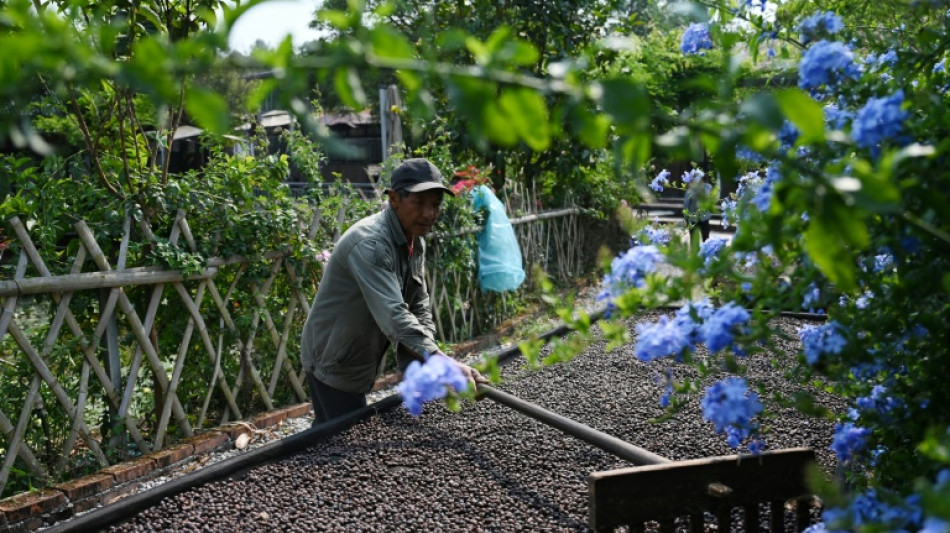
Nestled in a shady valley, spindly coffee trees line its steep hillsides, their cherry-like fruit drying on wooden pallets outside.
When AFP visited this month, clusters of tourists sipped boutique brews in the airy cafe overlooking its verdant slopes.
"It's very good," said Cai Shuwen, 21, as he perched on a bar stool lifting sample after sample to his lips.
"Even though some beans are more astringent than I imagined, others have exceeded my expectations."
- Brewing success -
Every year, Pu'er's plantations sell tens of thousands of tons of coffee to major Chinese cities, according to government data.
In metropolises such as Beijing and Shanghai, a thriving cafe scene has emerged in recent years, driven by people aged between 20 and 40.
To Liao, a trained roaster and barista, coffee from his home region possesses "a creamy flavour with a silky, viscous mouthfeel".
Modern commercial plantations only sprang up in Pu'er in the 1980s, and the area is still better known for its centuries-old tea trade.
Liao's grandfather, Liao Xiugui, said "nobody knew anything about coffee" when he arrived in Pu'er a few decades ago.
At the time, the older man was one of very few people in China who had studied coffee cultivation.
But the region's relatively high altitude and temperate climate were well-suited to the unfamiliar crop, the now 83-year-old told AFP.
"The quality of the coffee we plant here is strong but not too bitter, floral but not too heady, and slightly fruity," he added.
Free from artificial pesticides and interspersed with other species for biodiversity, Little Hollow yields about 500 tons of raw coffee fruit per year.
Liao Xiugui himself drinks two or three cups a day, and credits the caffeinated beverage for keeping him spry in his advanced years.
"Drinking coffee can make you younger and healthier... and prevent ageing," he smiled.
"Also, everyone is tired at work these days... and they want to give their brains a boost."
- Richer pickings -
China's coffee output has risen dramatically in recent years, though it still lags far behind traditional powerhouses such as Brazil, Vietnam and Colombia.
Yunnan, near three borders with Southeast Asian nations, accounts for virtually all of China's coffee production, much of it concentrated in Pu'er.
On a visit to Yunnan last month, President Xi Jinping said the province's coffee "represents China", according to state media.
Keen to further expand the sector, officials have rolled out policies to improve production, attract investment and boost exports, according to government statements.
They have also merged coffee production with tourism, dovetailing with a central government push to increase domestic consumption.
Longtime farmer Yu Dun, 51, said she had opened new income streams with plantation tours, homestays and a restaurant fusing coffee with the cuisine of her native Dai ethnicity.
Her prospects were bright, she said, adding that she also earned "10 times" more revenue from her beans since learning to process and roast them herself.
"We used to say only rich people could drink coffee, but that's all changed now," she said.
J.Gomez--AT