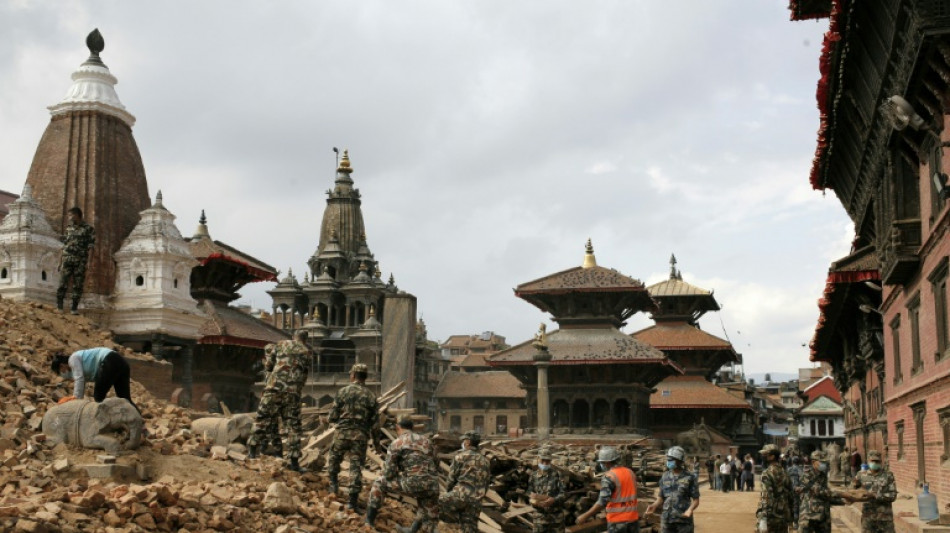
Nepal's long road to quake resilience / Photo: MATTHIEU ALEXANDRE - CARITAS INTERNATIONALIS/AFP/File

 Fury hits out at 'coward' Joshua as 'Battle of Britain' talks go on
 Maltese tycoon acquitted of masterminding reporter's murder

 George Clooney: a Hollywood icon and campaigner

 Europe, US closer than they look on tech rules, says EU tech chief

 Clooney honoured as Hollywood-light Venice Film Festival kicks off

 Third-ranked Pegula, Medvedev power into US Open third round

 Davis-Woodhall a doubt for Ultimate Championship after car crash

 Third-ranked Pegula powers into US Open third round

 Uber says laying off 'about 10%' of workforce worldwide

 US judge rejects bid to break up Google's ad business

 Rupert Murdoch 'very happy' to be played by Guy Pearce in new film

 Wall Street stocks rise despite bond yields, oil rising

 Brennan claims third Vuelta victory in stage 11 sprint

 Nepal flood survivors cling to zipline to cross treacherous river

 US Treasury issues $1 coin with Trump's face on it
 Fernandez 'didn't hesitate' over record Man City move

 Dutch shift 86 tonnes of gold from US, Canada to UK

 Nepal floods should mobilise climate action: UN green fund chief
 Nvidia boss presses G20 ministers to build AI infrastructure

 Liminal Launches Liminal Prime for Institutional OTC and Stablecoin Liquidity
 10 missing as cargo ship sinks after collision off Istanbul

 30 years on, 'Tomb Raider' reboot sees Lara Croft through a 'modern lens'

 King Charles, Macron to view Bayeux Tapestry as French leader starts UK visit

 George Clooney says US run by 'least qualified people'

 China's Xi urges against Mideast interference in rare Egypt visit
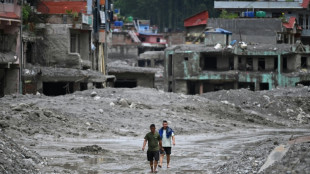
A decade has passed since a massive earthquake ripped through Nepal, but in Ram Bahadur Nakarmi's home the damage is still visible -- and so is the fear another might strike.
Ten years ago, on April 25, 2015, the ground beneath Nepal shuddered with a magnitude-7.8 earthquake, killing nearly 9,000 people, injuring over 22,000, and leaving millions homeless.
The disaster also reduced monuments to ruins, including centuries-old temples and royal palaces in the Kathmandu valley that attracted visitors from around the world.
Nakarmi's four-storey home in historic Bhaktapur city was damaged, but financial constraints made it impossible for him to rebuild.
The 61-year-old continues to live in his house despite the cracks.
"Even now, it is still scary," Nakarmi told AFP. "We are still feeling the tremors and they terrify us -- we run outside the house".
The aftermath of the quake exposed deep cracks in Nepal's disaster response system and the rebuilding efforts were initially hit by political infighting, bureaucracy and confusion.
Yet over the last decade, significant progress have been made.
According to official figures, nearly 90 percent of the homes destroyed have been rebuilt, alongside thousands of schools, health institutions, and public buildings.
Temples and cultural landmarks are also slowly rising again.
A joint assessment of affected districts by Nepal's National Society for Earthquake Technology, and the international Global Quake Model showed marked improvements for resilience in the face of another quake.
They estimated there had been a 44 percent reduction in the number of buildings at risk of complete collapse, after Nepal's rebuilding and retrofitting drive.
"Our initial years were focused on rebuilding. Now our focus should be in areas which were not affected in 2015 but are at risk of a quake," Dinesh Prasad Bhatt chief of the National Disaster Risk Reduction and Management Authority (NDRRMA), told AFP.
"We have to extend the reach of lessons learnt from the earthquake to all parts of the country."
- 'Inadequate progress' -
The disaster was a wake up call for a country that is situated on a dangerous geological faultline, where the Indian tectonic plate collides with the Eurasian plate to form the Himalayas.
According to the UN, Nepal ranks 11th in terms of earthquake risk.
Experts question if the country is prepared for the next one.
In the decade since the quake, the country has taken important steps.
The NDRRMA disaster reduction and management authority was established, and building codes were updated to reflect seismic safety standards.
Unlike 2015, there are elected members at local levels responsible for mobilising rescue teams, volunteers and stockpiles of emergency resources in case of a disaster.
"If you really look into a holistic picture, compared to what we had back in 2015 and right now, we've made massive progress," said Anil Pokharel, a former NDRRMA chief.
"But still, it is inadequate given the kind of growing risks."
Experts say that while Kathmandu's skyline now includes more reinforced buildings, rural areas -- where infrastructure is weaker and access to resources limited -- remain exposed.
Only 9.4 percent of structures were revealed to be safe in a 2023 integrity assessment of nearly 29,000 buildings of schools, health centres and government offices across the country by the NDRRMA.
Implementation of disaster preparedness policies and building codes is also inconsistent.
"Nepal has made many policies learning from the 2015 quake experience, but policies are only pieces of paper that dictate the system," said Surya Narayan Shrestha, from the National Society for Earthquake Technology.
"To make the system itself effective, we need people... and systems that have that capacity."
- 'Dangerously underprepared' -
David Sislen, the World Bank chief Nepal, said that despite better policies and institutional framework, the country remains "dangerously underprepared for a major disaster".
"Without stronger enforcement and implementation of risk reduction and mitigation measures, the physical footprint of vulnerability will continue to grow, putting people, services and assets are risk," Sislen said.
He added that there was a need for "a phased financing strategy for retrofitting schools, hospitals, and other vital infrastructure".
Records at the National Earthquake Monitoring and Research Center show that over 800 earthquakes with a magnitude of four or above have struck Nepal since the 2015 quake.
Every tremor takes Shri Krishna Chhusyabada, a quake survivor who lost three of his family members under the rubble of his house, back to the fateful day.
"It was a black day for us. That day took away all our happiness," Chhusyabada said. "I hope we never see such devastation again."
W.Nelson--AT