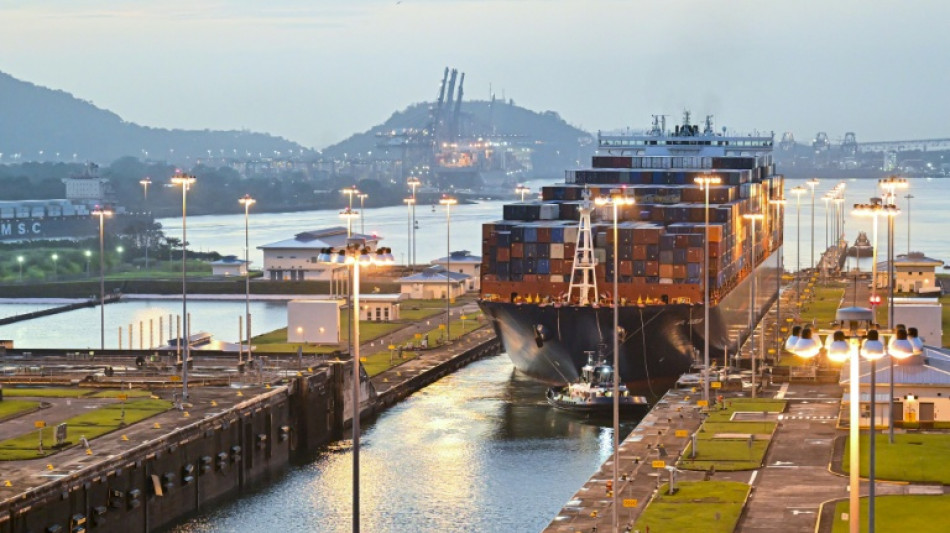
Trump resurrects ghost of US military bases in Panama / Photo: MARTIN BERNETTI - AFP/File

 Veteran Wallaby Slipper targets fifth World Cup after Brumbies deal
 Sabalenka storms into US Open third round as Pegula, Medvedev advance
 Zverev looks to improve after first-round scare
 Raiders to start Cousins over top NFL Draft pick Mendoza
 Palantir chief says France's digital sovereignty push 'backfiring'
 US energy firms dominate Venezuela deals worth billions
 Iran, US trade threats after escalation in fighting
 US jury deadlocks again in Lindsay Clancy's child murder trial
 Lake America? No way, Canadians say
 Spain report flags Moroccan police failings in Ceuta migrant rush
 Tech bosses press G20 to build data centers, but split on risk
 Dolly Parton to get new Hollywood star after vandalism
 Trump 'happy' Prince Harry and Meghan have left US
 Michelson shocks Nakashima in US Open clash of rising Americans
 Another body recovered after ferry capsizes off northern Cyprus: official
 Cupertino Chamber President Claudio Bono Invited to White House with GiveaRoof 3-Year Plan to End Homelessness
 Trump floats renaming Strait of Hormuz as 'Trump Strait'
 Man City, Chelsea fuel record-breaking Premier League transfer window
 Balogun rejected Everton move over transfer 'treatment'
 Northampton seek 'happy medium' in bid to keep England star Pollock
 US energy secretary in Venezuela to sign Trump's 'biggest' oil deal
 Branagh takes on action role in Apple's Cold War comedy 'Mayday'
 Lawson fills in again for injured Hadjar at Monza
 England omit Carse from squad for third Test against Pakistan
 Venice festival gets underway with Clooney taking swipe at US government
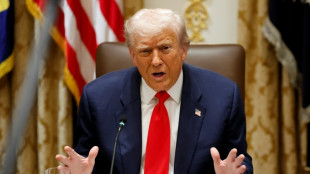
US President Donald Trump's bid to take back control of the Panama Canal has put his counterpart Jose Raul Mulino in a difficult position and revived fears in the Central American country that US military bases will return.
After Trump vowed to reclaim the interoceanic waterway from Chinese influence, US Defense Secretary Pete Hegseth signed an agreement with the Mulino administration last week for the United States to deploy troops in areas adjacent to the canal.
For more than two decades, after handing over control of the strategically vital waterway to Panama in 1999 and dismantling the bases that protected it, Washington has regularly conducted maneuvers in the country.
So what is changing and why is the new agreement causing controversy?
- Will US military bases return? -
Although the agreement does not allow the United States to build its own permanent bases, Washington will be able to maintain a long-term rotational force in Panama, similar to the one it has in Australia and other countries, for training, exercises and "other activities."
The United States will be able to deploy an unspecified number of personnel to three bases that Washington built when it previously had an enclave in the canal zone.
That is a "flagrant violation" of the constitution, which prohibits foreign bases, and the 1977 handover treaties that establish the "neutrality" of the canal and permit only Panama to have military forces on national territory, Euclides Tapia, a Panamanian professor of international relations, told AFP.
But there is a loophole: one of the treaties "allows the US to defend the canal when it feels the neutrality is jeopardized," said Will Freeman, an expert at the Council on Foreign Relations, a US-based think tank.
Benjamin Gedan, former director for South America on the US National Security Council, argues that Panama has cooperated with the United States in securing the canal.
Panamanian lawyer Arturo Hoyos sees no violation of laws or treaties, as the new agreement allows "joint" operations.
- Is Mulino in trouble? -
Mulino's government says that the facilities and land belong to Panama and will be for "joint use" by US and Panamanian security forces.
He maintains that he has not ceded an inch of sovereignty to Trump, a natural right-wing ally
The agreement is a "trade-off" because it "limits the Trump administration's pressure tactics and hostility and maybe the scope of the concessions" by Panama, Freeman said.
"The risk that nobody's pricing in, at least on the US side, is that they make Mulino a lame duck" by humiliating him, leaving the Panamanian leader "unable to govern," he added.
Former presidential candidate Ricardo Lombana accused Mulino of "camouflaging" military bases and disguising "surrender" as "cooperation."
"The United States is recolonizing and reoccupying us," said Julio Yao, who advised the Panamanian government in the 1977 negotiations.
Gedan, a professor at Johns Hopkins University, believes Panamanians "are not willing" to allow the return of US bases due to the trauma of the past occupation of the canal zone and the 1989 US invasion to overthrow dictator Manuel Antonio Noriega.
- What does Trump really want? -
The United States considers a Hong Kong company's operation of ports at both ends of the canal to be a threat to its national security.
"Trump wants to minimize the risk of Beijing blocking the canal to prevent the passage of military vessels in a potential conflict," Gedan said.
Natasha Lindstaedt, an expert at Britain's University of Essex, sees the US moves as "part of a larger conflict with China as the US is trying to curb China’s influence in Panama and the region more generally."
Freeman said that the Trump administration "most likely is trying to show that if it wanted to, it could close the canal to Chinese commerce as a way of exerting pressure on China, either not to invade Taiwan or in the event of a conflict over Taiwan."
"What we're seeing in Panama is also about Trump's doctrine of peace through strength," he said.
But Tapia was skeptical that China really poses a threat, suggesting the threats were aimed at boosting Trump's domestic support.
"Canada becoming part of the United States or saying that they will take over the canal and Greenland is just a gimmick aimed at the American public," he said.
S.Jackson--AT