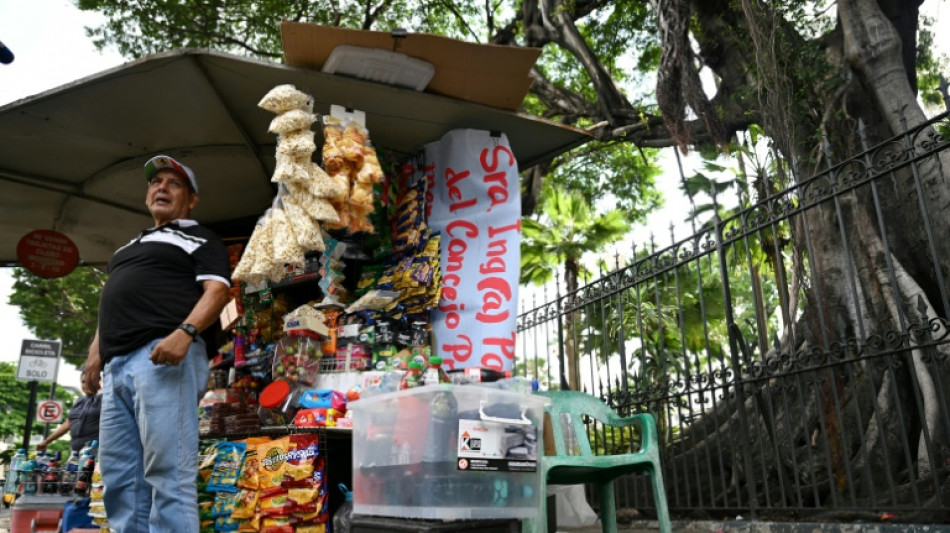
Ecuador's presidential hopefuls face toxic brew of crime, unemployment / Photo: Raul ARBOLEDA - AFP

 Stocks rise, yields ease as oil slips on Trump hint at short bombing campaign
 Brussels Diamond League finals Day 1 - five events to watch

 Thailand's 'Jurassic Park' shines light on dinosaur evolution
 'Role model' Stokes set to open for Adelaide Strikers
 Palau urges 'unified' Pacific response to China missile test

 Grinding away: in remote Appalachia, old mills fuel US clean food dreams

 Sabalenka races into US Open third round

 Chinese lucky loser stuns Jodar at US Open

 US Open under the influence: content creators spark debate

 NBA hammers Clippers over Leonard salary cap violations
 NBA strips five first-round draft picks from Clippers for Leonard salary cap violations
 Kane brace helps Bayern win German Cup opener
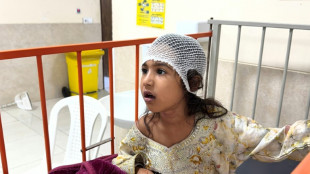
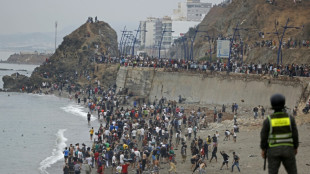
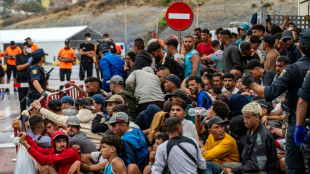 Migrant plight, local anger divide Ceuta one month after influx
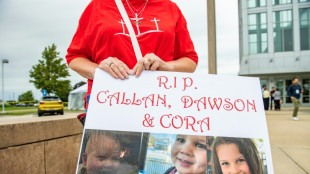
 Outrage as Maltese tycoon acquitted of reporter's murder

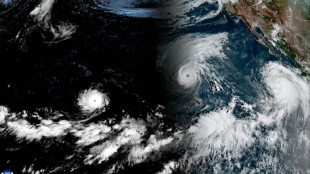 Rare train of Pacific cyclones fueled by historic El Nino
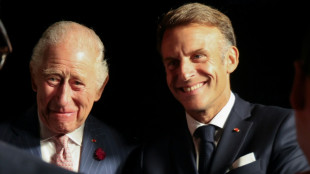 Macron, King Charles hail UK-France ties after viewing Bayeux Tapestry
 Fury hits out at 'coward' Joshua as 'Battle of Britain' talks go on
 Maltese tycoon acquitted of masterminding reporter's murder
 George Clooney: a Hollywood icon and campaigner
 Europe, US closer than they look on tech rules, says EU tech chief

 Clooney honoured as Hollywood-light Venice Film Festival kicks off
 Third-ranked Pegula, Medvedev power into US Open third round
 Davis-Woodhall a doubt for Ultimate Championship after car crash
 Third-ranked Pegula powers into US Open third round

 Uber says laying off 'about 10%' of workforce worldwide

Cartel violence is hollowing out Ecuador's largest city Guayaquil, scaring away tourists, pummelling the economy and leaving whoever wins Sunday's presidential election with a gargantuan problem.
In picturesque and once-bustling Seminary Park, these days iguanas almost outnumber visitors.
"In the afternoon it feels like a cemetery," said Juan Carlos Pesantes who has sold sweets and drinks from a park-side kiosk for 16 years.
"There are no tourists left."
Pesantes has watched as several businesses, including a once popular hotel, close down around him.
In three years, his income has halved and Guayaquil has been transformed from the beating heart of Ecuador's economy into one of the most violent cities in Latin America.
Some months, the country averages more than one murder an hour.
The park is now locked by 18:00 instead of 22:00, just in case any visitors are tempted to hang around after dark.
Against this grim backdrop, the economy fell into recession late last year.
But insecurity is not the only issue ailing Ecuador's economy.
Either incumbent president Daniel Noboa or his leftist rival Luisa Gonzalez will have to reckon with deep social inequality, unemployment, an energy crisis, low rates of investment, groaning public finances and low oil revenues.
Pesantes is "undecided" about which one of the two neck-and-neck rivals to vote for.
"There is no confidence" in them, he said.
- Going out is risky -
Ecuador's woes stem from a boom in Colombian cocaine production and the attractiveness of its ports for shipping the drug to lucrative markets in Asia, Europe and the United States.
The bloodshed has increased as a multitude of gangs, cartels and mafias vie to control routes.
The surge in gang activity has had a direct impact on normal economic activity.
Violence is "affecting consumption. The population has fewer possibilities to go out on the street, to a restaurant, to make a purchase, it's risky," said Alberto Acosta Burneo, an economic analyst at the Spurrier group.
In a poor neighborhood of Guayaquil, Paola Valdivieso, a 54-year-old salon worker, talks about the "fear, the dread" she feels when she has to walk "looking in all directions."
Bananas, one of Ecuador's main export products -- along with oil, cocoa, shrimp, and flowers -- also suffer from organized crime.
"We are victims of drug trafficking," Richard Salazar, director of a banana growers' association tells AFP.
"We are victims of crime and organized crime with extortions," and despite checks, drug traffickers use large shipments of fruit to move cocaine, he explained.
In a depressed economy, unemployment and underemployment affect almost a quarter of the population and one in three are poor, according to official figures.
There is "a lot of informality" in employment, with poorly paid and precarious jobs, Acosta Burneo said.
Septuagenarian retiree Gerardo Ortiz explained he can just about "subsist" on his $280 a month pension as he jokingly pointed to his "car" -- in reality a rusty bicycle leaning against a tree.
With cash tight and security poor, foreign investors that once flocked to dollarized Ecuador have stayed away.
The lack of investment "is reflected in an economy that does not grow as it should," according to Acosta Burneo.
In 2023 and 2024, a lack of investment in the power sector and a serious drought caused power outages that lasted up to 14 hours a day.
- No easy answers -
In response to this multi-headed economic crisis, the presidential candidates propose very different solutions.
"Gonzalez's plan is to bring a return of the strategic state" through infrastructure development and investments in public services, according to Christophe Ventura, a Latin America specialist at France's Institute for International and Strategic Affairs (IRIS).
The leftist candidate advocates for a tax system that imposes a higher burden on the private sector and plans to reduce value-added tax, which Noboa increased from 12 percent to 15 percent.
Noboa has backed tough security measures and traditional neoliberal economic policies -- negotiating a trade agreement with Canada to boost extractive industries.
P.Smith--AT