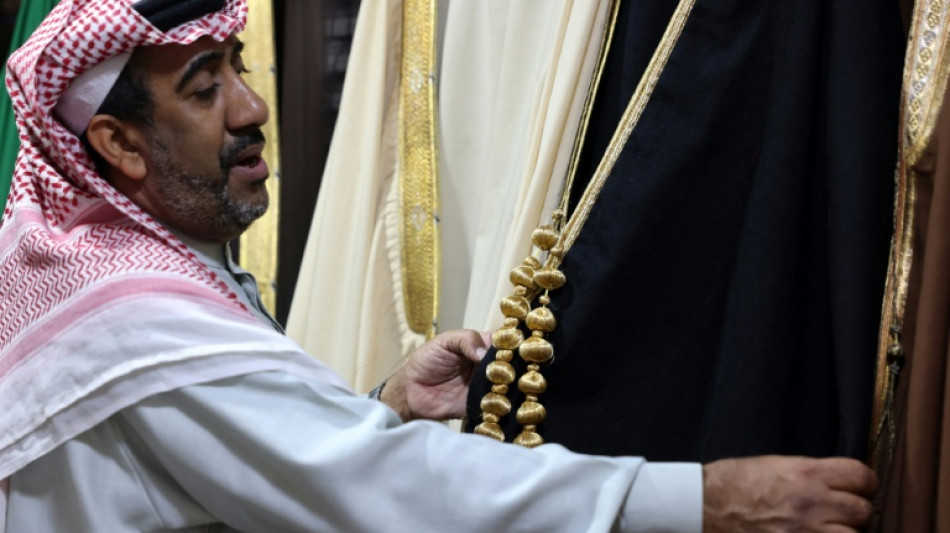
'My entire life': Saudi tailor keeps robe-making craft alive / Photo: Fayez Nureldine - AFP

 Antonelli will obey Mercedes orders to help 'tow' teammate Russell
 UK fintech Revolut gains conditional US banking licence
 Mara sisters channel childhood energy for twins performance at Venice

 UN's Sudan probe says foreign fighters fuelling conflict

 Violence erupts at S.Africa anti-migrant protest

 Nothing left: Nepal flood survivors face loss and uncertainty

 Tesla to launch self-driving 'Cybercab' in Texas

 Europe struggles to respond as Russia escalates shadow warfare

 Malta PM urges 'caution' after acquittal in journalist's murder

 Spanish PM says no 'solid proof' Morocco planned Ceuta migrant rush

 Venezuela's Maduro seek immunity from US drug charges

 Tazapay Now Live on the Borderless.xyz Network For Seamless Money Movement to Asia Pacific and Latin America

 DWF Labs Expands Global Regulatory Footprint with BVI Virtual Asset Service Provider Approval

 Just the beginning of the journey, Broeders-Bol says of 800m adventure

 US trade gap in July hits biggest in over a year on AI buildout

 Study shows plug-in hybrids polluting far more than expected

 Lost tool disrupted Airbus jet deliveries for months

 MEXC Concludes 0808 Stock Season with Over 86,000 Participants and More Than $1M Saved Through 0 Fee Trading

 US feminist icon Gloria Steinem dies at 92: foundation

 All Blacks drop veteran hooker Taylor for third Springboks Test

 British, French leaders hold talks on migrants, EU relations

 Oil prices jump as Iran strikes US targets

 Putin denies plan for new Russia military call up

 Caruana Galizia: 'one-woman WikiLeaks' who exposed Malta's shady side
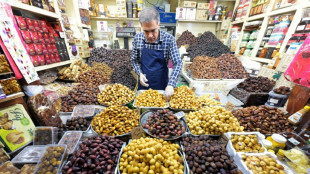 Kuwait's Iranians under pressure since start of war

Saudi tailor Habib Mohammed's shop once made ornate, hand-woven cloaks for royals, a time-honoured craft he is determined to preserve even as mass-produced garments flood the market, threatening his traditional business.
He makes "bisht", a long gown which for centuries has been a status symbol, worn by kings and princes -- and ordinary men -- and could take a week of meticulous work to create.
Now, with cheap Chinese-made robes taking a bite out of his business, the 60-year-old tailor is struggling to make a profit, and his only son wouldn't take over the beleaguered shop.
But Mohammed refuses to let the ancient craft die, searching for ways to hand down his knowledge.
"We've started training here at the shop and at home," he told AFP in his windowless atelier in the oasis city of Hofuf, with bishts hanging all around.
"I am teaching my grandchildren, be they girls or boys."
In Mohammed's native Al-Ahsa governorate, it was "considered shameful for a man to go to a funeral or a market, or make a visit to anyone anywhere without wearing the bisht", he said.
The bisht came to global attention in 2022 when Qatar's emir draped one over football star Lionel Messi after the World Cup final.
Although Arabs across the Gulf still sometimes wear traditional garb, especially in formal settings, factory-made clothing has replaced tailor services in the oil-rich countries of the region.
- Robe 'recession' -
At his workshop, Mohammed watched over his granddaughter Fajr, nine, and grandson Ghassan, 10, as they embroidered delicate gowns.
For the veteran craftsman, who learned to weave when he was only five, this is "my entire life".
"I came into this world... seeing only bishts around me," said Mohammed, wearing the Saudi national dress of white thobe robe and chequered red-and-white headdress.
"I was born in (my father's) tailor shop and grew up watching my mother sew. I saw my brothers and cousins work with my father in the tailor shop," he added with pride.
His wife was also a bisht seamstress, he said, skilled at collar embroidery.
But his modest shop in an artisans' market in Hofuf has fallen on hard times.
"A sort of recession has taken hold," he said.
A high-quality bisht could once have fetched up to 6,000 riyals ($1,600), but machine-made cloaks sell for just a fraction of that price, Mohammed said.
"Pieces I would make for 1,500 riyals now go for 150 riyals. It's not enough to make a living."
- 'Didn't give up' -
Mohammed refuses to let the tradition die out, and he is far from alone.
A bisht revival is taking shape in Saudi Arabia even as it opens up to the world, attracting tourists and foreign businesses.
Last year, the kingdom ordered ministers and other senior officials to wear a bisht when entering or leaving the workplace or attending formal events.
Saudi Arabia has named 2025 the Year of Handicrafts, when it will promote and support 10 crafts including bisht-weaving.
And Gulf countries are trying to include the bisht on the UNESCO list of intangible cultural heritage in a bid to preserve the craft.
Some of the bishts hanging on the walls of Mohammed's workshop are at least a century old, he said, proudly presenting a brown robe made from sheep's wool.
"Someone offered me 200,000 riyals for this, but I refused to sell it because it is as dear to me as my life. It represents my country's history," he said.
"I want to pass them down to my children and grandchildren, and I will instruct them never to sell them," he said, pointing to the pieces on the walls.
Mohammed also gives weekly bisht tailoring lessons at a nearby institute, mostly for young people.
"We didn't give up," he said, training the younger generation "to revive an old heritage that was disappearing".
"We will bring it to life once more," said Mohammed.
W.Morales--AT