Space telescope Gaia sent into 'retirement' but legacy endures / Photo: Handout - EUROPEAN SPACE AGENCY/AFP/File

 Antonelli will obey Mercedes orders to help 'tow' teammate Russell

 UK fintech Revolut gains conditional US banking licence

 Mara sisters channel childhood energy for twins performance at Venice

 UN's Sudan probe says foreign fighters fuelling conflict

 Violence erupts at S.Africa anti-migrant protest

 Nothing left: Nepal flood survivors face loss and uncertainty

 Tesla to launch self-driving 'Cybercab' in Texas
 Europe struggles to respond as Russia escalates shadow warfare

 Malta PM urges 'caution' after acquittal in journalist's murder

 Spanish PM says no 'solid proof' Morocco planned Ceuta migrant rush

 Venezuela's Maduro seek immunity from US drug charges

 Tazapay Now Live on the Borderless.xyz Network For Seamless Money Movement to Asia Pacific and Latin America

 DWF Labs Expands Global Regulatory Footprint with BVI Virtual Asset Service Provider Approval

 Just the beginning of the journey, Broeders-Bol says of 800m adventure

 US trade gap in July hits biggest in over a year on AI buildout

 Study shows plug-in hybrids polluting far more than expected

 Lost tool disrupted Airbus jet deliveries for months
 MEXC Concludes 0808 Stock Season with Over 86,000 Participants and More Than $1M Saved Through 0 Fee Trading

 US feminist icon Gloria Steinem dies at 92: foundation

 All Blacks drop veteran hooker Taylor for third Springboks Test

 British, French leaders hold talks on migrants, EU relations

 Oil prices jump as Iran strikes US targets

 Putin denies plan for new Russia military call up
 Caruana Galizia: 'one-woman WikiLeaks' who exposed Malta's shady side

 Kuwait's Iranians under pressure since start of war

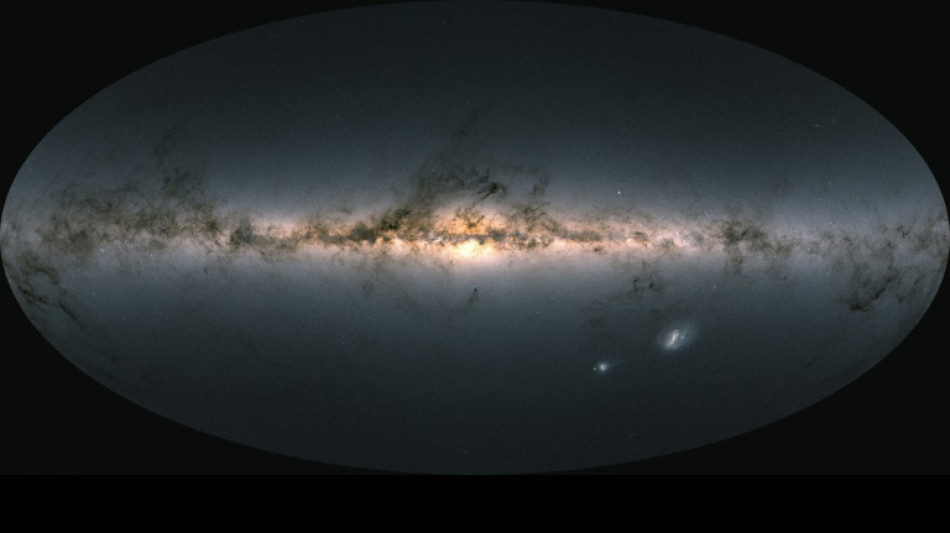
Europe's Gaia space telescope was powered down and sent into "retirement" on Thursday after a decade revealing the secrets of the Milky Way, but its observations will fuel discoveries for decades to come.
Since launching in 2013, the telescope has been charting the positions, motion and properties of nearly two billion stars to create an unparalleled map of our home galaxy, according to the European Space Agency.
Gaia has been peering into the universe from a stable orbit 1.5 million kilometres (930,000 miles) from Earth called the second Lagrange point.
But the neighbourhood has been getting more crowded with the recent arrivals of the powerful James Webb and Euclid space telescopes.
To avoid causing any problems for the new kids on the block, the ESA's team on the ground ordered Gaia's engines to give a final push on Thursday that will take the spacecraft into a distant orbit around the Sun.
This "retirement orbit" will make sure the spacecraft will remain at least 10 million kilometres from Earth for the next century.
Over nearly 11 years, Gaia has uncovered evidence of massive galaxies slamming into each other, identified vast clusters of stars, helped discover new exoplanets and mapped millions of galaxies and blazing galactic monsters called quasars.
A study last year using Gaia data identified two streams of ancient stars at the Milky Way's heart thought to have formed around the galaxy's birth more than 12 billion years ago.
According to astronomers using Gaia, the Milky Way then swallowed other dwarf galaxies as it grew -- notably one called Gaia-Enceladus around 10 billion years ago.
Our home galaxy is still slowing devouring the Sagittarius dwarf galaxy, Gaia helped reveal.
The telescope also spotted more than 50 dwarf galaxies orbiting the Milky Way. Inside the galaxy, it tracked down 150,000 asteroids and detected several dozen black holes.
- Final goodbye -
On Thursday, ESA engineers in Germany disconnected -- one-by-one -- all the satellite's systems that allow it to survive the perils of space, such as radiation storms or being struck by tiny meteorites.
"The spacecraft are designed so that they cannot be killed -- it is very difficult to disconnect them," ESA operations engineer Tiago Nogueira told AFP.
The team at the European Space Operations Centre in the city of Darmstadt then shut down Gaia's instruments before corrupting its on-board software.
Finally, they said their last goodbye, deactivating the spacecraft's communication system and central computer.
But Gaia's mission will continue back on Earth.
Scientists are still sifting through the deluge of data the telescope sent back, and are expected to deliver its fourth catalogue of the stars in 2026.
The final catalogue -- which will encompass 10 and a half years of observations -- is expected around 2030.
Ultimately, Gaia's catalogue "will serve as a reference for astronomy for at least 30 to 40 years," Gaia engineer Jose Hernandez told AFP.
This means that even as Gaia distantly orbits the Sun in silence, what it observed will be feeding new discoveries for future generations.
Some of the astronomers who will make these breakthroughs using Gaia's data are "still in primary school," Hernandez said.
S.Jackson--AT