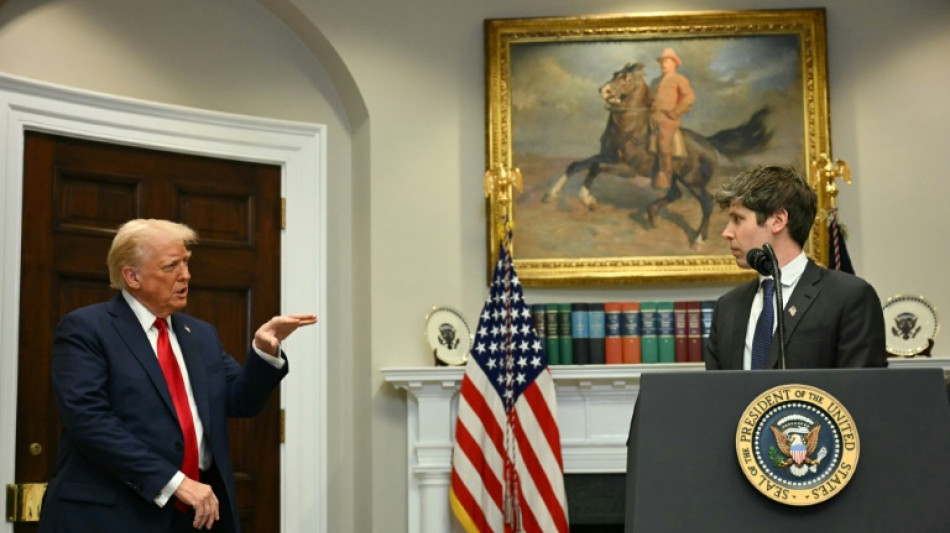
Trump's call for AI deregulation gets strong backing from Big Tech / Photo: Jim WATSON - AFP

 Lone juror blocking verdict in US mother's child murder trial: defense
 'Kinda chic' - Williams sisters set to launch US Open doubles bid

 Volkswagen says cutting 100,000 jobs by end of decade

 Russia slaps curfew on charity director over army criticism

 Ailing Auger-Aliassime upset by Khachanov at US Open
 Richarlison omitted from Tottenham's Premier League squad
 How El Nino is choking the Panama Canal

 Hamilton drives his Ferrari dream at Monza

 Senegal has an IMF loan, now what?
 Auger-Aliassime upset by Khachanov at US Open
 Hugging Face, the French start-up that became AI's warehouse
 World Cup winner Llorente retires from Spain team at 31

 Osaka squeezes into US Open third round

 Apple faces £2 bn lawsuit in UK over app privacy feature

 Former champ Swiatek eases into US Open third round

 DR Congo latest to promise moving Israel embassy to Jerusalem
 War criminal Mladic's body returns to Serbia with military honours
 Pierre Cardin museum brings designer's futurist style to Venice

 Slovenian rookie Omrzel triumphs as Mas extends Vuelta lead

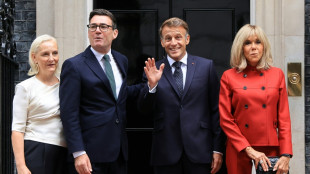 British, French leaders talk migrants, EU relations

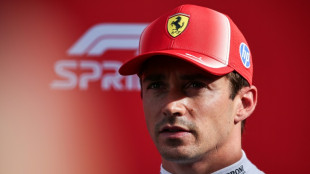 Heading for Ferrari's home race, Leclerc still dreams of world title

 Cafe at centre of Israel culture clash agrees to shut on Sabbath
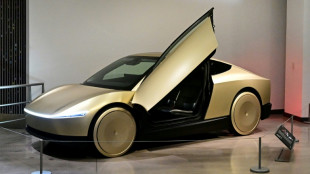
 Spacecraft bound for Mercury begins 'tricky' arrival

 Initial expert report blames tanker for collision off Istanbul

 'Everyone a winner' with Barcola transfer, says PSG coach Luis Enrique

Major tech firms are pushing the administration of President Donald Trump to loosen rules on building artificial intelligence, arguing it is the only way to maintain a US edge and compete with China.
Spooked by generative AI's sudden advance, governments initially scrambled to develop guardrails, as major tech companies rapidly integrated the technology into their products.
Since taking office in January, the Trump administration has shifted focus toward accelerating AI development at all costs, pushing aside concerns about the models suffering hallucinations, producing deepfakes, or destroying human jobs.
"The AI future is not going to be won by hand-wringing about safety," Vice President JD Vance told world leaders at a recent AI summit in Paris.
This message unsettled international partners, particularly Europe, which had proudly established the EU AI Act as a new standard for keeping the technology in check.
But, faced with America's new direction, European officials are now pivoting their messaging toward investment and innovation rather than safety.
"We're going to see a significant pullback in terms of the regulatory efforts... worldwide," explained David Danks, professor of data science and philosophy at University of California San Diego.
"That certainly has been signaled here in the United States, but we're also seeing it in Europe."
- 'Step back' -
Tech companies are capitalizing on this regulatory retreat, seeking the freedom to develop AI technologies that they claim have been too constrained under the Biden administration.
One of Trump's first executive actions was dismantling Biden's policies, which had proposed modest guardrails for powerful AI models and directed agencies to prepare to oversee the change.
"It's clear that we're taking a step back from that idea that there's going to be a coherent overall approach to AI regulation," noted Karen Silverman, CEO of AI advisory firm Cantellus Group.
The Trump administration has invited industry leaders to share their policy vision, emphasizing that the US must maintain its position as the "undeniable leader in AI technology" with minimal investor constraints.
The industry submissions will shape the White House's AI action plan, expected this summer.
The request has yielded predictable responses from major players, with a common theme emerging: China represents an existential threat which can only be addressed by plowing an open path for companies unencumbered by regulation.
OpenAI's submission probably goes the furthest in its contrast with China, highlighting DeepSeek, a Chinese-developed generative AI model created at a fraction of American development costs, to emphasize the competitive threat.
According to OpenAI, American AI development should be "protected from both autocratic powers that would take people's freedoms away, and layers of laws and bureaucracy that would prevent our realizing them."
For AI analyst Zvi Mowshowitz, OpenAI's "goal is to have the federal government not only not regulate AI," but also ban individual US states from doing so.
Currently engaged in litigation with the New York Times over the use of its content for training, OpenAI also argues that restricting access to online data would concede the AI race to China.
"Without fair use access to copyrighted material...America loses, as does the success of democratic AI," OpenAI said.
Another response submitted by a group of Hollywood celebrities -- including Ben Stiller and Cynthia Erivo -- rejected the notion, reflecting the film and television industry's contentious relationship with the technology.
- 'Essential' -
In its response, Meta touted its open Llama AI model as part of the fight for American technological superiority.
"Open source models are essential for the US to win the AI race against China and ensure American AI dominance," the company stated.
CEO Mark Zuckerberg has even advocated for retaliatory tariffs against European regulatory efforts.
Google's input focused on infrastructure investment for AI's substantial energy requirements.
Like its peers, Google also opposes state-by-state regulations in the US that it claims would undermine America's technological leadership.
Despite the push for minimal oversight, industry observers caution that generative AI carries inherent risks, with or without government regulation.
"Bad press is universal, and if your technology leads to really bad outcomes, you're going to get raked over the public relations coals," warned Danks.
Companies have no choice but to mitigate the dangers, he added.
F.Ramirez--AT