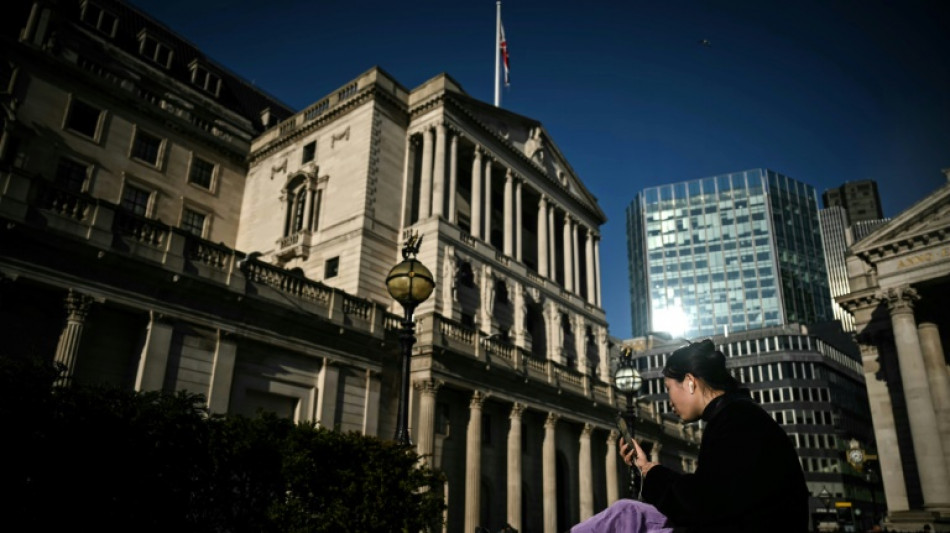
BoE warns on 'economic uncertainty' as rate held / Photo: Ben STANSALL - AFP/File

 Colombian judge bans strikes on guerrillas if minors are present

 Khachanov shocks ailing Auger-Aliassime, Swiatek and Osaka advance at US Open
 Lone juror blocking verdict in US mother's child murder trial: defense
 'Kinda chic' - Williams sisters set to launch US Open doubles bid

 Volkswagen says cutting 100,000 jobs by end of decade

 Russia slaps curfew on charity director over army criticism

 Ailing Auger-Aliassime upset by Khachanov at US Open
 Richarlison omitted from Tottenham's Premier League squad

 How El Nino is choking the Panama Canal

 Hamilton drives his Ferrari dream at Monza

 Senegal has an IMF loan, now what?

 Auger-Aliassime upset by Khachanov at US Open
 Hugging Face, the French start-up that became AI's warehouse

 World Cup winner Llorente retires from Spain team at 31
 Osaka squeezes into US Open third round

 Apple faces £2 bn lawsuit in UK over app privacy feature
 Former champ Swiatek eases into US Open third round

 DR Congo latest to promise moving Israel embassy to Jerusalem

 War criminal Mladic's body returns to Serbia with military honours

 Pierre Cardin museum brings designer's futurist style to Venice

 Slovenian rookie Omrzel triumphs as Mas extends Vuelta lead

 British, French leaders talk migrants, EU relations

 Heading for Ferrari's home race, Leclerc still dreams of world title

 Cafe at centre of Israel culture clash agrees to shut on Sabbath

 Spacecraft bound for Mercury begins 'tricky' arrival

The Bank of England kept its key interest rate at 4.5 percent Thursday, as it warned of "a lot of economic uncertainty" caused largely by US President Donald Trump's tariffs.
The BoE left borrowing costs at 4.5 percent, opting against a fourth cut in seven months despite stagnant UK economic growth as inflation stays elevated.
On Wednesday, the US Federal Reserve and Bank of Japan held borrowing costs steady, while Switzerland's central bank trimmed rates Thursday.
"There's a lot of economic uncertainty at the moment," Bank of England governor Andrew Bailey said in a statement.
The BoE noted in minutes of a regular policy meeting that "global trade policy uncertainty has intensified".
"Other geopolitical uncertainties have also increased and indicators of financial market volatility have risen globally.
"The German government has announced plans for significant reform to its fiscal rules," the central bank said.
Bailey added that the BoE still thinks "that interest rates are on a gradually declining path".
Analysts said this indicated, as expected, that the bank would cut at its next regular monetary policy meeting in May.
- 'Work to do' -
Official data Thursday showed that while British unemployment steadied at the start of the year, wages growth remains far above the annual inflation rate.
At the same time, the Consumer Prices Index jumped more than expected to 3.0 percent in January, which is above the BoE's two-percent target.
The UK economy meanwhile unexpectedly shrank in January.
"We've had three rate cuts since the summer, but there's still work to do to ease the cost of living," finance minister Rachel Reeves said in reaction to the latest BoE decision, backed by eight of the Monetary Policy Committee's nine policymakers, including Bailey.
Across the Atlantic, the Fed on Wednesday kept rates unchanged and warned of increased economic uncertainty as it seeks to navigate an economy unnerved by Trump's stop-start tariff rollout.
Policymakers voted to hold the US central bank's key lending rate at between 4.25 percent and 4.50 percent.
They also cut their growth forecast for this year and hiked the inflation outlook, while still pencilling in two rate cuts this year -- in line with their previous forecast in December.
This contrasted with the European Central Bank, which earlier this month cut borrowing costs to boost a struggling eurozone economy.
However, the ECB suggested that easing could be near an end as it warned of "rising" economic uncertainty, while noting a planned colossal spending boost for Germany's defence and infrastructure that risks a spike to inflation.
In Britain, the BoE last month halved its forecast for the country's total output this year, blaming global risks amid US tariff threats and deteriorating UK business confidence.
That came as the central bank in February cut its key interest rate by a quarter point, easing slightly the pressure on the UK government, which is struggling with tight public finances.
Prime Minister Keir Starmer's Labour administration this week announced contested cuts to disability welfare payments, hoping to save more than £5 billion ($6.5 billion) by 2030 as it looks to shore up Treasury coffers.
burs-bcp/ajb/rl
N.Walker--AT