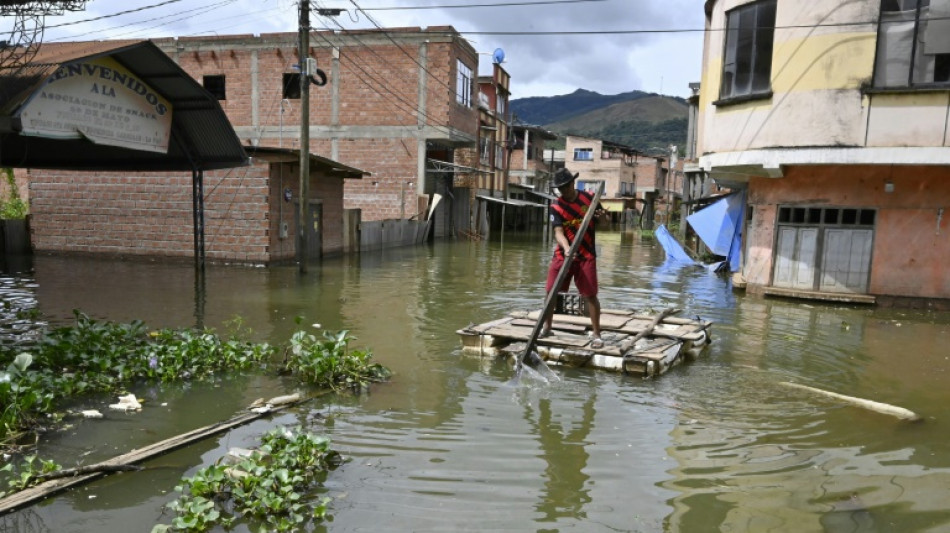
Too much water: Gold rush, climate change submerge Bolivian village / Photo: AIZAR RALDES - AFP

 Colombian judge bans strikes on guerrillas if minors are present

 Khachanov shocks ailing Auger-Aliassime, Swiatek and Osaka advance at US Open

 Lone juror blocking verdict in US mother's child murder trial: defense
 'Kinda chic' - Williams sisters set to launch US Open doubles bid

 Volkswagen says cutting 100,000 jobs by end of decade

 Russia slaps curfew on charity director over army criticism
 Ailing Auger-Aliassime upset by Khachanov at US Open

 Richarlison omitted from Tottenham's Premier League squad

 How El Nino is choking the Panama Canal

 Hamilton drives his Ferrari dream at Monza

 Senegal has an IMF loan, now what?

 Auger-Aliassime upset by Khachanov at US Open

 Hugging Face, the French start-up that became AI's warehouse
 World Cup winner Llorente retires from Spain team at 31

 Osaka squeezes into US Open third round

 Apple faces £2 bn lawsuit in UK over app privacy feature
 Former champ Swiatek eases into US Open third round

 DR Congo latest to promise moving Israel embassy to Jerusalem

 War criminal Mladic's body returns to Serbia with military honours

 Pierre Cardin museum brings designer's futurist style to Venice

 Slovenian rookie Omrzel triumphs as Mas extends Vuelta lead

 British, French leaders talk migrants, EU relations
 Heading for Ferrari's home race, Leclerc still dreams of world title
 Cafe at centre of Israel culture clash agrees to shut on Sabbath

 Spacecraft bound for Mercury begins 'tricky' arrival
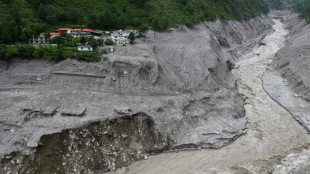
Navigating a makeshift raft between drifting furniture and submerged cars, Rafael Quispe steers through his village in western Bolivia, where the streets were turned into rivers two months ago.
His home is one of about 500 partly immersed in floodwaters in the village of Tipuani in the heart of a gold-mining region.
Gold mining has carved away at the banks of the river that runs through the municipality of 7,500 inhabitants. That, combined with unusual rains attributed to climate change, is to blame for the flooding, experts say.
Quispe, 54, is himself a miner and also used to run a bar out of his home.
"This town, as beautiful as it once was, is now a disaster," he told AFP.
The region is no stranger to flooding, and some of Tipuani's streets have been bogged down in a green sludge for more than a year -- a mixture of river water, rain, and overflow from a collapsed drainage system.
For the last three years, the region has been flooded every rainy season, which runs from November to April.
The municipality says 92 percent of residents make a living from mining and related activities around the isolated village -- accessible from the nearest main road only by a 30-kilometer (18.6-mile) trail of mud and rock dotted with tumultuous streams.
But the industry on which the village depends is also blamed for its demise.
A gold rush, with prices more than tripling in the past decade, has seen an increase in mechanical extraction of the noble metal in Bolivia.
With their machines, mining cooperatives are removing "land that should not be removed" and dumping their waste in the river -- altering its course and "causing floods," said Alfredo Zaconeta, a researcher at the Center for Labor and Agricultural Development Studies (Cedla).
- 'A sin' -
In Tipuani, former miner Sinforiano Checa, 67, has been living in a tent since his house was flooded in January.
What the mining companies do "is a sin," he told AFP, breathing laboriously due to silicosis -- a lung disease he contracted after many years of inhaling silica dust while digging for gold.
"This is nothing new, it's been going on for many years. All the waste was dumped into the river," said Rolando Vargas, president of the Chima Cooperative -- one of 14 extracting gold from the bed of the Tipuani river.
The practice stopped two years ago, Vargas told AFP, adding he felt "somewhat" responsible for the ills that have befallen the community.
After his interview with AFP, Vargas was reported missing, his truck swept away by the raging river, according to his family's social media posts.
- 'Totally anomalous' -
In the village of Chima, about 20 minutes from Tipuani in a 4x4 vehicle, children splash and ride bicycles in the contaminated waters surrounding their homes and school, which has been closed since February.
Those who have access to the internet, often patchy, follow classes online.
"The town may disappear but we have to keep working. What are we going to live on if we don't work?" said Manuel Barahona, a gray-haired 63-year-old whose house is also under water.
Added to the river-altering effects of gold mining, are the ravages of climate change in one of the poorest countries in Latin America.
Bolivia is one of the ten most exposed countries in the world to climate change, according to the 2021 Global Climate Risk Index compiled by advocacy group Germanwatch.
And the Alliance for Global Water Adaptation, an NGO that advises on policy, said in a report last year that "climate change is intensifying Bolivia's water vulnerabilities... increasing the frequency and severity of droughts and floods."
The rains that fell on Tipuani were the most intense for a month of January since 2012, according to Bolivia's National Meteorology and Hydrology Service (Senamhi).
"It is totally anomalous" for a period marked by the La Nina weather phenomenon that ordinarily brings less rainfall, not more, said Lucia Walper, head of forecasting at Senamhi.
Last year's record forest fires in Bolivia's east have also altered rainfall patterns, with less vegetation to retain moisture over the Amazon meaning more rains fall further west on the high plains, she explained.
W.Stewart--AT