Why are proposed deep-sea mining rules so contentious? / Photo: Jean-Michel CORNU, Valentina BRESCHI - AFP

 Premier League transfer windfall a lifeline for ailing French clubs

 Chile protesters see shades of Pinochet in new security plan

 Carreras reverts to fullback as Argentina change four for Australia Test

 Wilson back to lead Australia as Kiss rotates team for Argentina

 Yen surges on new intervention talk, US stocks rally

 Japan's Ueda fires Lille top of Ligue 1 on debut

 Arsenal chief executive reveals 'dynasty' ambition

 Spanish PM says no 'solid proof' Morocco planned migrant rush

 Iran war is not a war, US VP Vance says

 Khachanov stuns third-seeded Auger-Aliassime in US Open second round
 Bordeaux facing sixth-tier football after French federation upholds relegation

 Stoic Verstappen looking beyond 'painful' Monza weekend
 OpenAI begins rollout of new powerful AI model GPT-6 Astra

 FIFA blasts UEFA 'smear campaign,' fights World Cup plan disclosures

 Zelensky hopes to host US envoys in Kyiv in 'coming days'

 Martinelli joins Al-Hilal from Arsenal for reported £60 million

 Tesla's semi-autonomous driving could be adapted to EU norms: France

 37 people die from fumes during oil pipeline theft in Nigeria: NGO

 Ahead of elections, Israel tests West's patience on West Bank violence
 Antonelli will obey Mercedes orders to help 'tow' teammate Russell

 UK fintech Revolut gains conditional US banking licence

 Mara sisters channel childhood energy for twins performance at Venice

 UN's Sudan probe says foreign fighters fuelling conflict

 Violence erupts at S.Africa anti-migrant protest

 Nothing left: Nepal flood survivors face loss and uncertainty

After more than a decade of negotiations, a new round of talks to finalize a code to regulate deep-sea mining in international waters begins Monday in Jamaica, with hopes high for adoption this year.
The International Seabed Authority (ISA), an independent body established in 1994 under a UN convention, has been working since 2014 on the new rules for developing mineral resources on the ocean floor.
The huge task has gathered pace, under pressure from corporate concerns eager to cash in on the untapped minerals.
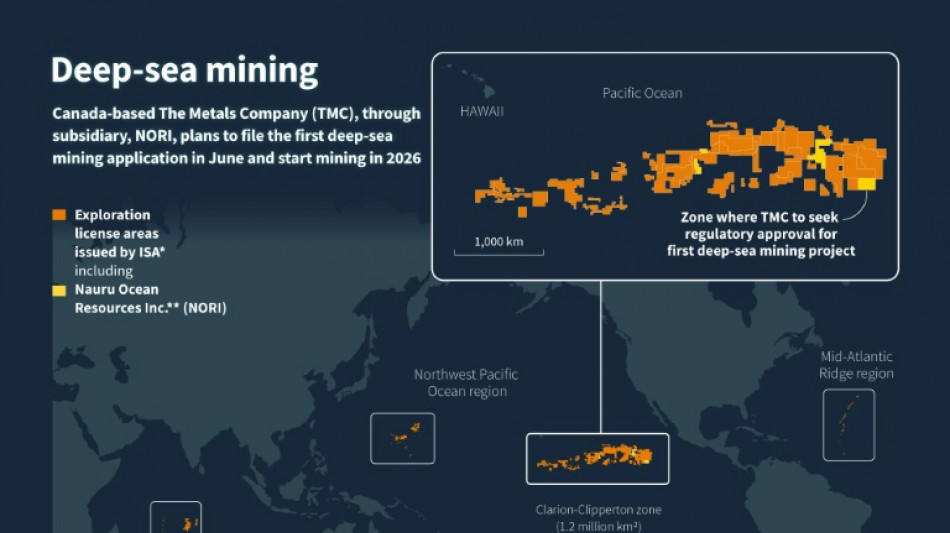
Canada's The Metals Company plans to file the first commercial mining license request in June, through its subsidiary Nori (Nauru Ocean Resources Inc.), which hopes to extract polymetallic nodules from the Pacific.
Here is a look at the proposed rules, and why they have sparked intense debate:
- What does this mining code entail? -
Under the UN Convention on the Law of the Sea (UNCLOS), the ISA must both oversee any exploration or mining of coveted resources (such as cobalt, nickel, or manganese) in international waters, and protect the marine environment.
For activists worried about the protection of hard-to-reach ocean ecosystems, this twin mandate is nonsensical. Some groups, and more and more countries, are asking for a moratorium on seabed mining.
With no consensus, the ISA-led negotiations have continued.
The ISA Council, made up of 36 of the authority's 169 member states, will spend the next two weeks trying to bridge the gaps on finalizing the code.
They are working from a 250-page "consolidated text" already riddled with parenthetical changes, and comments on disagreements.
But then there are dozens of amendments filed by countries, companies and non-governmental organizations.
Emma Wilson of the Deep Sea Conservation Coalition told AFP there were "over 2,000 textual elements that are still being discussed -- and that those debates were "not close to being resolved."
- How would seabed mining work? -
Any entity wishing to obtain a contract to mine the ocean floor must be sponsored by a specific country.
Those applications for mining licenses would first go through the ISA's legal and technical commission, which NGOs say is too pro-industry and opaque.
The commission would evaluate the financial, technical and environmental aspects of the proposed plans, and then make a recommendation to the ISA Council, the final decision-maker.
But some worry that rules already set by UNCLOS would make it too difficult to reject any favorable recommendations.
The draft code calls for initial contracts lasting 30 years, followed up with extensions of five years at a time.
- What about environmental protection? -
Potential mining companies must conduct a survey of the possible environmental risks of their activities, but details on these surveys are still up in the air, with negotiators not yet even agreed on how to define the terms.
More and more countries, along with NGOs, highlight that even the idea of surveying potential impact is effectively impossible, given the lack of scientific data about the zones.
And some Pacific states insist that the code explicitly state the need to protect "underwater cultural heritage," but that is under debate.
- What about compliance? -
The draft text calls for inspections and evaluations for deep-sea mining companies, but how such a system would work is under debate. Some even think such mechanisms are ultimately not all that feasible.
- Will there be profit-sharing? -
Under UNCLOS, resources on the ocean floor are seen as the "common heritage of mankind."
The mining code under consideration stipulates that each company must pay royalties to the ISA based on the value of the metals. But what percentage should they pay?
A working group has proposed royalties of anywhere from three to 12 percent, while African states believe 40 percent is more just.
L.Adams--AT