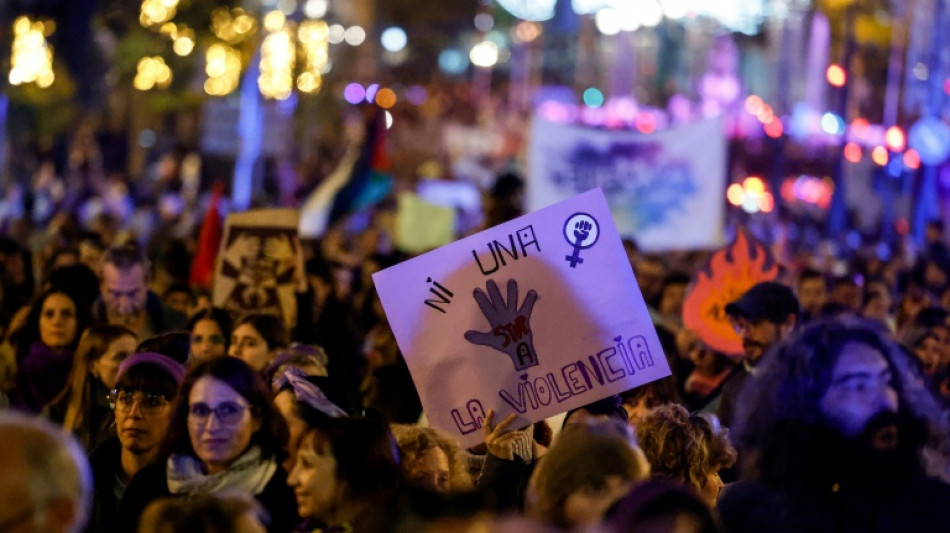
Spain targets men's 'deafening silence' in gender violence battle / Photo: OSCAR DEL POZO - AFP

 Lazio pull clear at Serie A summit as Gattuso warns of vertigo

 Israel elections chief says inquiry into irregularities will not undermine result

 Vacherot beats Lehecka to clinch Basel title

 Buzzy Holmes doc wins slow Halloween box office in N. America

 Mbappe strikes after China controversy as Real Madrid beat Santander

 Almgren makes triumphant marathon debut in New York
 Chinese state TV fails to air Real Madrid match after Mbappe row

 France launches 'attempted murder' probe after petrol bomb attacks on security forces

 Bayern's Saibari sidelined after ankle surgery

 France launches 'attempted murder' probe after petrol bomb attack on security forces

 Tens of thousands protest in India's capital against voter roll revision
 Irish European athletics champion Ciara Mageean dies aged 34

 Seifert blasts 93 as New Zealand win fifth India T20

 Portuguese police clash with housing protesters, arrest 13

 Marquez wins in Malaysia to stand on brink of MotoGP world title

 Binance says resuming withdrawals after major hack

 Divided Bulgaria votes in tense presidential runoff

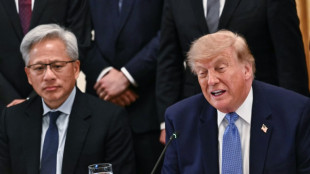 Trump says US looking 'closely' at report Nvidia CEO target of China spy plot

 Maxey scores 38 to lead Sixers 'fighters' to another comeback win

 Valkyries defeat Dream to capture first WNBA crown

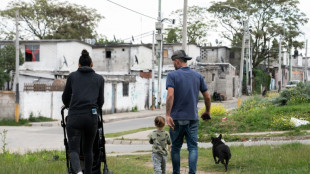 'Seen and heard': Uruguay neighborhood places hopes in pope

 Spewing US election falsehoods, AI chatbots face scrutiny

 EU's new levy on parcels kicks in

 Ocon denies reports of altercation after being dumped by Haas

 Hamilton says love of racing keeps him young

Feminist activists in Spain say inaction and men's silence are hindering the eradication of abuse, as the country celebrates 20 years of a pioneering law against gender-based violence.
The murder of Ana Orantes, a 60-year-old woman who had reported violence against her to the authorities and on television before being burned alive by her ex-husband in 1997, shocked the nation into action.
Parliament ended up adopting a law that entered into force in 2005 and recognised gender-based violence as a human rights violation for the first time, inspiring other countries.
The legislation laid the ground for a range of new support measures for women, including specialised courts, free legal assistance, emergency housing, prosecution even if the victim did not submit a complaint and tags keeping abusers away from the victim.
It was the first law in Spain to be conceived with an explicit gender-based perspective, punishing abuse perpetrated by males against their partners or ex-partners.
For lawyer and activist Altamira Gonzalo, the law stood out by aiming to "undermine the patriarchal structure of society, which is what allows and perpetuates inequality and therefore violence".
It was the first European law which sought to change different areas including the health system, media, advertising and "all those aspects of life in which inequality between men and women is reflected", Gonzalo added.
The measures helped bring down the number of femicides, which in 2024 dropped to a low of 48 since such records began in 2008, when 76 women were killed by their partner or ex-partner.
But "there is still lots of work to do with men, and especially with young males" and "macho attitudes", said Manuela Carmena, a former judge and mayor of Madrid from 2015 to 2019.
Equality Minister Ana Redondo said the scale of the problem was "enormous" and "inoculated like a virus in society" that spread on social networks.
- 'Deafening silence' -
Socialist Prime Minister Pedro Sanchez recently called out fellow men for their inaction, speaking of "a silence that covers macho culture's most subtle manifestations, but also the most extreme ones".
"Everywhere, this silence must end, because today it remains a deafening silence," he said at an event marking the 20th anniversary of Spain's gender-violence law.
This week, the Spanish bar awarded an equality prize to Gonzalo and French lawyers Stephane Babonneau and Antoine Camus, who represented Gisele Pelicot in her notorious mass rape trial that generated much soul-searching in Spain.
Pelicot was raped for years by her husband and dozens of men recruited by him online while sedated, and her insistence that the trial in France be made public made her a global feminist icon.
"Under how much silence was the continual rape of Gisele Pelicot maintained for years? How many men knew and kept quiet?" said Sanchez.
Sexual violence is "under-reported in Spain", agreed Gonzalo, a member of the national observatory against gender-based violence.
Nonetheless, the ground-breaking 2005 law has allowed more than three million women to report their suffering and escape from their ordeal, the lawyer added.
Spanish authorities are now widening the law's scope to include newer offences such as online and economic violence as well as "vicarious violence" -- abuse meted out to children with the aim of making the mother suffer.
O.Ortiz--AT