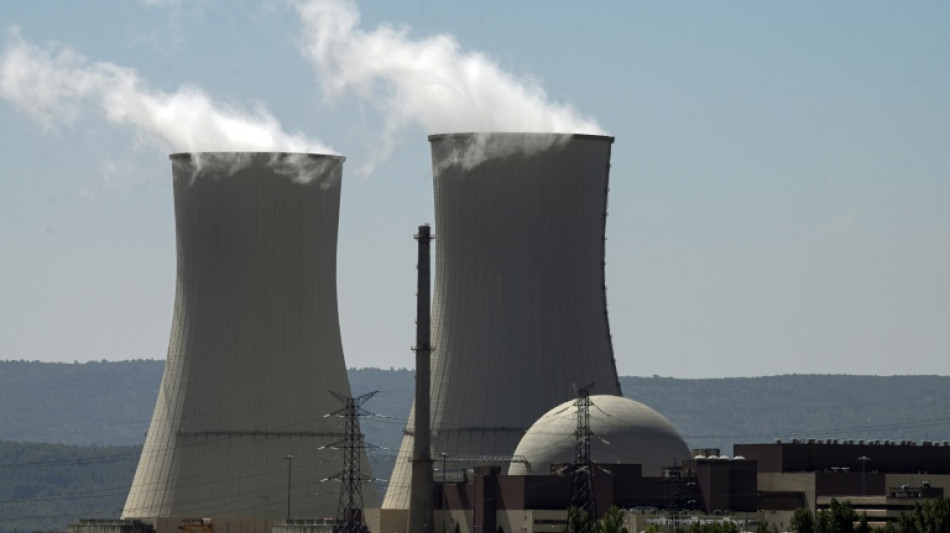
Spain under pressure to abort nuclear energy phase-out / Photo: OSCAR DEL POZO - AFP

 Nepal tunnel rescue revives hopes 10 days after flood
 Indonesia rescues second orangutan mother and baby from wildfire

 Box office magnet Robert Pattinson appears in paedophile thriller
 How haze from Indonesian fires impacts Southeast Asia

 Trump sends envoys to Moscow, Kyiv with new plan to 'end war'

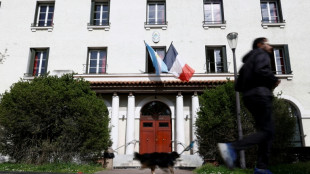 'Mini-dictatorship': Students slam Argentina-run residence in Paris

 The disgraced banker stirring the pot in Brazil's Supreme Court

 Panama Canal begins reducing crossings due to El Nino

 Trump again seeks to remove protections for wolves

 'Getting there' - Alcaraz into US Open last 16 along with Sabalenka

 Isak ready to show world his quality, says Van Dijk

 Stuttgart cruise past Cologne to bounce back from Bayern thumping

 'Smart, aggressive' Alcaraz into US Open last 16

 Isak fires Liverpool to first win under Iraola at Ipswich

 Stocks slip as robust US jobs data stokes rate hike odds

 Mistrial declared in case of US woman who killed her three children

 Seville, Alfred win at Diamond League finals, Duplantis hit with injury

 Moody’s Assigns First-Time Insurance Financial Strength Ratings to Freedom Insurance and Freedom Life

 Trump says envoys taking plan to 'end the war' to Moscow, Kyiv

 US Football Hall of Fame revamps selection process

 Judge declares mistrial in case of US woman who killed her children

 Edgar Davids art thief misses sentencing after being 'knocked out by luggage'

 Pegula rallies to reach US Open fourth round

 Defending champ Sabalenka leads way into US Open fourth round

 Bayeux Tapestry 'virtually unchanged', UK museum says, after France spots broken threads

Spain, a European renewable energy leader, is coming under increasing pressure from the right and business groups to reverse its plans to phase out its nuclear power plants by 2035.
At the height of enthusiasm for nuclear power in the 1980s, Spain had eight nuclear plants providing 38 percent of its electricity. Now it has five, providing 20 percent of its power.
Under the country's nuclear phase-out plans, agreed in 2019 under the government of Socialist Prime Minister Pedro Sanchez, these remaining plants will be closed over the next decade, as the country focuses instead on green energy sources such as solar and wind power.
But as the planned closure of the country's oldest and most powerful atomic plant at Almaraz in western Spain in 2027-28 approaches, calls are growing for Spain to follow in the footsteps of other European countries that are reviving their nuclear power.
The two reactors at Almaraz generate around seven percent of the total electricity produced in the European Union's fourth-largest economy.
Spain's decision to close its plants "was adopted in a completely different industrial, geopolitical, social and economic context" and no longer makes sense without "a viable alternative," the Nuclear Forum lobby group that represents the sector said in a statement.
Atomic power will be needed to meet Spain's electricity needs as demand will soar due to growing sales of electric vehicles and the expansion of data centres to accommodate the greater use of AI, it added.
- 'Absolutely necessary' -
Ignacio Sanchez Galan, the chairman of Spanish energy company Iberdrola, which operates several atomic power plants as well as renewable energy farms, said nuclear energy is "absolutely necessary" to keep the lights on.
Iberdrola is one of around 30 companies that signed a manifesto last month calling for the extension of Spain's nuclear power plants.
"Dismantling this infrastructure prematurely would cause irreparable economic and social damage," the manifesto said.
Since gas prices spiked with the Ukraine war, global interest in the nuclear sector is at its highest since the oil crises in the 1970s, according to the International Energy Agency.
The Netherlands and Sweden are planning to build new nuclear plants, while Belgium's new conservative-led government has reversed a two-decade pledge to phase out atomic power.
Italy's cabinet last month opened the door to a return to nuclear power, 25 years after the closure of its last reactors.
- 'Not ready' -
Spain's conservative main opposition People's Party (PP) has added to the pressure.
It has tabled a motion, which has been approved by the parliament, calling on the government to keep the nuclear plants in operation.
During a visit to the Almaraz plant last month, the influential PP head of Madrid's regional government, Isabel Diaz Ayuso, said the measure was necessary to "protect jobs and energy sovereignty" and warned that Spain was "not ready to replace nuclear energy".
The price of electricity in Spain could rise by 23 percent for domestic consumers and by 35 percent for businesses if the country's nuclear reactors are shut down, according to a study by PwC.
Abandoning nuclear power is a "big change" because it means replacing a "constant and predictable energy supply" with "more volatile" sources such as solar and wind, Enric Bartlett, a professor of environmental law at Esade Law School, told AFP.
But it should be possible to close the remaining nuclear plants "without disruption" if Spain has the right amount of installed capacity to generate electricity by other means by 2035, and the "appropriate transport and storage networks", he added.
"There will have to be a significant increase in investment," Bartlett said.
R.Lee--AT