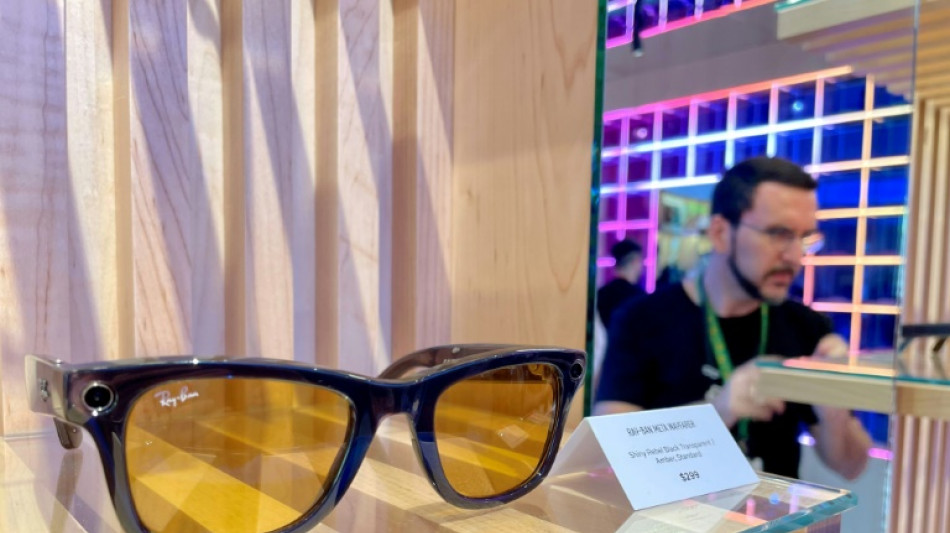
Wearable tech has far to go before challenging smartphones / Photo: Julie JAMMOT - AFP/File

 US envoy on West Bank visit says Israel has responsibility for Palestinians

 Ethiopian Miss World contestant spotlights pain of sister's murder

 'Leader' Raphinha rising to Barca striker challenge

 Oasis fans gather in Venice for band reunion film

 Two Nepal rescues revive hopes 10 days after flood

 Pogacar to miss worlds after season-ending Vuelta crash

 Greenwood, Guendouzi handed bans after Fenerbahce-Lyon brawl

 In Iceland, the mystery of the poet, the tomb and the Danish grocer

 Ratko Mladic: Bosnian Serb commander to convicted war criminal

 Bolivian army base blasts kill two, wound dozens

 Alcaraz, Sabalenka into US Open last 16 as Williams sisters lose on return

 Williams sisters fall in thrilling return to US Open doubles

 Bangladesh measles toll nears grim 1,000-child mark
 Bolivia farmers return to streets over diesel price hikes

 Tetris distances itself from controversial White House 'arcade' games

 Africa bigger, US smaller - UN adopts new map

 Bad weather will not affect All Blacks, says captain Savea

 Mbappe misses penalty as Parrott lifts Betis past Real Madrid

 PSG still winless in Ligue 1 as Monaco go top

 Defending champion Alcaraz reaches last 16 at US Open

 Lyles ends season before Budapest due to injury flare ups
 US Republicans announce probe into environment groups

 Sabalenka survives despite 'tricky' weed smell at US Open

 S&P Revises Outlook on Freedom Holding Corp. and Core Subsidiaries to Positive

 Job growth but record-high diesel prices -- Trump's midterms mixed bag

Wearable gadgets like smart watches and glasses are growing more capable every year, but experts say smartphones will remain ubiquitous for the foreseeable future -- not least thanks to artificial intelligence features.
A slew of wearable products and prototypes were on show at the Mobile World Congress in Barcelona Monday, even as smartphone makers and network operators played up AI integration as making handsets more useful.
Such "new product ranges allow manufacturers to diversify the hopes until now placed in phones" said Cesar Corcoles, an IT and telecoms professor at the Open University of Catalonia.
The trade show in Barcelona will see "prototypes and demonstrations of smart glasses that place a small, very limited screen in front of our eyes".
Smart glasses have seemed on the horizon for more than a decade, with Google's Glass headset and camera released in 2013 -- although it has since been discontinued.
Meta has encountered more success recently with its frames developed alongside Ray-Ban, offering features including a built-in camera, music playback and voice interactions with the company's AI.
Yann LeCun, star AI researcher at the company which owns Facebook and Instagram, is often seen showing off the glasses at public appearances.
Worldwide, the market for smart glasses appears to be surging in terms of unit sales, with a 210-percent year-on-year increase in 2024 according to specialist research firm Counterpoint -- far faster than the seven-percent growth in smartphone shipments calculated by analysts Canalys.
- 'Cool gimmick' for now -
But comparing the number of devices rather than growth rates, last year's roughly two million pairs of smart glasses barely register compared to the 1.2 billion smartphones sold.
Counterpoint predicts the glasses market will grow further in the coming years as more producers -- from social media giants to smartphone makers -- look to claim a piece of the action.
Other wearable categories may need longer to take off, with the recent shutdown of "AI Pin" maker Humane a sign some wearable tech is not yet mature.
Designed to be worn at chest level like a brooch, the would-be smartphone replacement incorporating a camera and mini projector was designed to be used via AI-powered voice interactions but received poor reviews.
Humane has now been sold to HP after the device failed to make the hoped-for impact.
The "AI Pin" was "just not that useful yet", Canalys expert Jack Leathem said.
Voice-controlled devices are "a cool gimmick, but humans have become very, very used to text-based interactions on touchscreens," he added -- habits it would take a powerful sales pitch to change.
"The most challenging thing is getting people to change their behaviour," agreed Shen Ye of smartphone maker HTC's Vive wearables arm.
"We still use a QWERTY keyboard because it's what we're used to... even though there are probably much better ways of typing," he added.
- AI on your phone -
Beyond consumer inertia, wearable tech is still up against engineering challenges stemming from its bid to squeeze smartphone-like functionality into a smaller package.
"There are limits around the computing power currently and battery performance," Leathem said. "You can't make them that compact."
That's one reason why smart watches able to make calls and send messages largely remain tethered to wearers' smartphones for now.
"Every smart watch that comes out now is there to interact with a smartphone, not to replace it. It's an accessory," Leathem said.
What's more, manufacturers are incentivised to get consumers buying a wider range of gadgets rather than simply swapping one for another.
And even as wearables become more useful, AI is expected to pump more value into smartphones themselves.
The latest offerings from Apple, Samsung or China's Xiaomi have bet on offering users integrated "AI assistant" features.
"All the money is going into AI... their vision of the future is keeping the same smartphone form factor, but making it way more useful," Leathem said.
Canalys predicts that the share of smartphones sold worldwide with AI features will leap from 16 percent at present to more than half by 2028.
R.Garcia--AT