Italy breaks 'taboo' with push to revive nuclear / Photo: FILIPPO MONTEFORTE - AFP

 US envoy on West Bank visit says Israel has responsibility for Palestinians

 Ethiopian Miss World contestant spotlights pain of sister's murder
 'Leader' Raphinha rising to Barca striker challenge
 Oasis fans gather in Venice for band reunion film

 Two Nepal rescues revive hopes 10 days after flood
 Pogacar to miss worlds after season-ending Vuelta crash
 Greenwood, Guendouzi handed bans after Fenerbahce-Lyon brawl

 In Iceland, the mystery of the poet, the tomb and the Danish grocer

 Ratko Mladic: Bosnian Serb commander to convicted war criminal
 Bolivian army base blasts kill two, wound dozens
 Alcaraz, Sabalenka into US Open last 16 as Williams sisters lose on return
 Williams sisters fall in thrilling return to US Open doubles
 Bangladesh measles toll nears grim 1,000-child mark

 Bolivia farmers return to streets over diesel price hikes
 Tetris distances itself from controversial White House 'arcade' games

 Africa bigger, US smaller - UN adopts new map

 Bad weather will not affect All Blacks, says captain Savea

 Mbappe misses penalty as Parrott lifts Betis past Real Madrid

 PSG still winless in Ligue 1 as Monaco go top

 Defending champion Alcaraz reaches last 16 at US Open

 Lyles ends season before Budapest due to injury flare ups
 US Republicans announce probe into environment groups
 Sabalenka survives despite 'tricky' weed smell at US Open

 S&P Revises Outlook on Freedom Holding Corp. and Core Subsidiaries to Positive

 Job growth but record-high diesel prices -- Trump's midterms mixed bag
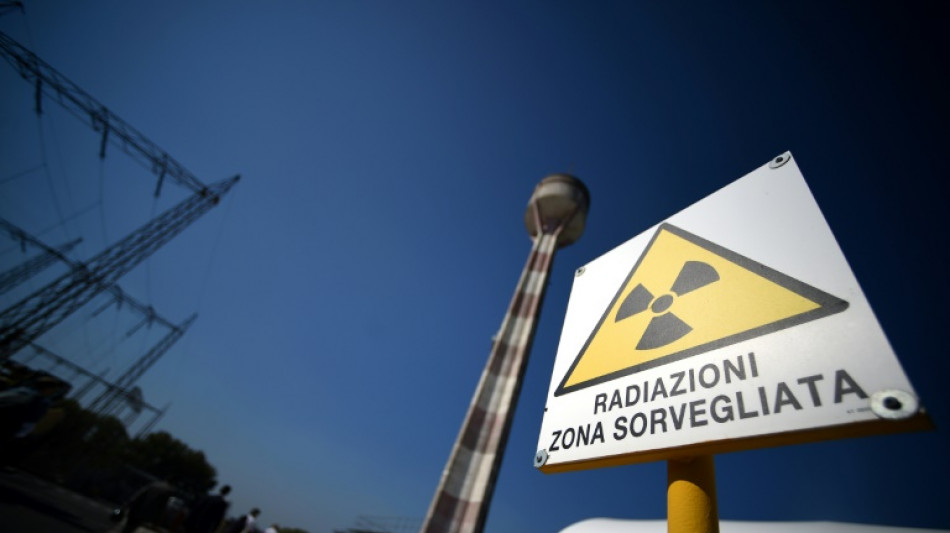
Italy's cabinet opened the door Friday to a return to nuclear power, aiming to overturn nearly 40 years of opposition -- though experts say any revival is at least a decade away.
Prime Minister Giorgia Meloni's hard-right government says nuclear could play a key role in increasing energy security, as well as slashing Italy's carbon emissions and sky-high electricity prices.
Energy Minister Gilberto Pichetto Fratin has set a 2026 deadline to draw up a legal framework for everything from traditional reactors to next-generation technologies.
"With the latest generation of nuclear power, together with renewables, we will be able to achieve the objectives of decarbonisation, guaranteeing the country's full energy security," Pichetto Fratin said on Friday.
But opponents say nuclear is much more costly than other low-carbon energies, takes years to implement and gives policymakers an alibi to slow the phase-out of gas, a fossil fuel driving climate change.
In neighbouring France, which boasts one of the globe's largest nuclear power programmes, the latest, new-generation plant cost four times the initial estimate and came online 12 years behind schedule.
Luca Bergamaschi from Italy's ECCO climate think tank told AFP that "in the best-case scenario, Italy could not have nuclear power before 2035".
- 'Taboo' -
Italy used to be a pioneer in nuclear power but Italians voted overwhelmingly against it after the 1986 Chernobyl disaster, triggering a phase-out.
The last reactors shut in 1990 and attempts by Rome to revive the sector were stymied by another referendum in 2011 following the Fukushima accident.
Nor does Italy have a national repository for nuclear waste, as over 50 proposed sites have refused to host it.
Energy consultant Simona Benedettini welcomed moves to break the "taboo" around nuclear and said Italy still boasts top-class researchers in the field it can draw on.
In addition to covering traditional fission reactors, the new legal framework will also cover research, development and use of fusion energy.
It will also cover the dismantling of old plants, management of radioactive waste and spent nuclear fuel.
Italy had four nuclear reactors, all of which have been defueled and are being decommissioned.
No specific new sites or projects have been identified but the energy minister says nuclear power would also be used for hydrogen production, to help decarbonise Italy's most energy-intensive sectors, such as steel.
The ministry will fund investments to the tune of 20 million euros ($21 million) a year from 2027 to 2029, Pichetto Fratin said.
Talks are already underway between energy group Enel, engineering company Ansaldo and defence company Leonardo to set up state-backed company to build small modular reactors (SMRs), he said.
SMRs are advanced nuclear reactors that have about one-third of the generating capacity of a traditional nuclear power reactor.
Designed to be built in factories, they offer the promise of being cheaper to produce and quick to build, but are still experimental.
- 'Geopolitical risk' -
Italy is not alone in flirting with nuclear power again. Since gas prices spiked with the Ukraine war, global interest in the sector is at its highest since the oil crises in the 1970s, according to the International Energy Agency.
Britain said in February it was changing laws to speed up the country's rollout of mini-nuclear reactors.
But Beatrice Petrovich, senior energy analyst at climate think tank Ember, said focusing on nuclear in Italy "risks being counterproductive".
New nuclear "is more expensive than wind and solar and takes longer to commission and install", while policymakers should be looking at storage and enhanced power grids for renewables instead, she said.
"Nuclear would also introduce an additional reliance on foreign fuel", namely uranium, "which could pose real geopolitical risk", she told AFP.
Some 81 percent of Italians are still anti-nuclear, according to an Ipsos poll from November -- and critics are already mobilising support for a potential new referendum.
But businesses hope it could be a way to slash electricity costs, which are much higher in Italy than some of its EU neighbours, in part due to its reliance on gas.
Just over 50 percent of Italy's electricity generation mix in 2024 was fossil power, according to Ember.
In a 10-year energy and climate plan published last year, Rome said it aims to install enough nuclear capacity by 2050 to generate between 11 percent and 22 percent of the power it uses.
It said that could be done using mainly SMRs, but also fusion power plants -- a technology Meloni has said is a "game changer", but which is still highly experimental.
- 'Greenwashing' -
Emanuele Orsini, the head of Italy's business lobby Confindustria, has called for old reactors to be "reactivated".
He has also suggested local communities' opposition to new sites could be bypassed by companies housing SMRs in-house.
But Bergamaschi, from the ECCO think tank, said there were so many legal, technical and political hurdles to nuclear power that "it will most likely never arrive" in Italy.
He said the narrative of reviving nuclear was being pushed by firms that want government support to develop and sell new technologies.
The idea also benefits those who "want to slow down the deployment of cheaper renewable generation, storage and grid in the power sector, to protect the market share and profits of gas".
Meloni's hard-right government has proved lukewarm on renewables, instead seeking to transform Italy into a "gas hub" for the Mediterranean.
Focusing on nuclear allowed ministers to appear committed to low-carbon energy while sticking with fossil fuels, Bergamaschi argued, saying that "as far as Italy is concerned, for all practical reasons, nuclear power is greenwashing".
N.Walker--AT