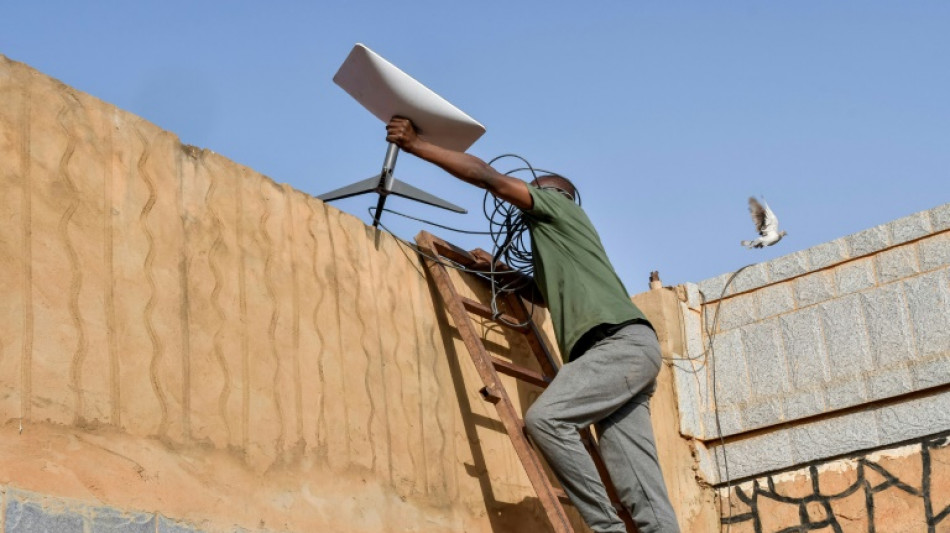
Niger turns to satellites to bridge digital divide / Photo: BOUREIMA HAMA - AFP

 Inter and Roma roar back to win thrillers and share top spot

 Don't stop them now: fans party for Freddie Mercury's 80th birthday

 AFP photographer wins top prize for Madagascar protest coverage

 Keys: 'I felt like I couldn't play tennis'

 Simmonds stars as Pau upset Montpellier
 Inter roar back in five-goal thriller with Napoli

 Haaland keeps Man City perfect in Premier League, blunt Spurs held

 Hamilton worried by Ferrari pace while Antonelli prepares for a fight

 Vuelta stage 15 shortened due to extreme heat, Mas consolidates lead

 Putin meets US envoys for Ukraine war talks

 Modric available for Croatia in Nations League

 Potapova upsets 2025 US Open runner-up Anisimova

 Gasly a 'class act' says Alpine boss after Monza pole

 Athletic Bilbao crush Simeone's flat Atletico

 Stay far from battlefield, warns Japanese director in Vietnam War film

 Tens of thousands of Croatians protest over hazardous waste

 Haaland heads unconvincing Man City top of Premier League

 US envoys in Moscow as Russia and Ukraine vow not to hit capitals during talks
 Motorsport governing body rejects Alpine boss's claims of bias

 US envoy on West Bank visit says Israel has responsibility for Palestinians

 Ethiopian Miss World contestant spotlights pain of sister's murder

 'Leader' Raphinha rising to Barca striker challenge

 Oasis fans gather in Venice for band reunion film

 Two Nepal rescues revive hopes 10 days after flood
 Pogacar to miss worlds after season-ending Vuelta crash
Less than a third of Niger's vast territory has internet access, so the west African country is betting on satellite broadband to bridge the digital divide in remote rural areas.
The patchy coverage is mostly down to a lack of investment and the destruction of relay antennae by the numerous armed groups active in the country, according to electronic communications regulator ARCEP.
In November, Niger's military rulers granted a five-year contract with US billionaire Elon Musk's company Starlink to provide high-speed internet access across the Sahel state.
It is one of around 15 African countries to have authorised the use of Starlink's thousands of satellites on their territory.
"Essential services that drive economic development -- banks, hospitals, schools, the energy and farming sectors -- all rely on the internet and data," said economist Ibrahim Adamou Louche.
Communications Minister Sidi Ahmed Raliou predicted the move would provide internet access to "about 80 to 100 percent" of Niger -- 1,267 square kilometres (490 square miles) largely covered by desert plains and sand dunes.
The deal is lucrative for the US company.
In a country where almost 50 percent of the population earns less than a dollar a day, according to the World Bank, users who want internet access must pay between 260,000 and 400,000 CFA francs ($414 and $637) for the satellite firm's necessary basic equipment.
- Big in the country -
The drive to access the internet has also spawned illicit operations.
The equipment, much of it imported from neighbouring Nigeria, is sometimes brought across the border illegally.
Users who cannot afford the equipment must pay the US company for one-off access to the internet for a limited amount of time.
"On market days especially, people congregate round the wifi router," said Moussa Djibrilla, a secondary school teacher in the rural western community of Mangaize.
Much of the enthusiasm for satellite broadband comes from remote areas, said vendor Ali Sat.
In the capital, Niamey, sales of equipment have not so far taken off and only a handful of homes are connected, he added.
In rural areas, the situation is different.
Technician Moumouni Harouna said the biggest demand for satellite internet equipment came from people "out in the bush" who liked it because "they don't lose connection".
- Elusive signal -
"We're back in civilisation," grinned Alfa Hama, a villager in the western hamlet of Gorou, near the border with Mali, where the local phone and internet relay antennae were destroyed eight years ago.
"We don't need to go six kilometres and climb to the top of a hill to get an elusive signal any more," he said. "The wifi is right here."
For a price, high-speed internet access is now available in some parts of the Tenere desert, through which travellers pass, alongside thousands of migrants seeking to make the perilous journey out of one of the world's poorest countries and through Libya towards the El Dorado of Europe.
In Tabelot, a little further south, illegal gold mining operations, markets and the long-distance bus station all offer connection points for those who can pay.
Local Touareg chief Youssaf Houssa said whole neighbourhoods sometime clubbed together to afford a piece of communal satellite equipment.
"People are able to come together more thanks to WhatsApp groups and do business online," he said.
Niger's four long-standing telecommunications operators, who are often criticised for the quality of their services, are less than keen to see the military rulers embrace the new US competitor.
"Satellite solutions complement what we do but they can't replace the advantages we offer in terms of cost, performance and personal service," said a senior official from one of the operators, asking to remain anonymous.
E.Flores--AT