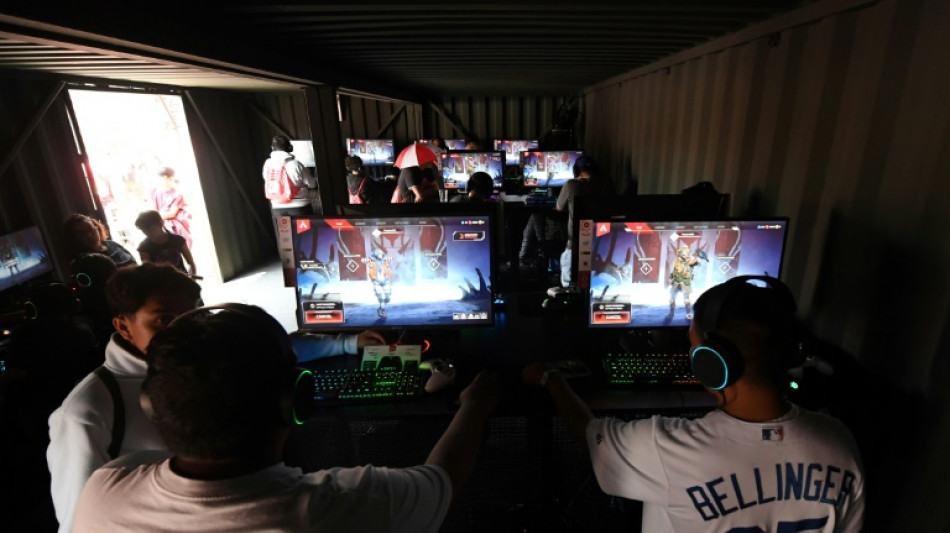
Spain eyes crackdown on video game 'loot boxes' / Photo: Mark RALSTON - AFP/File

 US envoys in Moscow as Russia and Ukraine vow not to hit capitals during talks

 Motorsport governing body rejects Alpine boss's claims of bias
 US envoy on West Bank visit says Israel has responsibility for Palestinians

 Ethiopian Miss World contestant spotlights pain of sister's murder

 'Leader' Raphinha rising to Barca striker challenge

 Oasis fans gather in Venice for band reunion film

 Two Nepal rescues revive hopes 10 days after flood
 Pogacar to miss worlds after season-ending Vuelta crash
 Greenwood, Guendouzi handed bans after Fenerbahce-Lyon brawl

 In Iceland, the mystery of the poet, the tomb and the Danish grocer

 Ratko Mladic: Bosnian Serb commander to convicted war criminal

 Bolivian army base blasts kill two, wound dozens

 Alcaraz, Sabalenka into US Open last 16 as Williams sisters lose on return
 Williams sisters fall in thrilling return to US Open doubles

 Bangladesh measles toll nears grim 1,000-child mark
 Bolivia farmers return to streets over diesel price hikes

 Panama Canal begins reducing crossings due to El Nino
 Trump again seeks to remove protections for wolves
 'Getting there' - Alcaraz into US Open last 16 along with Sabalenka

 Isak ready to show world his quality, says Van Dijk

 Stuttgart cruise past Cologne to bounce back from Bayern thumping

 'Smart, aggressive' Alcaraz into US Open last 16

 Isak fires Liverpool to first win under Iraola at Ipswich

 Stocks slip as robust US jobs data stokes rate hike odds

 Mistrial declared in case of US woman who killed her three children

Spain's government will within days present a draft bill to regulate video game "loot boxes" for which users must pay, a minister said Friday, warning of the addiction risks for youngsters.
An increasingly common feature in many video games, "loot boxes" are caches of virtual weapons and equipment which a player can buy to increase their prowess or status within the game.
But not all boxes contain useful tools and gamers can only see what's inside after paying, prompting widespread criticism for encouraging behaviour similar to that associated with gambling.
"We have drawn up a very specific law which we will present in the coming days" that will regulate the sale of such content, Spain's Consumer Affairs Minister Alberto Garzon told Radiocable.
"It is like gambling... because it involves compulsive consumption behaviour which provokes a series of issues for players, from stress to financial bankruptcy," he told the independent radio station.
"At the end of the day, these are sums which pile up and can lead to gambling addiction," Garzon said.
Such features were aimed above all "at the under-18 age group, where in 2021, up to 30 percent admitted they had paid significant amounts of money to obtain such rewards" within a game, he said, citing health ministry statistics.
The age ratings for such games "don't take into account the danger posed by this feature, so parents could buy a game for a 13-year-old, for example, without being aware it includes an element which, in real life, could not be bought by anyone under 18," he explained.
- 'Predatory' -
In April, PEGI, the European body that issues age ratings for video games, introduced a labelling change that requires gaming companies to say if a game includes "paid random items" -- a form of optional in-game purchases.
Many other countries have also been struggling with the controversial question of "loot boxes" although few have taken steps to regulate them.
On Tuesday, 20 European consumer groups threw their weight behind a Norwegian Consumer Council (NCC) report on loot boxes that described them as "exploitative and predatory", with the groups demanding better regulation of the video game industry.
"The sale and presentation of loot boxes often involve exploiting consumers through predatory mechanisms, fostering addiction, targeting vulnerable consumer groups and more," the NCC's head of digital policy Finn Myrstad said in a statement.
Gaming companies often used "highly problematic practises to increase their own revenue" through features that "manipulate consumers to spend large sums of money through aggressive marketing, exploitation of cognitive biases, and misleading probabilities", the report found.
In Europe, only Belgium and the Netherlands have banned loot boxes after directly associating them with gambling.
In a statement issued in response to the government's move, the Spanish Association of Video Games (AEVI) said it "rejects any association with gambling" and insisted on the sector's right to "self-regulation".
M.King--AT