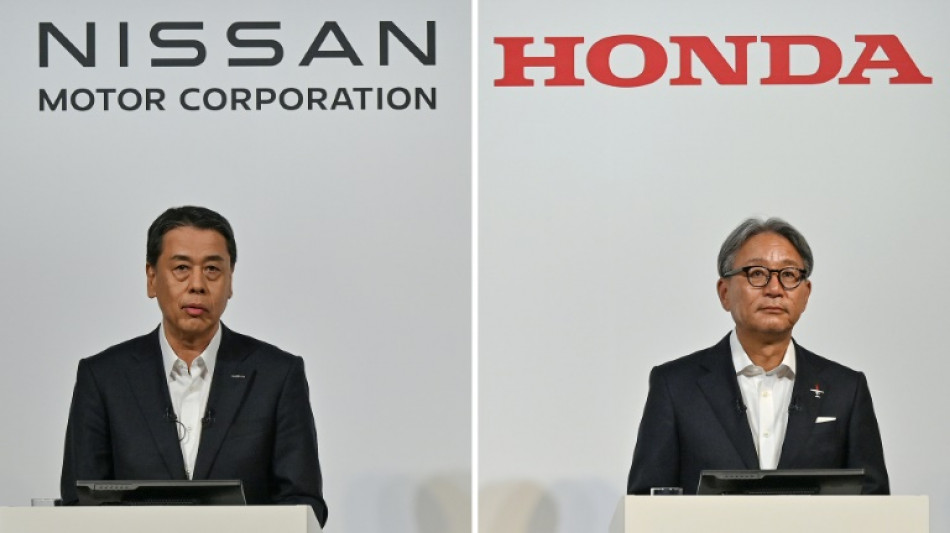
What next for Honda and Nissan? / Photo: Richard A. Brooks - AFP/File

 Argentina threatens to sanction oil projects around Falklands

 Gauff into round four at US Open after straight-set win

 Bordeaux hammer Racing in Top 14 start as Bielle-Biarrey extends deal

 Zheng, Potapova pull off upsets to reach US Open last 16

 Swiatek into US Open fourth round in tight two-setter

 Werro wins in Brussels, as Russell and Dos Santos shine

 Kolbe breaks jaw and shoulder injury sidelines Savea

 US military strikes oil tankers as Iran vows tougher reprisals

 Zheng rallies to stun Keys, Anisimova out in US Open third round

 Bayern held to draw by stubborn Schalke
 Lens lose again ahead of Champions League date

 Olympic champion Zheng storms home to reach US Open last 16
 Big-spending Spurs must make better attacking decisions, says De Zerbi

 South Africa dominate New Zealand in second half to lead series

 Kiefer Sutherland still in action, but ibuprofen lending helping hand
 'Are we ready?' Oasis film captures band's frosty reunion

 Commemoration held for late Bosnian Serb war criminal Ratko Mladic

 Haaland keeps new-look Man City perfect in Premier League, blunt Spurs held

 Alpine's Gasly takes shock pole for Italian Grand Prix

 Nwaneri helps Dortmund to comeback win on Bundesliga debut
 US military says destroys Iranian oil tankers after missile attacks

 US envoys in Moscow for Ukraine war negotiations

 Commemoration held for late Serbian war criminal Ratko Mladic

 Russell on top ahead of Hamilton in final Italian GP practice

 Motorsport governing body rejects Alpine boss's claims of impartiality

Honda and Nissan on Thursday announced the scrapping of merger talks that would have created the world's third-biggest auto company by unit sales behind Toyota and Volkswagen.
Here are some key points about why the Japanese companies explored a tie-up, the reasons for their failure, and where this leaves them in a difficult global auto industry.
- What is their history? -
Honda was founded in 1948 as a small factory making motorcycles and is now the world's biggest producer of the two-wheelers. It also makes 3.7 million four-wheel vehicles annually.
More than 40 percent of these were sold in North America last year, roughly 20 percent in China, 18 percent in Japan and three percent in Europe.
Nissan, founded in 1933, produced 3.1 million cars last year. North America accounts for 38 percent of its global sales, China 20 percent, Japan 14 percent and Europe 10 percent.
French automaker Renault took a 36.8 percent stake in the then loss-making firm in 1999 and Mitsubishi Motors joined the alliance 17 years later, with Nissan taking a 34-percent stake in its struggling Japanese rival.
But tensions emerged, stoked by the French state increasing its stake in Renault in 2015, followed by the 2018 arrest of Nissan boss Carlos Ghosn in Japan on suspicion of financial misconduct and his subsequent flight from the country.
In 2023, Renault sold part of its stake in Nissan as part of an alliance overhaul that saw them retain 15 percent cross-holdings.
- Why did they try to merge? -
Nissan has been struggling, last year reporting a 93-percent plunge in first-half net profit and axeing 9,000 jobs in November. It is also saddled with billions of dollars of debt.
For both companies, achieving economies of scale would have served to "enhance R&D capabilities, and better compete" in the areas of "advanced technologies including electrification and software-defined vehicles", said Tatsuo Yoshida, senior auto analyst at Bloomberg Intelligence.
Japanese carmakers have long lagged in the electric vehicle sector, especially against Chinese firms, with the country's leading EV-maker BYD last year selling more vehicles globally than Honda and Nissan.
The pair had already agreed on talks over partnership in electrification technologies and software development, and were later joined by Mitsubishi Motors.
- Why did merger talks fail? -
When the merger talks were announced in December the plan was that the two automakers along with Mitsubishi Motors would integrate their businesses under a new holding company.
But local media reports have said Honda, frustrated by its rival's slow decision-making on restructuring, wanted to make it a subsidiary, which Nissan's leadership found unacceptable.
"Nissan appears to be stressing its independence and freedom of (decision-making on) its strategy," which "for Honda's eyes may not maximise benefit of economy of scale," Mizuho Securities analyst Yoshitaka Ishiyama said.
- What happens next? -
In the long term at least, both firms will need to seek alternative partners as they look to get a leg-up in the technology race, analysts say.
"For Honda, there remains a concern about how to beef up its four-wheel vehicle business," said Seiji Sugiura, auto analyst at Tokai Tokyo Intelligence Laboratory.
"The fact that Honda executives had wanted to merge with Nissan means that they needed a close collaboration in R&D at a deeper level than an alliance, (which) involves sharing confidential company information," he added.
Nissan's position is worse, as it "faces significant challenges, including financial instability and the need to strengthen its position in the advanced technology battlefield", said Bloomberg's Yoshida.
Sugiura added that tech firm Foxconn "remains to be an option for Nissan".
Recent reports have said the Taiwanese giant, also known as Hon Hai, had been in talks with Renault over buying the French automaker's stake in the Japanese firm.
However, Sugiura added that a Foxconn-Honda tie-up was also possible "as it has technologies Honda wants".
And he added: "If Honda really wants Nissan's technology, it can launch a hostile takeover bid of Nissan."
R.Garcia--AT