Ecuadoran frogs Rocket and Harlequin taking on mining industry
/ Photo: Cristina Vega RHOR - AFP

 US envoys in Moscow as Russia and Ukraine vow not to hit capitals during talks

 Motorsport governing body rejects Alpine boss's claims of bias

 US envoy on West Bank visit says Israel has responsibility for Palestinians

 Ethiopian Miss World contestant spotlights pain of sister's murder

 'Leader' Raphinha rising to Barca striker challenge

 Oasis fans gather in Venice for band reunion film

 Two Nepal rescues revive hopes 10 days after flood

 Pogacar to miss worlds after season-ending Vuelta crash

 Greenwood, Guendouzi handed bans after Fenerbahce-Lyon brawl
 In Iceland, the mystery of the poet, the tomb and the Danish grocer
 Ratko Mladic: Bosnian Serb commander to convicted war criminal

 Bolivian army base blasts kill two, wound dozens

 Alcaraz, Sabalenka into US Open last 16 as Williams sisters lose on return

 Williams sisters fall in thrilling return to US Open doubles

 Bangladesh measles toll nears grim 1,000-child mark

 Bolivia farmers return to streets over diesel price hikes

 Panama Canal begins reducing crossings due to El Nino

 Trump again seeks to remove protections for wolves

 'Getting there' - Alcaraz into US Open last 16 along with Sabalenka

 Isak ready to show world his quality, says Van Dijk

 Stuttgart cruise past Cologne to bounce back from Bayern thumping

 'Smart, aggressive' Alcaraz into US Open last 16

 Isak fires Liverpool to first win under Iraola at Ipswich

 Stocks slip as robust US jobs data stokes rate hike odds

 Mistrial declared in case of US woman who killed her three children

On the banks of a crystalline waterfall, biologist Andrea Teran lets out a yelp.
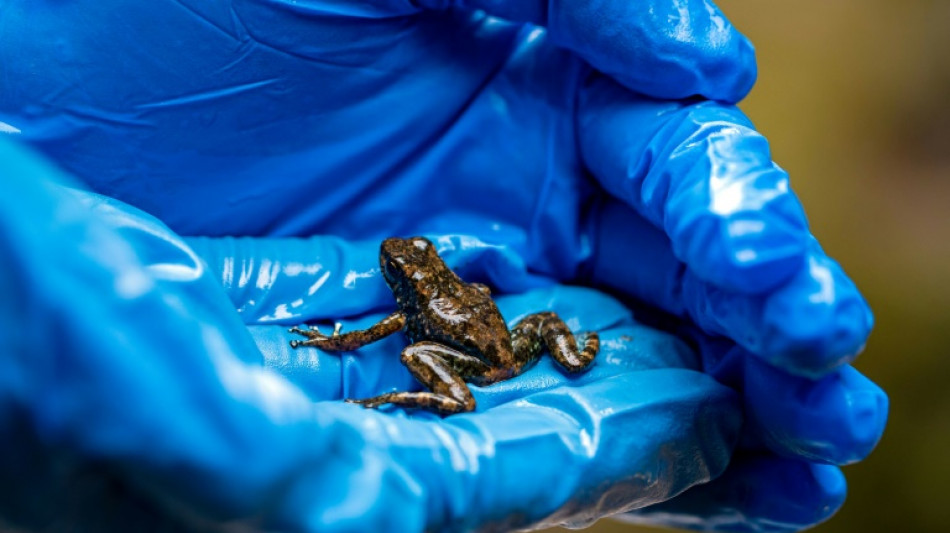
She holds in the palm of her hand one of two frog species at the center of a legal battle against Ecuador's mining industry.
Teran, 37, is a specialist in the fragile existence of a creature called the Resistance Rocket Frog, which does not yet have a scientific name, and the Longnose Harlequin (Atelopus longirostris), which was believed extinct for 30 years.
The discovery several years ago of these two tiny frogs measuring no more than four centimeters has become the central argument in opposition to a proposed nearly 5,000 hectare mining project in a native forest in Junin, Imbabura province, around three and a half hours north of Quito.
The Longnose Harlequin reappeared in 2016.
"It was a frog that came back from the dead," said an emotional Teran, whom AFP accompanied on an expedition in this forest area following a two-hour walk.
"If the water is polluted (by mining) the last populations of this frog will be lost," said the biologist from the Jambatu Center dedicated to the study and conservation of amphibians.
The Longnose Harlequin is extinct according to the International Union for the Conservation of Nature's (IUCN) red list.
But scientists rediscovered traces of life in this forest where the mineral exploitation license was granted to Ecuador's Enami and Chile's Codelco. They are due to begin in 2024 to extract 210,000 tons of copper a year.
In Ecuador, which launched a massive mining exploitation operation in 2019, there are at least 12 projects at advanced stages to mine reserves of 43.7 million ounces of gold, 46 billion pounds of copper and 183 million ounces of silver, according to the Spurrier Group consultancy.
But the 2019 discovery of a new species of rock frog has only intensified the desire to protect its forest habitat.
- Last hope -
In 2020, Teran launched a legal battle to prevent the mining project from going ahead.
Although she succeeded in the first instance, she then lost on appeal.
But the mining concession has also been challenged by a collective of Junin residents pointing to errors in the environmental impact studies, such as the lack of a protection plan for the two frog species.
"There are so many mistakes. They are violating the rights of nature, and on top of that the documents were never correctly communicated to the community and there was no environmental consultation," the file's lawyer Mario Moncayo told AFP.
But a judge rejected the claim of oversights.
Defenders of these two frogs can still appeal, which is perhaps their last hope of halting the mining project.
Contacted by AFP, both the government and the mining companies refused to comment.
- No solutions -
When the Jambatu Center scientists came across the new rocket frog species they initially mistook it for one called the Confusing Rocket Frog (Ectopoglossus confusus).
However, an anatomical difference in its tongue was found, and genetic studies allowed experts to identify it as a completely new Ectopoglossus species that they named "resistance."
"It lives in unique conditions, with the sound of the waterfall we don't know how it communicates, we don't know anything about its reproductive biology," said Teran.
Their skin contains great medicinal potential, and renders them extremely sensitive to environmental changes.
They are thus considered bioindicators, meaning that if the ecosystem is affected, they could disappear.
Protection of nature is enshrined in the constitution of Ecuador, which has 650 known species of frogs, 60 percent of which are in danger of extinction.
But the South American country derives six percent of its GDP from its oil and mining industries, according to the Central Bank.
"We are in a mega-diverse region and the decisions taken have to be mega-responsible," said Teran.
It's an issue that divides opinion in Junin.
"If authorities value the species that live here then they need to halt" the mining project, said farmer Hugo Ramirez, 40.
But for carpenter Pedro Vallejos, 63, environmentalists are offering no solutions to end poverty.
"There's no employment in the countryside, there are no alternatives," he said.
T.Perez--AT