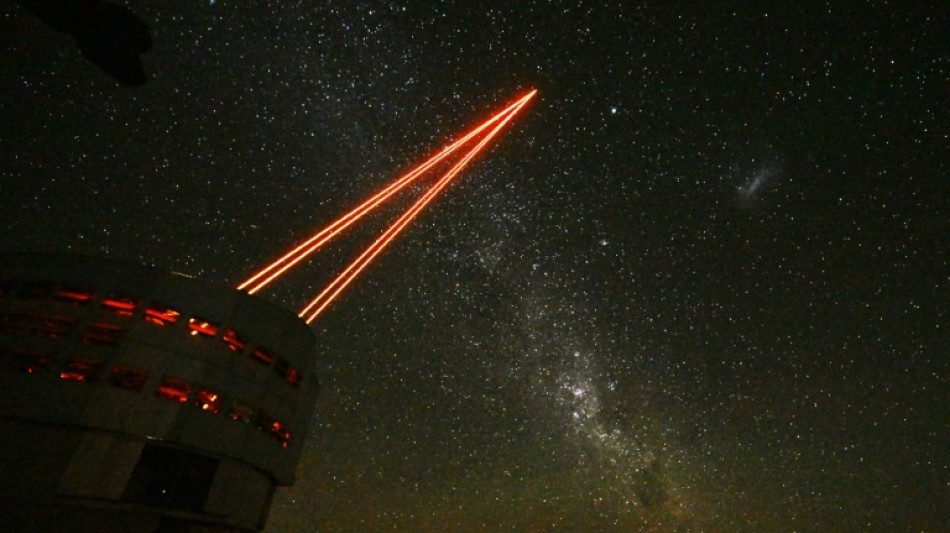
Could a climate megaproject cloud Chile's unparalleled views of universe? / Photo: RODRIGO ARANGUA - AFP

 Kiss's winning run ends as Argentina hold Australia to draw
 Alcaraz excited to face 'dangerous' Paul for US Open quarter-final berth

 Prince William to represent King Charles III at Norway late King Harald's funeral

 Inter and Roma roar back to win thrillers and share top spot

 Don't stop them now: fans party for Freddie Mercury's 80th birthday

 AFP photographer wins top prize for Madagascar protest coverage

 Keys: 'I felt like I couldn't play tennis'

 Simmonds stars as Pau upset Montpellier

 Inter roar back in five-goal thriller with Napoli

 Haaland keeps Man City perfect in Premier League, blunt Spurs held

 Hamilton worried by Ferrari pace while Antonelli prepares for a fight

 Vuelta stage 15 shortened due to extreme heat, Mas consolidates lead

 Putin meets US envoys for Ukraine war talks

 Modric available for Croatia in Nations League

 Potapova upsets 2025 US Open runner-up Anisimova
 Gasly a 'class act' says Alpine boss after Monza pole
 Athletic Bilbao crush Simeone's flat Atletico

 Stay far from battlefield, warns Japanese director in Vietnam War film

 Tens of thousands of Croatians protest over hazardous waste
 Haaland heads unconvincing Man City top of Premier League

 US envoys in Moscow as Russia and Ukraine vow not to hit capitals during talks

 Motorsport governing body rejects Alpine boss's claims of bias

 US envoy on West Bank visit says Israel has responsibility for Palestinians

 Ethiopian Miss World contestant spotlights pain of sister's murder
 'Leader' Raphinha rising to Barca striker challenge
As night falls on the Atacama desert in northern Chile four giant telescopes turn their gaze towards the star-strewn heavens.
The driest place on Earth is the best place to observe the universe, with darkness offering dazzling spectacles of cosmic wonder.
The area is home to the Paranal Observatory, which houses the European Southern Observatory's Very Large Telescope, used by astronomers to search the Milky Way with "unparalleled clarity," according to Spanish astrophysicist Itziar de Gregorio.
Perched at 2,635 meters (8,645 feet) above sea level, and located dozens of kilometers (miles) from the nearest town of Antofagasta, Paranal's unique atmospheric conditions make it one of the most productive observatories in the world.
The Very Large Telescope -- made up of four individual telescopes -- produced the first ever image of an exoplanet (a planet outside our solar system) in 2004.
But a huge green energy project, part of Chile's plans to become carbon neutral, risks clouding the view, scientists say.
Latin America's fifth-largest economy aims to phase out fossil fuels by 2050, replacing them with renewable energy sources, which can also be used to produce green hydrogen.
Green hydrogen, a clean method of generating electricity, has been touted as a means to help decarbonize Chile's crucial copper mining sector, among other industries.
AES Andes, the Chilean subsidiary of US energy company AES Corporation, has submitted proposals for a 3,000-hectare (7,400-acre) site in the Atacama desert near Paranal to harness solar and wind energy, which in turn can be used to produce green hydrogen and ammonia, a gas used in making fertilizers.
But scientists say the artificial light from such a facility could obscure some of the celestial phenomena observed at Paranal, such as eclipses and meteorite showers.
They worry it could also endanger the functioning of the ESO's Extremely Large Telescope, billed as the world's "biggest eye on the sky," currently under construction near the Paranal Observatory.
The stadium-sized telescope is slated to be completed by 2028.
De Gregorio, the ESO's representative in Chile, warns that the country's unique "window onto the universe" could close, hampering scientists' quest to answer the great question of our time: Are we the only intelligent life form in the universe?
- Like 'a tap running' -
Chile, home to around 70 percent of the world's telescopes, has long been seen as a hub for stargazers.
By day, astronomers at Paranal crunch numbers. By night, they explore the galaxy.
The observatory's research covers almost all celestial phenomena, from planets and exo-planets to black holes and near-Earth comets, Steffen Mieske, the head of the site's scientific operations, said.
That work could be jeopardized if the night sky brightens, even a fraction.
"Light pollution is the main threat to astronomy because it affects the quality of the observable sky," the Skies of Chile Foundation, which works to preserve the quality of the country's night skies, argues.
"When you see a tap running, you realize you're wasting water. But if you see a place lit up brightly at night, you don't think of it as pollution," the foundation's director Daniela Gonzalez said.
AES Andes, in a statement, assured that its hydrogen and ammonia project, codenamed Inna, conformed to the "highest norms in terms of lighting," including a new Chilean rule aimed at protecting astronomy sites from skyglow.
It has rejected Paranal's claim that it would be within 11 kilometers of the observatory, saying the distance would be around twice that.
A group of 40 astronomers, scientists and poets have called for the establishment of a "light exclusion zone" around Paranal, to keep it pitch-black at night.
The Inna project, which is currently awaiting an environmental permit, is not expected to be licensed for another two or three years.
A.Ruiz--AT