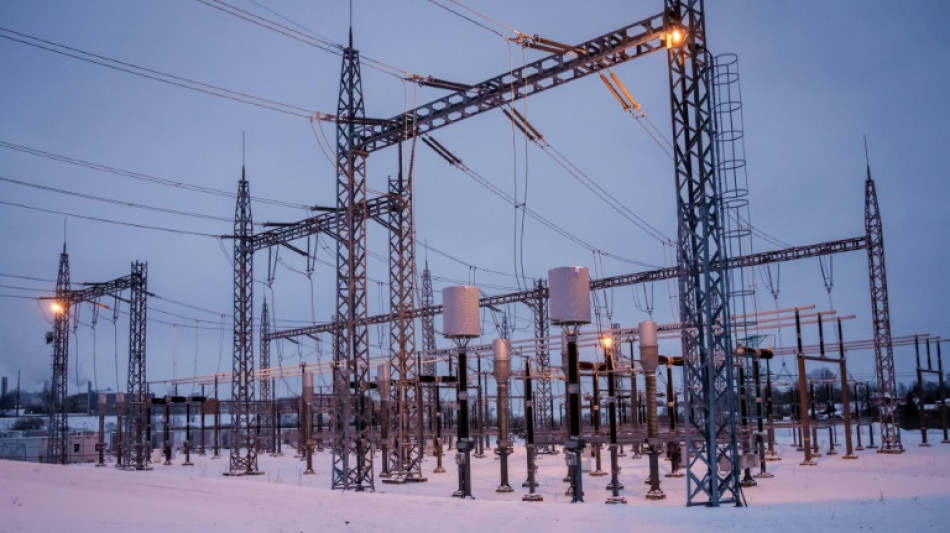
Baltic nations 'successfully' link with European power grid / Photo: Gints Ivuskans - AFP

 Zheng stuns Keys as US Open upsets dim American hopes

 Jovic 'loses sanity five times over' to oust Eala and book Gauff clash

 'Like a jewel': Japan's luxury ice revered by bars worldwide

 'The flood is coming': How a Nepal principal saved 900 students

 Kiss's winning run ends as Argentina hold Australia to draw
 Alcaraz excited to face 'dangerous' Paul for US Open quarter-final berth

 Prince William to represent King Charles III at Norway late King Harald's funeral

 Inter and Roma roar back to win thrillers and share top spot

 Don't stop them now: fans party for Freddie Mercury's 80th birthday

 AFP photographer wins top prize for Madagascar protest coverage

 Keys: 'I felt like I couldn't play tennis'

 Simmonds stars as Pau upset Montpellier
 Inter roar back in five-goal thriller with Napoli

 Haaland keeps Man City perfect in Premier League, blunt Spurs held

 Hamilton worried by Ferrari pace while Antonelli prepares for a fight

 Vuelta stage 15 shortened due to extreme heat, Mas consolidates lead

 Putin meets US envoys for Ukraine war talks

 Modric available for Croatia in Nations League

 Potapova upsets 2025 US Open runner-up Anisimova

 Gasly a 'class act' says Alpine boss after Monza pole

 Athletic Bilbao crush Simeone's flat Atletico
 Stay far from battlefield, warns Japanese director in Vietnam War film

 Tens of thousands of Croatians protest over hazardous waste

 Haaland heads unconvincing Man City top of Premier League

 US envoys in Moscow as Russia and Ukraine vow not to hit capitals during talks
The three Baltic states successfully connected to the European power grid Sunday after severing Soviet-era links with Russia's network, a shift that EU chief Ursula von der Leyen hailed as "freedom from threats and blackmail".
Estonia, Latvia and Lithuania -- former Soviet states that are now EU and NATO members -- have been planning the switch for years but had been particularly keen to do so since Russia invaded Ukraine in 2022.
The small Baltic countries fear that they too could be targeted. The staunch Ukraine supporters had also worried that Russia would weaponise the electricity grid against them.
"Moments ago, I received great news," Lithuanian President Gitanas Nauseda told reporters in Vilnius, alongside his Estonian, Latvian and Polish counterparts and von der Leyen.
"The synchronisation of the Baltic states' electricity system with the continental European system has been successfully completed... We have achieved full energy independence," he said.
Nauseda also posted a video to X of the moment he received confirmation of the grid connection. "Goodbye Russia, goodbye Lenin," he said on the phone, before von der Leyen and others applauded.
Von der Leyen told reporters 'today history is made".
"Electricity lines with Russia and Belarus are being dismantled. These chains of power lines linking you to hostile neighbours will be a thing of the past," she said.
"This is freedom, freedom from threats, freedom from blackmail."
A total of 1.6 billion euros ($1.7 billion) -- mostly EU funds -- have been invested in the synchronisation project across the Baltic states and Poland.
The Baltics integrated into the European grid via Poland.
- 'Emancipation' -
Polish President Andrzej Duda called the synchronisation "a milestone development... for the entire European Union".
"It is the final step towards emancipation from the post-Soviet sphere of dependence," he added.
Nauseda called for "substantial action at the European Union level" to improve the resilience of the Baltic states' critical infrastructure.
"Now is the time to secure our achievements. Russia's war against Ukraine has radically transformed the perception of the threats to the critical infrastructure in Europe," he said.
"Recent incidents involving undersea infrastructure in the Baltic Sea provide a matter of great concern. And a call for resolute action, as well."
Several undersea telecom and power cables have been severed in the Baltic Sea in recent months.
Some experts and politicians have accused Russia of waging a "hybrid war", including the unconventional targeting of energy supplies, an allegation Moscow denies.
The Baltics had long planned to integrate with the European grid but faced technological and financial issues before the Ukraine war gave the project a jolt of urgency.
They stopped purchasing Russian gas and electricity after the invasion but their power grids remained connected to Russia and Belarus, and so controlled from Moscow.
This left them dependent on Moscow for a stable electricity flow, which is crucial for factories and facilities requiring a reliable power supply.
- 'No surprises' -
The Baltic states disconnected from the Russian grid on Saturday morning.
They then operated as a so-called "energy island" while running tests to assure Europe their system was stable.
The Baltic grid operators said all tests had gone as planned.
Ukrainian Energy Minister German Galushchenko hailed the disconnection as a "significant event for the whole of Europe".
"Such steps deprive the aggressor of the opportunity to use the electricity sector for blackmail and political games," he said Saturday.
Authorities had warned of the potential for sabotage or other disruptions linked to the grid switch, but the disconnection went off without a hitch.
The Baltic grid operators said Russia had cooperated during the process.
Latvian operator AST told AFP the biggest surprise Saturday was "that there were no surprises".
Latvian police said they had recorded no incidents related to the grid switch.
Lithuanian engineer Aras Valiukas, 45 called the event "symbolic".
"We have disconnected from the Soviet Union," he told AFP in downtown Vilnius.
A.Moore--AT