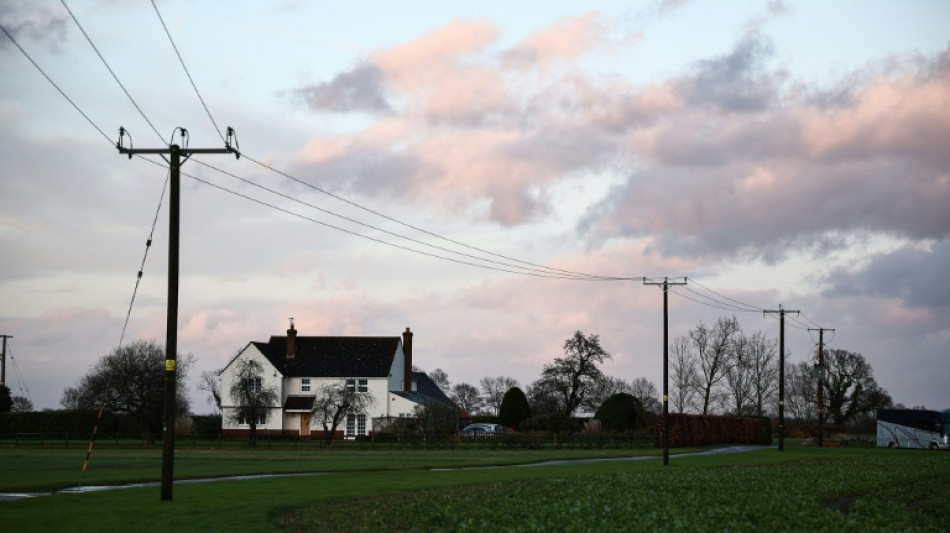
In the English countryside, a pylon war looms / Photo: HENRY NICHOLLS - AFP

 Zheng stuns Keys as US Open upsets dim American hopes

 Jovic 'loses sanity five times over' to oust Eala and book Gauff clash

 'Like a jewel': Japan's luxury ice revered by bars worldwide

 'The flood is coming': How a Nepal principal saved 900 students

 Kiss's winning run ends as Argentina hold Australia to draw
 Alcaraz excited to face 'dangerous' Paul for US Open quarter-final berth

 Prince William to represent King Charles III at Norway late King Harald's funeral

 Inter and Roma roar back to win thrillers and share top spot

 Don't stop them now: fans party for Freddie Mercury's 80th birthday

 AFP photographer wins top prize for Madagascar protest coverage

 Keys: 'I felt like I couldn't play tennis'

 Simmonds stars as Pau upset Montpellier

 Inter roar back in five-goal thriller with Napoli

 Haaland keeps Man City perfect in Premier League, blunt Spurs held

 Hamilton worried by Ferrari pace while Antonelli prepares for a fight

 Vuelta stage 15 shortened due to extreme heat, Mas consolidates lead

 Putin meets US envoys for Ukraine war talks

 Modric available for Croatia in Nations League

 Potapova upsets 2025 US Open runner-up Anisimova

 Gasly a 'class act' says Alpine boss after Monza pole

 Athletic Bilbao crush Simeone's flat Atletico

 Stay far from battlefield, warns Japanese director in Vietnam War film

 Tens of thousands of Croatians protest over hazardous waste

 Haaland heads unconvincing Man City top of Premier League

 US envoys in Moscow as Russia and Ukraine vow not to hit capitals during talks

Standing by his winter wheat field on a plot of land where tall electricity pylons are set to be built, John Stacey feels far from bright about the future.
"They will cut our farm in half," he told AFP referring to the large metal structures due to be erected across Witham, northeast of London, by the start of the next decade.
Part of a multibillion pound project approved by the UK government, it has pitted residents like farmer Stacey against those seeking to upgrade Britain's energy infrastructure.
The four pylons planned for his land are to be operated by National Grid, a privately-run company responsible for transporting electricity in England and Wales.
Once installed, they will carry power from wind and solar farms to London.
For Stacey, in his 60s, the construction on his land threatens not just where he works but also his home.
"I had long term visions of staying here for my retirement and my family running the farm," he said as seagulls flew overhead close to the North Sea.
"Can I live here with pylons and the noise they may make? Probably not," he said, adding he sees "no hope" the Labour government will scrap the plans.
National Grid has assured it will listen to the viewpoints of those effected to "limit the impact" of the pylons.
At the same time, National Grid deputy director Tom McGarry insisted the country needs "rewiring" following the closure of coal-fired power stations.
Labour sees the pylons as essential to help deliver net zero carbon emissions and improved energy security.
- Unprecedented scale -
The Witham project would be on the route to the Bramford substation, whose rows of pylons on land the size of nearly 20 football pitches emit a persistent humming.
Residents are concerned about an expansion already attracting firms to build necessary grid-linked infrastructure.
A large solar farm is under construction nearby, as is a large warehouse serving as a connection point for offshore wind turbines.
National Grid plans to invest £35 billion ($44 billion) by 2031 to transform its electricity network, a project of an unprecedented scale since the 1960s.
New production sites are in more remote areas, which means "building a lot of new transmission lines to bring that power back to population centres", noted Stephen Jarvis, a researcher at the London School of Economics.
"Some big investments are needed, not just in the UK, this is a pretty global phenomenon," he said.
Opposition groups argue that while new connections may be necessary, alternative projects such as cables buried under land and sea -- and with closer proximity to London -- have not been seriously considered.
The projects are being carried out "without consulting with communities first," said Rosie Pearson, founder of an action group for local residents in East Anglia.
- 'Pylon war' -
In a small cafe near the village of Ardleigh, east of London, Pearson met with a group of pylon opponents, whose concerns ranged from the impact on biodiversity to inadequate compensation for property owners.
There is opposition also to having 50-metre high pylons blocking picturesque views.
The group crowded around a table looking at highly detailed maps of future electric lines.
"It's the beginning of a very big pylon war," said Pearson, who is ready to fight in court to prove that other cheaper solutions are viable.
Prime Minister Keir Starmer, who came to power in July, has promised to override those he sees as "blockers" preventing big new infrastructure projects and the reform of Britain's restrictive planning rules.
"Securing Britain's clean energy future will require improving infrastructure in a cost-effective way," a government spokesperson told AFP.
"Underground cabling is more expensive, and costs are borne by the electricity billpayer," they added.
W.Morales--AT