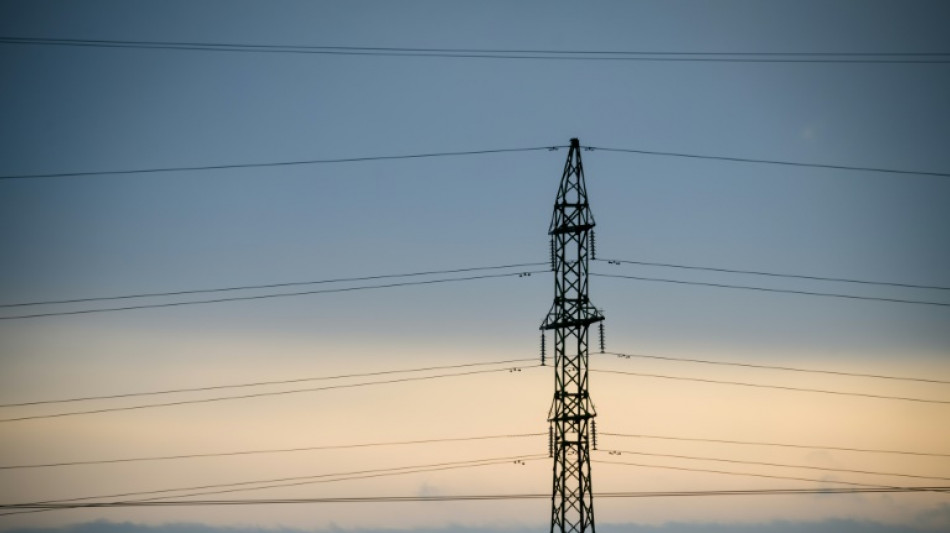
Baltics to cut Soviet-era ties to Russian power grid / Photo: Gints Ivuskans - AFP

 US aircraft carrier departs Thailand after port call

 Haze emergency grips Malaysian Borneo town

 Messi creates both Miami goals in 2-2 draw with Atlanta
 Rybakina books US Open fourth-round berth, inches closer to No. 1

 Sobering reality: Curbs on alcohol in northeast Syria cause discontent

 Wobbly Osaka 'shocked' to battle past Mertens and reach last 16

 Indian Oscar-nominated filmmaker turns camera on his cancer

 Argentina 'let off hook' by Australia as Kiss's winning run ends

 Argentina threatens to sanction oil projects around Falklands

 Gauff into round four at US Open after straight-set win
 Bordeaux hammer Racing in Top 14 start as Bielle-Biarrey extends deal

 Zheng, Potapova pull off upsets to reach US Open last 16

 Swiatek into US Open fourth round in tight two-setter

 Werro wins in Brussels, as Russell and Dos Santos shine

 Kolbe breaks jaw and shoulder injury sidelines Savea

 US military strikes oil tankers as Iran vows tougher reprisals

 Zheng rallies to stun Keys, Anisimova out in US Open third round

 Bayern held to draw by stubborn Schalke

 Lens lose again ahead of Champions League date

 Olympic champion Zheng storms home to reach US Open last 16
 Big-spending Spurs must make better attacking decisions, says De Zerbi

 South Africa dominate New Zealand in second half to lead series

 Kiefer Sutherland still in action, but ibuprofen lending helping hand

 'Are we ready?' Oasis film captures band's frosty reunion

 Commemoration held for late Bosnian Serb war criminal Ratko Mladic

Baltic states Lithuania, Latvia and Estonia are to disconnect from the Russian power grid on Saturday, a politically-charged move that severs their Soviet-era energy ties with Moscow.
A giant digital clock in the Lithuanian capital, Vilnius, is counting down the hours until the states join the western European power grid. "We are now removing Russia's ability to use the electricity system as a tool of geopolitical blackmail," Lithuania's Energy Minister Zygimantas Vaiciunas told AFP.
Official celebrations are planned across the Baltics, although some consumers worry about disruptions to supply.
Latvia will physically cut a power line to Russia on Saturday and European Commission president Ursula von der Leyen is to attend a ceremony with Baltic leaders in Vilnius on Sunday.
"This is the last step in our fight for energy independence. We can finally take matters into our own hands," Vaiciunas said.
The Baltic states were once Soviet republics but are now part of the European Union and key NATO members on the frontier with Russia.
They have been preparing to integrate with the European grid for years but have faced technological and financial issues.
The switch became more urgent after Russia invaded Ukraine in 2022, which spooked the Baltic states into thinking they could be targeted.
They stopped purchasing Russian gas and electricity after the invasion but their power grids remained connected to Russia and Belarus, controlled from Moscow.
This left them dependent on Moscow for a stable electricity flow, which is crucial for factories and facilities requiring a reliable power supply.
After Saturday, the three states will regulate their own supply.
"So far, Russia has been able to use energy as a weapon, creating the risk of unplanned electricity disruptions driven by political decisions," Vaicunas said.
- 'In sync with Europe' -
After the Baltic states disconnect from the Russian power grid at 0700 GMT on Saturday, the three countries will operate in so-called "isolated mode" for about 24 hours to test their frequency, or power levels.
"We need to carry out some tests to ensure Europe that we are a stable energy system," said Rokas Masiulis, head of Lithuania’s state-run grid operator, Litgrid.
"We'll switch power stations on and off, observe how the frequency fluctuates and assess our ability to control it," he said.
The states will then integrate into the European power grid via Poland.
"In simple terms, the only change will be that our frequency will start fluctuating in sync with Europe," Masiulis said.
Lithuania has warned of potential risks linked to the change.
"Various short-term risks are possible, such as kinetic operations against critical infrastructure, cyber-attacks and disinformation campaigns," the country's state security department told AFP in a statement.
Poland's power grid operator PSE said it will use helicopters and drones to patrol the connection with Lithuania.
Several undersea telecom and power cables have been severed in the Baltic Sea in recent months. Some experts and politicians have accused Russia of waging a hybrid war, an allegation Moscow denies.
- Generator sales increase -
A total of 1.6 billion euros ($1.7 billion) has been invested in the synchronisation project across the Baltic states and Poland.
Vaiciunas said consumers should not see disruptions during the change. "I do not expect any supply interruptions," he said.
But sales of generators have shot up in Estonia as some consumers worry about power cuts.
"January sales numbers show a clear rise in interest towards generators," Margo Pruunlep, sales and marketing director at home improvement store Ehituse ABC, told AFP.
Priit Vaio, director of corporate sales and e-commerce at home improvement store, Bauhof, said: "In January 2025, generator sales rose several dozen times compared to the same time last year."
The Baltic states are meanwhile ramping up domestic energy production capacity, including with offshore wind farms in the Baltic Sea.
After the Baltic decoupling, the energy system in the Russian enclave of Kaliningrad will lose its grid connection to mainland Russia.
Kaliningrad has been building up power generation capacity for years and Kremlin spokesman Dmitry Peskov dismissed all concerns.
Asked about the cut-off last week, he said: "We have taken all measures to ensure the uninterrupted reliable operation of our unified energy system."
W.Moreno--AT