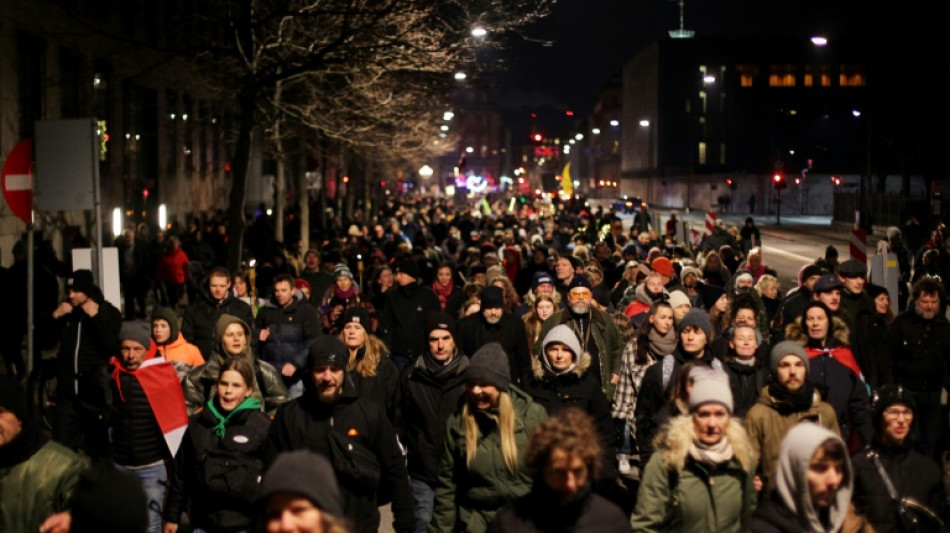
Denmark returns to 'life as we knew it' despite Omicron

 Hunger and malnutrition stalk Gazans, a year on from ceasefire

 Fernandez trumps MotoGP championship duo to grab Indonesia pole

 October 7 scars push Israel's first-time voters to right
 India deploys police, restricts transport ahead of major protest

 Three Mexicans convicted in murders of Australian, US surfers

 Powerful waves lash California coast as storm threatens more damage

 Trump hails Russia deal to release diesel as midterms loom

 Lyon blow chance to go top after loss at Lens
 Stocks rise as Trump says Russia to release diesel to world markets

 Wildfire smoke shuts schools in Amazon's biggest city

 Turkey jails 2 journalists pending trial for fund crisis 'misinformation'

 Major earthquake rocks Panama, triggers tsunami warning

 Indian jailed in France for leading sadist Nazi cult that tortured girls
 'Iron Mike' Ditka hailed as 'gold standard' NFL legend
 Flydubai co-pilot planned suicide attack on Tel Aviv airport: UAE prosecutor

 Mike Ditka: Chicago Bears icon as player and coach

 Outrage over plan to livestream US military firing squad execution

 US sanctions: a 'test of resilience' for ICC
 NFL legend Mike Ditka dead at 86
 Hurricane Isaias set to strike Gulf Coast late Friday

 Trump forms panel to probe US Fed governor Lisa Cook

 Clashes in Durban as fresh anti-migrant riots erupt in South Africa

 France students plan more protests, UN 'concerned' over violence

 De Zerbi calls on struggling Spurs to react in Man Utd clash

 US sanctions on ICC: a 'test of resilience'

Denmark on Tuesday becomes the first European Union country to lift all of its Covid restrictions despite record numbers of cases, relying on its high vaccination rate to cope with the milder Omicron variant.
After a first attempt at lifting all its restrictions between September and November, the Scandinavian country is once again ditching its facemasks, Covid passes and limited opening hours for bars and restaurants.
"I'm so happy that this is all going to be over tomorrow. It's good for life in the city, for nightlife, just to be able to be out longer", 17-year-old student Thea Skovgaard told AFP the day before the lifting.
Nightclubs reopen on Tuesday, when limits on the number of people allowed at indoor gatherings also come to an end.
Only a few restrictions remain in place at the country's borders, for unvaccinated travellers arriving from non-Schengen countries.
The easing comes as Denmark registers around 40,000-50,000 new Covid cases a day, or almost one percent of the country's 5.8 million inhabitants.
"We have an extremely high coverage of adults vaccinated with three doses," epidemiologist Lone Simonsen of the University of Roskilde told AFP.
More than 60 percent of Danes have received a third dose -- one month ahead of health authorities' schedule -- compared to an EU average of just under 45 percent.
Including those who have recently had Covid, health authorities estimate that 80 percent of the population are protected against severe forms of the disease.
"With Omicron not being a severe disease for the vaccinated, we believe it is reasonable to lift restrictions", Simonsen said.
The broad spread of the Omicron variant is also expected to lead to a "more robust and long-lasting immunity", helping the country fend off future waves, she said.
Two years after the outbreak of Covid-19, the Danish strategy enjoys broad support at home.
In a poll published Monday by daily Politiken, 64 percent of Danes surveyed said they had faith in the government's Covid policy.
- Personal responsibility -
Going forward, Danes are being urged to exercise personal responsibility, Simonsen said.
"Without a Covid pass there will be a shift of responsibility", she said.
Danes have increasingly used home tests to detect infection, but these are now being phased out and instead, anyone with symptoms is advised to stay home.
The Danish Health Authority currently "recommends" those who test positive to isolate for four days, while contact cases no longer need to quarantine.
Facemasks and the Covid pass are also recommended for hospital visits.
The government said it does not expect to have to revert to new closures again but has remained cautiously optimistic.
"We can't provide any guarantees when it comes to biology", Prime Minister Mette Frederiksen said last week when announcing the country's return "to life as we knew it before corona".
"It's really nice that this is ending but will we really live without any restrictions now? I doubt it," said Cille Hjort, a fast-food vendor eager to see her patrons' faces without masks again.
This is the second time Denmark has tried to return to a pre-pandemic lifestyle.
On September 10, the country lifted all its restrictions, before reintroducing some of them in early November.
Museums, cinemas and theatre and concert venues then closed just before Christmas, and reopened again in early January.
Faced with a lower level of hospitalisations than in previous waves, several European countries, including France, Ireland and the United Kingdom, have announced the lifting or a considerable reduction of their restrictions, despite record or very high cases.
"Two years into the pandemic, populations in most countries have reached high levels of immunity, from vaccines or natural illness", Simonsen said.
"This is how it ends, judging from what we have seen with historical pandemics".
According to the World Health Organization, 73 percent of the European population has contracted Covid-19 at least once since January 2020.
Tyra Krause of Denmark's public health and research institution SSI said meanwhile she expected Covid-19 to return in regular waves, "like the flu".
"We may end up having to vaccinate risk groups ahead of the autumn to prevent severe cases", she told science magazine Videnskab.
R.Garcia--AT