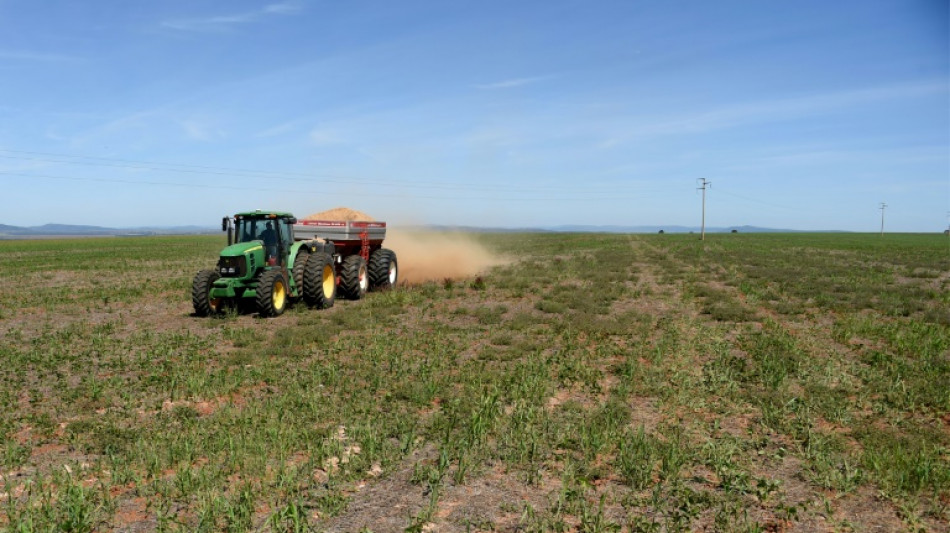
Ukraine war pushes Brazil toward natural fertilizers / Photo: EVARISTO SA - AFP

 Trump envoys arrive in Kyiv for first Ukraine visit

 Indonesia's main airport suspends operations after volcanic eruption

 US aircraft carrier departs Thailand after port call

 Haze emergency grips Malaysian Borneo town

 Messi creates both Miami goals in 2-2 draw with Atlanta

 Rybakina books US Open fourth-round berth, inches closer to No. 1

 Sobering reality: Curbs on alcohol in northeast Syria cause discontent

 Wobbly Osaka 'shocked' to battle past Mertens and reach last 16

 Indian Oscar-nominated filmmaker turns camera on his cancer

 Argentina 'let off hook' by Australia as Kiss's winning run ends

 Argentina threatens to sanction oil projects around Falklands

 Gauff into round four at US Open after straight-set win

 Bordeaux hammer Racing in Top 14 start as Bielle-Biarrey extends deal

 Zheng, Potapova pull off upsets to reach US Open last 16

 Swiatek into US Open fourth round in tight two-setter

 Werro wins in Brussels, as Russell and Dos Santos shine

 Kolbe breaks jaw and shoulder injury sidelines Savea

 US military strikes oil tankers as Iran vows tougher reprisals

 Zheng rallies to stun Keys, Anisimova out in US Open third round

 Bayern held to draw by stubborn Schalke

 Lens lose again ahead of Champions League date

 Olympic champion Zheng storms home to reach US Open last 16

 Big-spending Spurs must make better attacking decisions, says De Zerbi

 South Africa dominate New Zealand in second half to lead series

 Kiefer Sutherland still in action, but ibuprofen lending helping hand

Fearing Russia's invasion of Ukraine will disrupt its crucial supply of fertilizer imports, agricultural powerhouse Brazil is increasingly turning to natural alternatives.
Brazil, a top producer of soy, corn, cotton, sugarcane and coffee, is the world's fourth-biggest consumer of so-called "NPK" chemical fertilizers -- nitrogen-, phosphorus- and potassium-based.
It imports around 80 percent of its total supply -- and 25 percent of that from Russia, whose exports have now been targeted by Western sanctions over the Ukraine invasion.
That is causing farmers in the South American giant to turn to alternatives, including remineralizers, or "agrominerals" -- pulverized, nutrient-rich rocks that are spread on fields before planting.
Brazil, which authorized remineralizers for agricultural use in 2013, is the world leader in the technique, which is also used in the United States, Canada, India and France, among others.
"Brazil is a tropical country, and the rains tend to wash away soil nutrients. Rock powder rebuilds the soil and renews it," says Marcio Remedio, mineral resources director at the Brazilian Geological Service.
The technique also "allows plants' roots to develop better and capture the nutrients they need to grow," says Suzi Huff Theodoro, a geologist at the University of Brasilia.
"We have rocks with the right profile in various parts of the country, and the cost is significantly cheaper" than chemical fertilizers, she told AFP.
- Beyond chemicals -
A study last year found around five percent of farmland in Brazil used remineralizers.
That figure looks set to jump this year: the country's 30 suppliers report they are seeing unprecedented demand, says Theodoro.
"Most of them have already sold their entire output for the year, to all kinds of farms -- from industrial to mid-sized to small and mostly ecologically minded," she says.
Farmer Rogerio Vian has almost stopped using chemical fertilizers altogether.
Vian, who runs a 1,000-hectare (nearly 2,500-acre) soy and corn farm in the central-western state of Goias, was an early adopter of alternative technologies.
He started out nine years ago making his own products from microorganisms found in native forests.
He pulverized them and applied them while planting to protect against parasites and help his crops absorb nutrients.
Now Vian, who founded the 700-member Association for Sustainable Agriculture (GAAS), is using remineralizers, too.
"I've cut my fertilizer and seed treatment costs by 50 percent, with no loss of productivity," he says.
"Brazil is a mega-biodiverse country, and that holds enormous potential in terms of tools and techniques for our work, which we're only just starting to discover."
- 'Unstoppable change' -
Brazil will still be using NPK fertilizers for the foreseeable future, but it could dramatically reduce its dependence on foreign suppliers, says researcher Jose Carlos Polidoro of the state-owned Brazilian Agricultural Research Corporation (Embrapa).
"Organic and organomineral fertilizers -- made with mining residue, organic agro-industrial residue and sewage sludge -- account for five percent of the Brazilian fertilizer market today," he says.
"But they have the potential to reduce our imports by 20 percent."
Another fast-growing technique: treating crops with rhizobacteria, which draw nitrogen from the air and deliver it directly to plants, helping them grow -- and reducing the consumption of industrial nitrogen-based fertilizers.
Not that the farmers rapidly adopting these products have an easy row to hoe.
"Farmers are running into difficulty finding financing to invest more, and there's a shortage of technical assistance available," says Carlos Pitol, an agricultural consultant in the central-western state of Mato Grosso do Sul and a member of GAAS.
"But the change in the production system is growing, and it's unstoppable."
P.Hernandez--AT