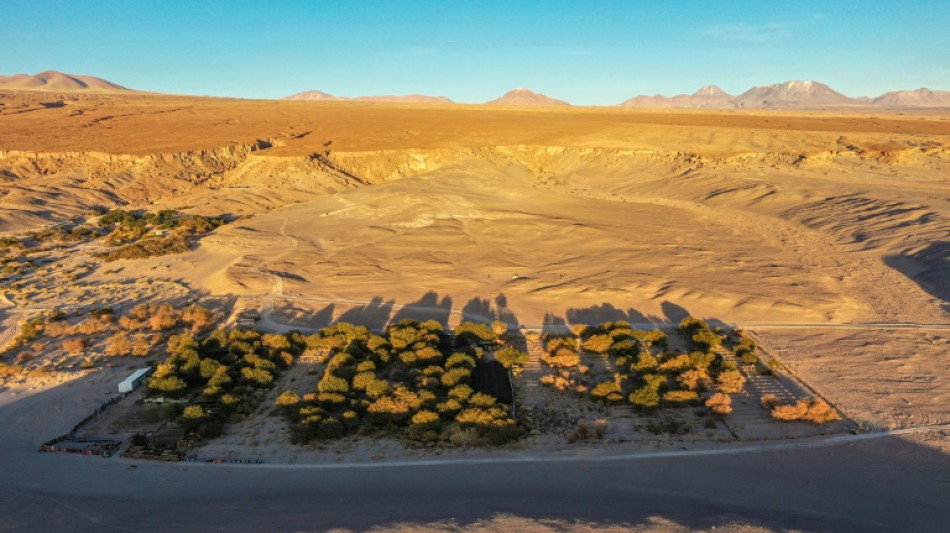
'Kind of complicated': Growing grapes in the world's driest desert / Photo: MARTIN BERNETTI - AFP/File

 Neo Group Launches Mutual Fund to Expand Financial Services Platform

 Michigan Pizza Driver Halts $785K GoFundme After Viral Prank

 British Doctor Evacuated to London Isolation Unit After Ebola Contracted in Congo

 Gladstone Investment Corporation Acquires Majority Stake in McFarlane Toys

 Watermelon Z Strain Guide Clarifies Conflicting Breeder Information and Genetic Lineage

 Patterson-UTI Reports Drilling Activity for October 2026

 IRS Reports a Record $5.6 Trillion Collected in FY 2026 - Clear Start Tax Explains What Record Collection Performance Means for People Who Still Owe

 RAEK Unveils New Designs for Creator Vault, Its First Private AI Appliance

 Moderna Reports Third Quarter 2026 Financial Results and Provides Business Updates

 BioScience Health Innovations, Inc. Announces Its Subsidiary Vitalcore Research has Executed Master Distribution Agreement with Rule Imports
 SMX: Plastic Recycling is no Longer a Favor; it's a Must

 Pebble Beach Concours d'Elegance Reaches $50 Million in Charitable Giving

 Nathan Charnes Elected 45th President of the PGA of America
 OSR Health Exercises $15 Million VXM01 Equity Option, Elects Settlement Through Staged Convertible Notes
 Prometheus Laboratories Presents Research Showing Superior Performance of MASH Precis Fibrosis Score in Identifying Treatment-Eligible Patients

 Plastic Recycling has a New Passport; SMX is the Stamp

 Maxon Expands Creative Possibilities with New Touch and Spatial Experiences in Cinema 4D and ZBrush for Apple Products

 Globa Terra Acquisition Corporation Reports Encouraging Investor Support Ahead of November 9 Extension Vote

 South Korea Proposes Fourth Delay of Cryptocurrency Gains Tax to 2029

 ASIC Fines Mona Museum Owner $198,000 for Late Financial Report
 Business Leaders Criticize Productivity Commission Inquiry Scope

 Kate McClymont Testifies at Alan Jones Trial Over Reporting Methods

In the middle of Chile's Atacama desert, the driest in the world, Hector Espindola has an unexpected job: he runs a vineyard.
Nearly 2,500 meters (8,000 feet) above sea level, his small Bosque Viejo farm produces muscat grapes -- and another of a unique "criollo," or local, variety -- in the shadow of quince, pear and fig trees irrigated by a stream fed by melting Andean snow.
Espindola, 71, farms in an oasis in the Toconao region in Chile's extreme north -- some 1,500 kilometers (932 miles) from the vineyards at the center of the world's longest country that have made it one of the world's top 10 wine exporters.
But growing grapes in the desert is no easy task.
Espindola contends with extreme day-night temperature fluctuations and extreme solar radiation on top of wind and frost.
"You have to be dedicated. I water here at night... at three in the morning, eleven at night," he told AFP while caressing his vines, dry and brown two months after the harvest.
"You have to be careful because here the heat, the climate is no joke," he said.
"Sometimes it is windy and production is lost, sometimes the frost comes early. It is kind of complicated."
- For her sons -
Espindola sends his crop to the Ayllu cooperative which since 2017 has received grapes from 18 small vineyards around Toconao.
In 2021, the cooperative received 16 tons of grapes for a yield of 12,000 bottles.
The harvest was better in 2022 with more than 20 tons of grapes -- enough for 15,000 bottles but still just a drop, at about one percent, of Chile's annual production.
Most contributors to the cooperative are members of indigenous communities who were previously individual, small-scale producers.
One of them, 67-year-old Cecilia Cruz, grows syrah and pinot noir grapes at an altitude of about 3,600 meters outside the village of Socaire -- Chile's highest vineyard.
"I feel special... to have this vineyard here and to produce wine at this altitude," she said amid the vines that still sport a few bunches of wrinkled, dried grapes.
But she has a bigger goal: "a future" for her three sons.
- 'Taste the Atacama' -
For Ayllu oenologist Fabian Munoz, 24, the mission is to create a unique wine that captures the characteristics of the volcanic rock in which the grapes grow.
"When the consumer tastes an Ayllu wine (they should) think: 'Wow! I'm tasting the Atacama desert'," he said.
Carolina Vicencio, an expert in wine chemistry, said the altitude, low atmospheric pressure and extreme temperature fluctuations make for a thicker-skinned grape.
"This generates more tannin molecules in the skin of the grape which gives a certain bitterness in the wine," she said.
"There is also higher salinity of the soil... which makes for a touch of mineralization in the mouth" that makes the Atacama desert wine one of a kind.
E.Rodriguez--AT