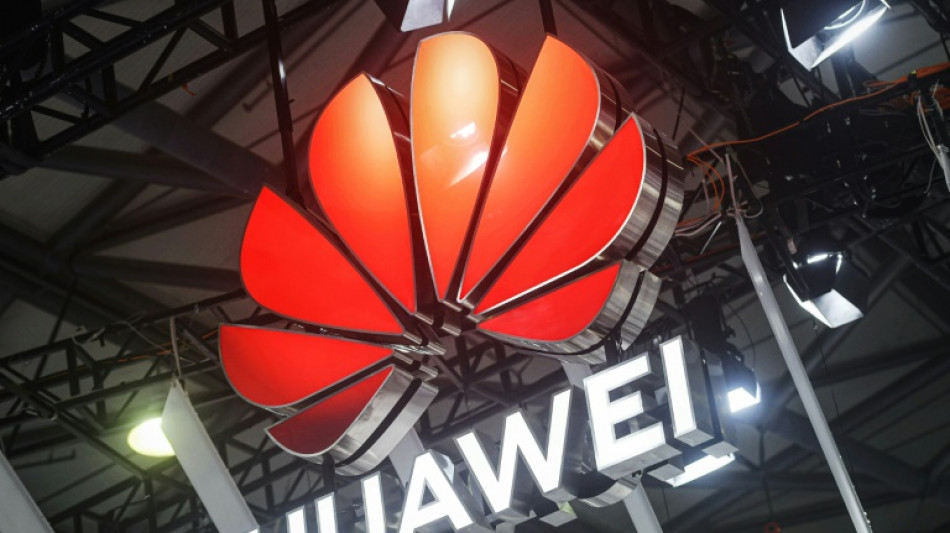
China's Huawei launches 'milestone' smartphone with homegrown OS / Photo: STR, STR, STR - AFP

 Dukascopy Bank Unveils AI-Powered Trading, 25,000+ Stock CFDs and a New Flagship E-Banking App

 Tech firms rally but Asian markets mixed, with eyes on US inflation

 Nepal holds day of mourning as families pray missing still alive

 African players in Europe: Mbeumo fires solo goal as United draw

 Malaysia cancels haze emergency, but warns problems remain

 Philippine sensation Eala looks forward to Asian Games 'fun'

 Jakarta airport extends closure after volcano eruption

 Lonely woman director in Venice sees industry backsliding on gender

 Tech firms rally on mixed day for Asian markets, with eyes on US inflation

 World number one An sends Asian Games warning with China hat-trick

 PSG go for three in a row as Champions League returns

 "Super-human' Alcaraz books US Open quarter-final clash with Shelton
 ECB set to hike interest rates as Iran war flares anew

 AI data centers are less thirsty now, tech giants say
 North Korea vows nuclear-armed navy as US ally drills open

 Under-fire Labuschagne named in Australia Test squad for South Africa
 InterContinental Hotels Group PLC Announces Transaction in Own Shares - September 07

 Best Way to Protect A 401(k) in 2026: Guide Released by Experts

 Tiafoe tops Medvedev in straight sets at US Open
 Zverev seeks US Open last eight as Osaka faces Rybakina

 Alcaraz turns up heat to reach US Open quarters
 Gatti salvages Juve draw with AC Milan in Serie A

 Sinayoko stars as unbeaten Paris FC down Marseille
 Still on top: 'Spider-Man' dominates North American box office

 Zelensky in fresh talks with US envoys: Ukraine official

Chinese tech giant Huawei on Tuesday launched its first smartphone equipped with a fully homegrown operating system, a key test in the firm's fight to challenge the dominance of Western juggernauts.
Apple's iOS and Google's Android are currently used in the vast majority of mobile phones, but Huawei is looking to change that with its newest Mate 70 devices, which run on the company's own HarmonyOS Next.
The launch caps a major turnaround in the fortunes of Huawei, which saw its wings clipped by gruelling US sanctions in recent years but has since bounced back with soaring sales.
"The search for a viable, scaleable mobile operating system largely free of Western company control has been a lengthy one in China," Paul Triolo, a Partner for China and Technology Policy Lead at consulting firm Albright Stonebridge Group, told AFP.
But the new smartphone -- also powered by an advanced domestically produced chip -- shows Chinese tech firms can "persevere", he said.
"Today, the long-awaited Mate 70, the most powerful one ever, is here," Richard Yu, executive director of Huawei's Consumer Business Group, announced during a launch event Tuesday afternoon at the firm's Shenzhen headquarters.
More than three million have been pre-ordered, according to the firm's online shopping platform, though that does not require them to be purchased.
The risks are high -- unlike a previous iteration, based on Android's open-source code, HarmonyOS Next requires a complete rewiring of all apps on the smartphones it powers.
"HarmonyOS Next is the first home-grown operating system, a milestone for China to move away from reliance on Western technologies for software with performance improvement," Gary Ng, a senior economist at Natixis, told AFP.
But, "while Chinese firms may be willing to allocate resources to contribute to Huawei's ecosystem, there are challenges to whether HarmonyOS Next can offer the same number of apps and functionalities to global consumers", Ng said.
- 'High expectations' -
Huawei found itself at the centre of an intense tech rivalry between Beijing and Washington, with US officials warning its equipment could be used to spy on behalf of Chinese authorities -- allegations they deny.
Since 2019, US sanctions have cut Huawei off from global supply chains for technology and US-made components, a move that initially hammered its production of smartphones.
That fight is only set to intensify under US President-elect Donald Trump, who has promised huge tariffs on Chinese imports in response to what he says are Beijing's unfair trade practices.
"Rather than Huawei inspiring the tech industry as a whole, it is the self-reliance trend of the Chinese tech industry that has made Huawei's progress possible," Toby Zhu, a senior analyst at technology research firm Canalys, told AFP.
The success of Huawei's new generation of smartphone products will be a key gauge of whether that drive has worked, said Zhu.
"This generation of products cannot afford to miss the mark because everyone has high expectations for them," he added.
Huawei was once China's largest domestic smartphone maker before it became embroiled in a tech war between Washington and Beijing.
The company shipped more than 10.8 million smartphone units in the third quarter -- capturing just 16 percent of the Chinese market, according to a recent Canalys report.
In September the firm unveiled the world's first triple-folding phone at more than three times the price of the newest iPhone, the Mate XT, priced at an eye-watering $2,800.
The Mate 70 is unlikely to cost that much -- while its price is not yet public, its predecessor launched with a starting price of $750.
And it's unclear whether developers overseas will be willing to spend the money needed to build a completely new version of their apps for the latest smartphones, Rich Bishop, co-founder and CEO of AppInChina, a publisher of international software in China, told AFP.
One third-party agency in China quoted a price of two million yuan ($275,500) to custom-fit a foreign app for HarmonyOS Next, he said.
To convince them, "Huawei needs to continuously improve the software, provide better support for developers, and convince the developer community that it is committed to the long-term development of the Harmony ecosystem", said Triolo.
A.Clark--AT