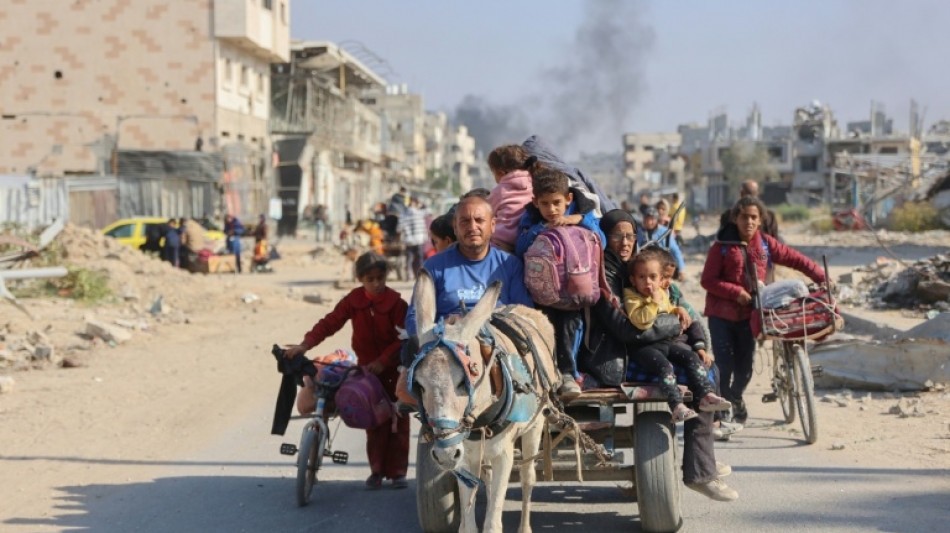
Donkeys offer Gazans lifeline amid war shortages / Photo: Omar AL-QATTAA - AFP/File

 Dukascopy Bank Unveils AI-Powered Trading, 25,000+ Stock CFDs and a New Flagship E-Banking App

 Tech firms rally but Asian markets mixed, with eyes on US inflation

 Nepal holds day of mourning as families pray missing still alive

 African players in Europe: Mbeumo fires solo goal as United draw

 Malaysia cancels haze emergency, but warns problems remain

 Philippine sensation Eala looks forward to Asian Games 'fun'
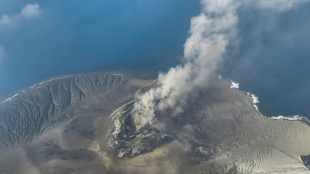 Jakarta airport extends closure after volcano eruption

 Lonely woman director in Venice sees industry backsliding on gender

 Tech firms rally on mixed day for Asian markets, with eyes on US inflation

 World number one An sends Asian Games warning with China hat-trick
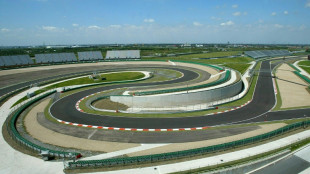
 PSG go for three in a row as Champions League returns

 "Super-human' Alcaraz books US Open quarter-final clash with Shelton

 ECB set to hike interest rates as Iran war flares anew

 AI data centers are less thirsty now, tech giants say

 North Korea vows nuclear-armed navy as US ally drills open

 Under-fire Labuschagne named in Australia Test squad for South Africa

 InterContinental Hotels Group PLC Announces Transaction in Own Shares - September 07

 Best Way to Protect A 401(k) in 2026: Guide Released by Experts

 Tiafoe tops Medvedev in straight sets at US Open
 Zverev seeks US Open last eight as Osaka faces Rybakina

 Alcaraz turns up heat to reach US Open quarters

 Gatti salvages Juve draw with AC Milan in Serie A

 Sinayoko stars as unbeaten Paris FC down Marseille
 Still on top: 'Spider-Man' dominates North American box office
 Zelensky in fresh talks with US envoys: Ukraine official

Amina Abu Maghasib's livelihood rests on one animal: a donkey that pulls the cart she uses to transport people around Gaza, where more than a year of war has led to a widespread shortage of fuel for cars.
"Before the war, I used to sell milk and yoghurt, and the factory used to take the milk from me," she said from the central Gaza city of Deir el-Balah, holding reins in one hand and a rubber stick in the other that she uses to manoeuvre her cart.
"Now, I have no income other than the donkey and the cart."
Donkey-pulled carts were a fairly common sight in pre-war Gaza. But the lack of fuel and destruction in the territory since the conflict began between Israel and Hamas last year have made them one of the few remaining forms of transport.
Displaced Gazans fleeing fighting or air strikes pile aboard them to rush to safety with their belongings.
For others, a donkey cart is virtually the only form of transportation.
Marwa Yess uses a donkey cart to get around with her family.
"I pay 20 shekels ($5.40) for the cart to take me from Deir el-Balah to Nuseirat. The price is outrageous, but under these circumstances, everything seems reasonable," she said. The distance is about five kilometres (three miles).
"I used to feel embarrassed to ride a donkey cart at the beginning of the war, but now there's no other option," the teacher and mother of three told AFP.
- Soaring prices -
According to the United Nations Food and Agriculture Organization, 43 percent of Gaza's working animals -- a category that includes donkeys, horses and mules -- had been killed in the war by August 2024, leaving only 2,627 alive.
Abu Maghasib's only running costs are fodder, she told AFP sitting on her cart, a few planks of wood held together by a metal frame and mounted on four wheels.
But the price of food for people and animals has soared.
After costs, Abu Maghasib has made a profit of 20 shekels at the end of the day from the clients who hop on and off from the roadside.
"I bought this donkey on credit, and the first donkey died in the war in Deir el-Balah after being hit by shrapnel," she said.
The new one cost her 2,500 shekels.
Abdel Misbah, a 32-year-old man displaced with his family of 20 from Gaza City to the territory's south, also made the livelihood switch to donkey transportation.
"I used to sell vegetables on a cart before the war. Now, I work in delivery," he said, lamenting that "the donkey panics when the bombing gets too close".
He too feels the pain of skyrocketing fodder prices.
"I make sure to feed it well, even though the price of barley (per sack) has gone up from three shekels to 50 shekels," he said.
- 'More valuable than gold' -
Israel imposed a near-total siege on Gaza in the early stages of the war last year, complicating aid and goods distribution.
The lack of fuel, war-damaged roads and looting, as well as fighting in densely populated areas and the repeated displacement of much of Gaza's 2.4 million people, also contribute to the shortages.
A UN-backed assessment this month said famine looms in northern Gaza, and the United Nations agency supporting Palestinian refugees, UNRWA, said aid entering the territory had reached its lowest level in months.
Yusef Muhammad, a 23-year-old displaced from Gaza's north to Khan Yunis in the south, said his donkey has become a "lifeline" for his family.
"When the war started, car fares were too expensive. I had no choice but to rely on a donkey. Thank God I had it when we were forced to evacuate."
Beyond the widespread destruction, Israel's military campaign has killed at least 44,211 people in Gaza, most of them civilians, according to figures from the Hamas government's health ministry, which the UN considers reliable.
Hamas's October 7, 2023 attack on Israel that sparked the war resulted in 1,206 deaths, mostly civilians, according to an AFP tally of Israeli official figures.
When Israeli military evacuation orders, which usually precede fighting and bombing, send thousands of people and their belongings onto the road in an instant, donkey carts can be one of the only ways out of danger.
Hosni Abu Warda, 62, said his home was destroyed in the northern area of Jabalia, the scene of an intense Israeli military operation since early October.
When he fled, Abu Warda said he had no choice but to turn to four-hoofed transportation. He waited 14 hours for a cart before escaping with his family "packed like sardines".
In times like these, "the donkey is more valuable than gold and even more valuable than modern cars", Abu Warda said.
E.Flores--AT