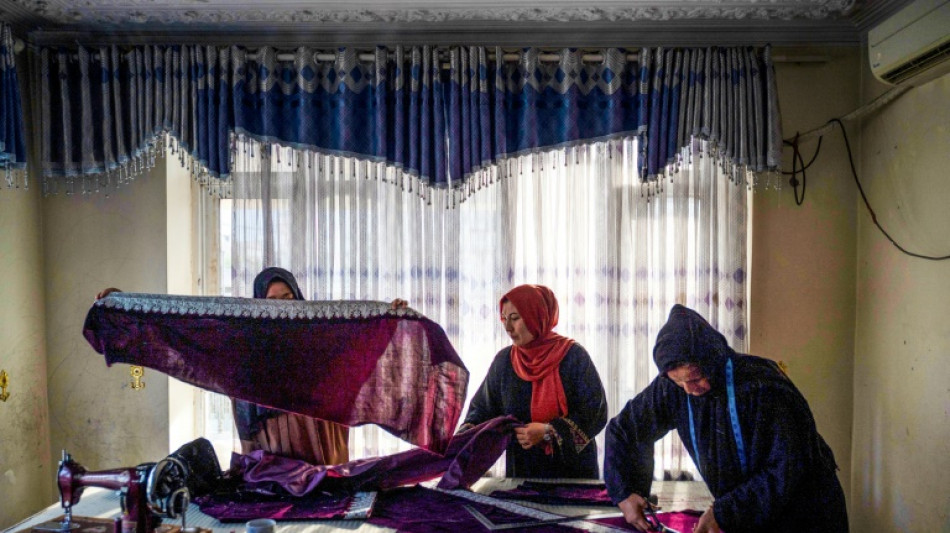
Afghan women turn to entrepreneurship under Taliban / Photo: Wakil KOHSAR - AFP

 Dukascopy Bank Unveils AI-Powered Trading, 25,000+ Stock CFDs and a New Flagship E-Banking App

 Tech firms rally but Asian markets mixed, with eyes on US inflation

 Nepal holds day of mourning as families pray missing still alive

 African players in Europe: Mbeumo fires solo goal as United draw

 Malaysia cancels haze emergency, but warns problems remain

 Philippine sensation Eala looks forward to Asian Games 'fun'
 Jakarta airport extends closure after volcano eruption

 Lonely woman director in Venice sees industry backsliding on gender

 Tech firms rally on mixed day for Asian markets, with eyes on US inflation

 World number one An sends Asian Games warning with China hat-trick

 PSG go for three in a row as Champions League returns

 "Super-human' Alcaraz books US Open quarter-final clash with Shelton

 ECB set to hike interest rates as Iran war flares anew

 AI data centers are less thirsty now, tech giants say

 North Korea vows nuclear-armed navy as US ally drills open

 Under-fire Labuschagne named in Australia Test squad for South Africa

 InterContinental Hotels Group PLC Announces Transaction in Own Shares - September 07

 Best Way to Protect A 401(k) in 2026: Guide Released by Experts

 Tiafoe tops Medvedev in straight sets at US Open

 Zverev seeks US Open last eight as Osaka faces Rybakina

 Alcaraz turns up heat to reach US Open quarters

 Gatti salvages Juve draw with AC Milan in Serie A

 Sinayoko stars as unbeaten Paris FC down Marseille

 Still on top: 'Spider-Man' dominates North American box office
 Zelensky in fresh talks with US envoys: Ukraine official

When Zainab Ferozi saw Afghan women struggling to feed their families after Taliban authorities took power, she took matters into her own hands and poured her savings into starting a business.
Two-and-a-half years after putting 20,000 Afghanis ($300) earned from teaching sewing classes into a carpet weaving enterprise, she now employs around a dozen women who lost their jobs or who had to abandon their education due to Taliban government rules.
Through her business in the western province of Herat, the 39-year-old also "covers all the household expenses" of her family of six, she told AFP from her office where samples of brightly coloured and exquisitely woven rugs and bags are displayed.
Her husband, a labourer, cannot find work in one of the poorest countries in the world.
Ferozi is one of many women who have launched small businesses in the past three years to meet their own needs and support other Afghan women, whose employment sharply declined after the Taliban took power in 2021.
Before the Taliban takeover, women made up 26 percent of public sector workers, a figure that "has effectively decreased to zero", according to UN Women.
Girls and women have also been banned from secondary schools and universities under restrictions the UN has described as "gender apartheid".
Touba Zahid, a 28-year-old mother-of-one, started making jams and pickles in the small basement of her home in the capital Kabul after she was forced to stop her university education.
"I came into the world of business... to create job opportunities for women so they can have an income that at least covers their immediate needs," Zahid said.
Half a dozen of her employees, wearing long white coats, were busy jarring jams and pickles labelled "Mom's delicious homecooking".
- Growing number of businesses -
While women may be making the stock, running the shops in Afghanistan remains mostly a man's job.
Saleswomen like Zahid "cannot go to the bazaar to promote and sell their products" themselves, said Fariba Noori, chairwoman of the Afghanistan Women's Chamber of Commerce and Industry (AWCCI).
Another issue for Afghan businesswomen is the need for a "mahram" -- a male family member chaperone -- to accompany them to other cities or provinces to purchase raw materials, said Noori.
After 40 years of successive conflicts, many Afghan women have been widowed and lost many male relatives.
Despite these challenges, the number of businesses registered with AWCCI has increased since the Taliban takeover, according to Noori.
The number went "from 600 big companies to 10,000" mainly small, home-based businesses and a few bigger companies, said Noori, herself a businesswoman for 12 years.
Khadija Mohammadi, who launched her eponymous brand in 2022 after she lost her private school teaching job, now employs more than 200 women sewing dresses and weaving carpets
"I am proud of every woman who is giving a hand to another woman to help her become independent," said the 26-year-old.
Though businesses like Mohammadi's are a lifeline, the salaries ranging from 5,000 to 13,000 Afghanis, cannot cover all costs and many women are still stalked by economic hardship.
Qamar Qasimi, who lost her job as a beautician after the Taliban authorities banned beauty salons in 2023, said that even with her salary she and her husband struggle to pay rent and feed their family of eight.
"When I worked in the beauty salon, we could earn 3,000-7,000 Afghanis for styling one bride, but here we get 5,000 per month," said the 24-year-old.
"It's not comparable but I have no other choice," she added, the room around her full of women chatting as they worked at 30 looms.
- Women-only spaces -
The closure of beauty salons was not only a financial blow, but also removed key spaces for women to socialise.
Zohra Gonish decided to open a restaurant to create a women-only space in northeastern Badakhshan province.
"Women can come here and relax," said the 20-year-old entrepreneur.
"We wanted the staff to be women so that the women customers can feel comfortable here."
But starting her business in 2022, aged 18 was not easy in a country where the labour force participation for women is 10 times lower than the world average, according to the World Bank.
It took Gonish a week to convince her father to support her.
Aside from helping their families and having space to socialise, some women said work has given them a sense of purpose.
Sumaya Ahmadi, 15, joined Ferozi's carpet company to help her parents after she had to leave school and became "very depressed".
"(Now) I'm very happy and I no longer have any mental health problems. I'm happier and I feel better."
The work has also given her a new goal: to help her two brothers build their futures.
"Because schools' doors are closed to girls, I work instead of my brothers so they can study and do something with their lives."
Ch.Campbell--AT