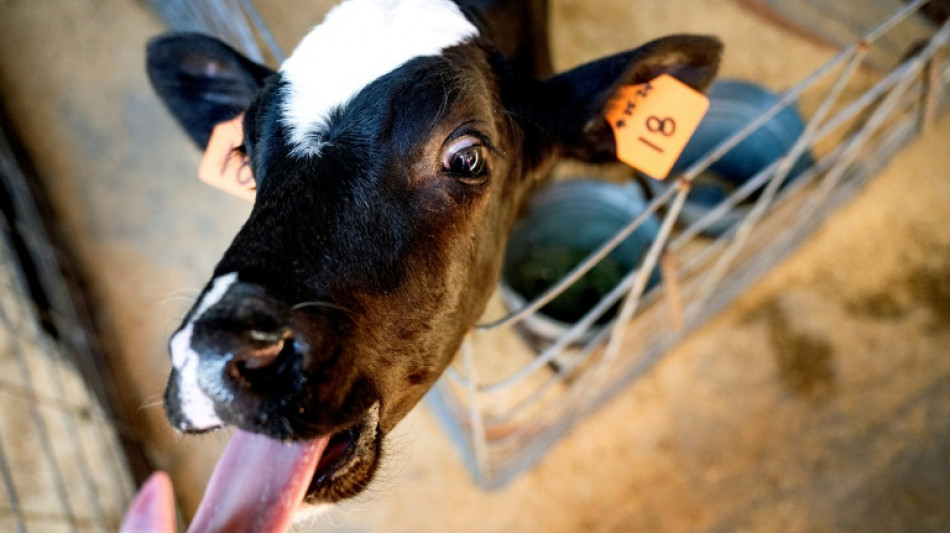
Scientists seek miracle pill to stop methane cow burps / Photo: NOAH BERGER - AFP

 Dukascopy Bank Unveils AI-Powered Trading, 25,000+ Stock CFDs and a New Flagship E-Banking App

 Tech firms rally but Asian markets mixed, with eyes on US inflation

 Nepal holds day of mourning as families pray missing still alive

 African players in Europe: Mbeumo fires solo goal as United draw

 Malaysia cancels haze emergency, but warns problems remain

 Philippine sensation Eala looks forward to Asian Games 'fun'

 Jakarta airport extends closure after volcano eruption

 Lonely woman director in Venice sees industry backsliding on gender

 Tech firms rally on mixed day for Asian markets, with eyes on US inflation

 World number one An sends Asian Games warning with China hat-trick

 PSG go for three in a row as Champions League returns
 "Super-human' Alcaraz books US Open quarter-final clash with Shelton

 ECB set to hike interest rates as Iran war flares anew

 AI data centers are less thirsty now, tech giants say

 North Korea vows nuclear-armed navy as US ally drills open

 Under-fire Labuschagne named in Australia Test squad for South Africa

 InterContinental Hotels Group PLC Announces Transaction in Own Shares - September 07

 Best Way to Protect A 401(k) in 2026: Guide Released by Experts

 Tiafoe tops Medvedev in straight sets at US Open

 Zverev seeks US Open last eight as Osaka faces Rybakina

 Alcaraz turns up heat to reach US Open quarters

 Gatti salvages Juve draw with AC Milan in Serie A

 Sinayoko stars as unbeaten Paris FC down Marseille

 Still on top: 'Spider-Man' dominates North American box office
 Zelensky in fresh talks with US envoys: Ukraine official

A scientist guides a long tube into the mouth and down to the stomach of Thing 1, a two-month-old calf that is part of a research project aiming to prevent cows from burping methane, a potent greenhouse gas.
Paulo de Meo Filho, a postdoctoral researcher at University of California, Davis, is part of an ambitious experiment aiming to develop a pill to transform cow gut bacteria so it emits less or no methane.
While the fossil fuel industry and some natural sources emit methane, cattle farming has become a major climate concern due to the sheer volume of the cows' emissions.
"Almost half of the increase in (global) temperature that we've had so far, it's been because of methane," said Ermias Kebreab, an animal science professor at UC Davis.
Methane, the second largest contributor to climate change after carbon dioxide, breaks down faster than CO2 but is more potent.
"Methane lives in the atmosphere for about 12 years" unlike carbon dioxide which persists for centuries, Kebreab said.
"If you start reducing methane now, we can actually see the effect on the temperature very quickly."
Filho uses the tube to extract liquid from Thing 1's rumen -- the first stomach compartment containing partially digested food.
Using the rumen liquid samples, the scientists are studying the microbes that convert hydrogen into methane, which is not digested by the cow but instead burped out.
A single cow will burp roughly 220 pounds (100 kilograms) of the gas annually.
- 'Social critters' -
Thing 1 and other calves receive a seaweed-supplemented diet to reduce methane production.
Scientists hope to achieve similar results by introducing genetically modified microbes that soak up hydrogen, starving methane-producing bacteria at the source.
However, the team proceeds cautiously.
"We can't just simply cut down methane production by removing" methane-making bacteria, as hydrogen could accumulate to the point of harming the animal, warned Matthias Hess, who runs the UC Davis lab.
"Microbes are kind of social critters. They really like to live together," he said.
"The way they interact and affect each other impacts the overall function of the ecosystem."
Hess's students test different formulas in bioreactors, vessels that reproduce microorganisms' living conditions in a stomach from movements to temperature.
- More productive cows -
The project is being carried out at UC Davis as well as UC Berkeley's Innovative Genomics Institute (IGI).
IGI scientists are trying to identify the right microbe -- the one they hope to genetically alter to supplant methane-producing microbes.
The modified microorganisms will then be tested at UC Davis in the lab and in the animals.
"Not only are we trying to reduce methane emissions, but you also increase the feed efficiency," said Kebreab.
"Hydrogen and methane, they are both energy, and so if you reduce that energy and redirect it to something else... we have a better productivity and lower emissions at the same time."
The ultimate goal is a single-dose treatment administered early in life, since most cattle graze freely and can't receive daily supplements.
The three research teams have been given $70 million and seven years to achieve a breakthrough.
Kebreab has long studied sustainable livestock practices and pushes back against calls to reduce meat consumption to save the planet.
While acknowledging this might work for healthy adults in developed nations, he pointed to countries like Indonesia, where the government is seeking to increase meat and dairy production because 20 percent of children under five suffer from stunted growth.
"We can't tell them to not eat meat," he said.
W.Moreno--AT