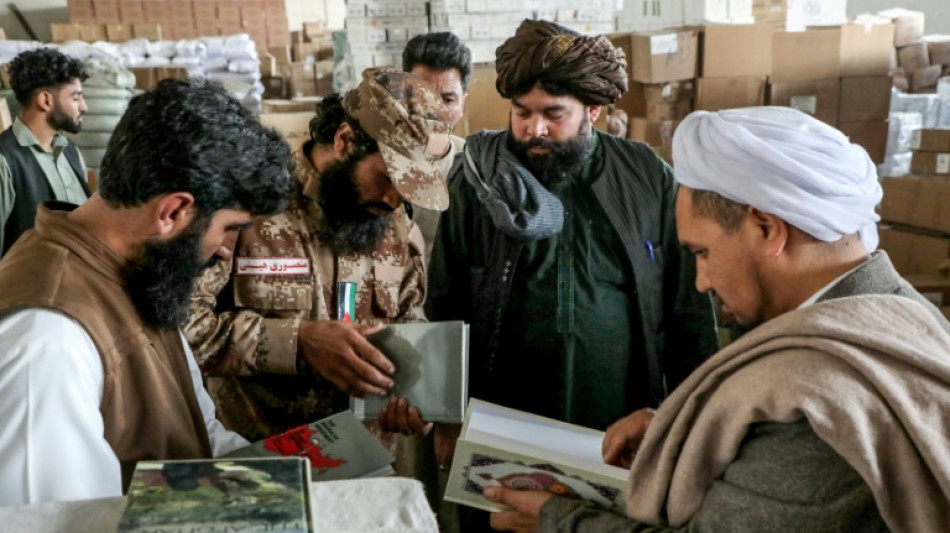
Taliban govt clearing 'un-Islamic' books from Afghanistan shelves / Photo: Mohsen KARIMI - AFP

 Pietersen joins England coaching team ahead of World Cup

 Germany's triumphant far-right AfD aims fire at Merz

 Fury claims Joshua bout is off, calls for Usyk trilogy

 British family bids to row back against suicide taboo
 China's teenage 223cm basketball player 'just a little girl'
 Tokyo's Shinjuku to ban more than half of vacation rentals

 Australian Rules limits contact training to reduce concussion
 Germany's Merz under pressure from far-right election triumph
 Nepal tunnel rescues face 'unprecedented' challenge
 Mourinho's Real Madrid European revival bid starts with Inter reunion
 Solomons PM survives attempt to oust government
 Ohtani 'unlikely' to pitch again this season, says Dodgers manager
 Driver thanks 'superhero' rival for saving him from flaming race car

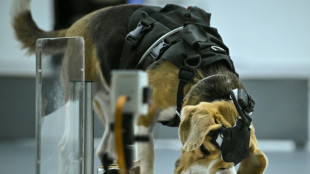 Can dogs sniff cancer? AI joins the hunt in India

 Shelton steams into US Open quarter-final clash with Alcaraz

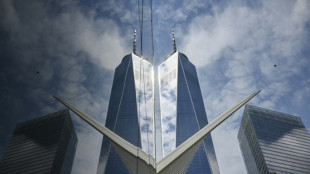 25 years on, America seeks to keep 9/11 memories alive
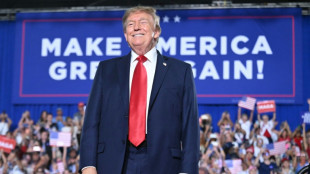 'Trumpapalooza' tests Republican bet on unpopular US president
 Pegula tops Cirstea to reach US Open quarter-finals
 Australians could opt out of social media algorithms under new law
 Genflow Biosciences PLC Announces Appointment of Investor Relations Adviser
 Enjoying the moment: Alcaraz steps it up to reach US Open quarter-finals

 Five dead, five injured after Amazon cargo plane overshoots Miami runway
 La Rochelle half-backs lead fightback against Toulouse

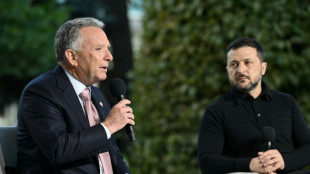 US envoys have 'more effective proposals': Ukraine official

 Defending champion Alcaraz powers into US Open quarter-finals

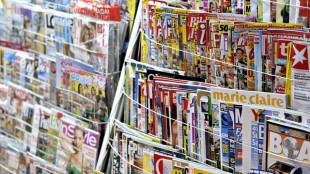
Checking imported books, removing texts from libraries and distributing lists of banned titles -- Taliban authorities are working to remove "un-Islamic" and anti-government literature from circulation.
The efforts are led by a commission established under the Ministry of Information and Culture soon after the Taliban swept to power in 2021 and implemented their strict interpretation of Islamic law, or sharia.
In October, the ministry announced the commission had identified 400 books "that conflicted with Islamic and Afghan values, most of which have been collected from the markets".
The department in charge of publishing has distributed copies of the Koran and other Islamic texts to replace seized books, the ministry statement said.
The ministry has not provided figures for the number of removed books, but two sources, a publisher in Kabul and a government employee, said texts had been collected in the first year of Taliban rule and again in recent months.
"There is a lot of censorship. It is very difficult to work, and fear has spread everywhere," the Kabul publisher told AFP.
Books were also restricted under the previous foreign-backed government ousted by the Taliban, when there was "a lot of corruption, pressures and other issues", he said.
But "there was no fear, one could say whatever he or she wanted to say", he added.
"Whether or not we could make any change, we could raise our voices."
- 'Contradictory to religion' -
AFP received a list of five of the banned titles from an information ministry official.
It includes "Jesus the Son of Man" by renowned Lebanese-American author Khalil Gibran, for containing "blasphemous expressions", and the "counterculture" novel "Twilight of the Eastern Gods" by Albanian author Ismail Kadare.
"Afghanistan and the Region: A West Asian Perspective" by Mirwais Balkhi, an education minister under the former government, was also banned for "negative propaganda".
During the Taliban's previous rule from 1996 to 2001, there were comparatively few publishing houses and booksellers in Kabul, the country having already been wracked by decades of war.
Today, thousands of books are imported each week alone from neighbouring Iran -- which shares the Persian language with Afghanistan -- through the Islam Qala border crossing in western Herat province.
Taliban authorities rifled through boxes of a shipment at a customs warehouse in Herat city last week.
One man flipped through a thick English-language title, as another, wearing a camouflage uniform with a man's image on the shoulder patch, searched for pictures of people and animals in the books.
"We have not banned books from any specific country or person, but we study the books and we block those that are contradictory to religion, sharia or the government, or if they have photos of living things," said Mohammad Sediq Khademi, an official with the Herat department for the Propagation of Virtue and the Prevention of Vice (PVPV).
"Any books that are against religion, faith, sect, sharia... we will not allow them," the 38-year-old told AFP, adding the evaluations of imported books started some three months ago.
Images of living things -- barred under some interpretations of Islam -- are restricted according to a recent "vice and virtue" law that codifies rules imposed since the Taliban returned to power, but the regulations have been unevenly enforced.
Importers have been advised of which books to avoid, and when books are deemed unsuitable, they are given the option of returning them and getting their money back, Khademi said.
"But if they can't, we don't have any other option but to seize them," he added.
"Once, we had 28 cartons of books that were rejected."
- Clearing stock -
Authorities have not gone from shop to shop checking for banned books, an official with the provincial information department and a Herat bookseller said, asking not to be named.
However, some books have been removed from Herat libraries and Kabul bookstores, a bookseller told AFP, also asking for anonymity, including "The History of Jihadi Groups in Afghanistan" by Afghan author Yaqub Mashauf.
Books bearing images of living things can still be found in Herat shops.
In Kabul and Takhar -- a northern province where booksellers said they had received the list of 400 banned books -- disallowed titles remained on some shelves.
Many non-Afghan works were banned, one seller said, "so they look at the author, whose name is there, and they are mostly banned" if they're foreign.
His bookshop still carried translations of Russian author Fyodor Dostoyevsky's "The Gambler" and fantasy novel "Daughter of the Moon Goddess" by Sue Lynn Tan.
But he was keen to sell them "very cheap" now, to clear them from his stock.
strs-qb-sw/cwl
Ch.Campbell--AT