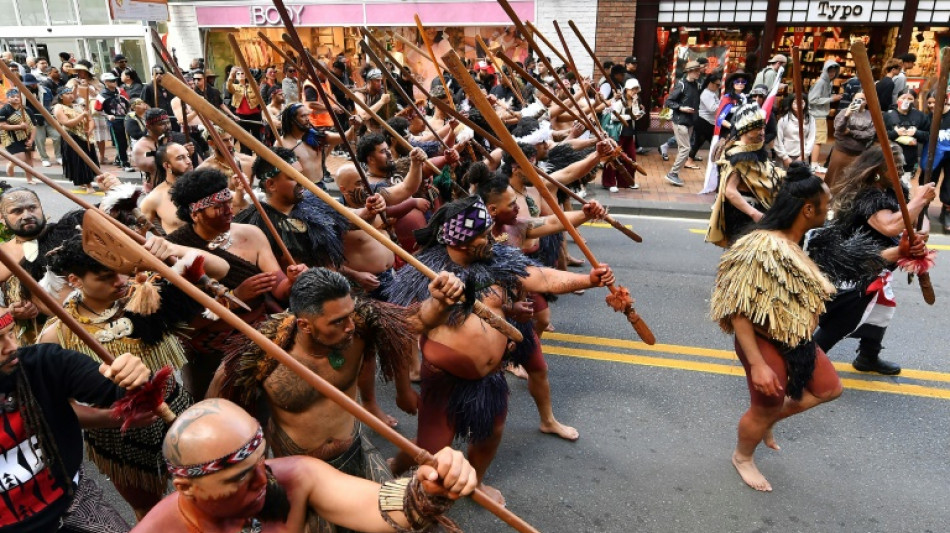
Tens of thousands march in New Zealand Maori rights protest / Photo: Sanka Vidanagama - AFP

 Pietersen joins England coaching team ahead of World Cup

 Germany's triumphant far-right AfD aims fire at Merz

 Fury claims Joshua bout is off, calls for Usyk trilogy

 British family bids to row back against suicide taboo

 China's teenage 223cm basketball player 'just a little girl'

 Tokyo's Shinjuku to ban more than half of vacation rentals

 Australian Rules limits contact training to reduce concussion

 Germany's Merz under pressure from far-right election triumph

 Nepal tunnel rescues face 'unprecedented' challenge
 Mourinho's Real Madrid European revival bid starts with Inter reunion

 Solomons PM survives attempt to oust government

 Ohtani 'unlikely' to pitch again this season, says Dodgers manager

 Driver thanks 'superhero' rival for saving him from flaming race car

 Can dogs sniff cancer? AI joins the hunt in India

 Shelton steams into US Open quarter-final clash with Alcaraz

 25 years on, America seeks to keep 9/11 memories alive
 'Trumpapalooza' tests Republican bet on unpopular US president

 Pegula tops Cirstea to reach US Open quarter-finals
 Australians could opt out of social media algorithms under new law

 Genflow Biosciences PLC Announces Appointment of Investor Relations Adviser

 Enjoying the moment: Alcaraz steps it up to reach US Open quarter-finals

 Five dead, five injured after Amazon cargo plane overshoots Miami runway

 La Rochelle half-backs lead fightback against Toulouse

 US envoys have 'more effective proposals': Ukraine official

 Defending champion Alcaraz powers into US Open quarter-finals

Booming Indigenous Maori "haka" chants rang out across New Zealand's capital on Tuesday, as tens of thousands rallied against a conservative push to redefine the nation's founding treaty.
More than 35,000 demonstrators poured into the harbourside city of Wellington, police said, shutting down busy streets as their spirited procession inched its way towards parliament.
Bare-chested men draped in traditional feather cloaks were joined by horse riders waving the red, white and black Maori flag.
Children marched alongside adults bearing distinctive full-face Maori "moko" tattoos and clutching ceremonial wooden weapons.
"The vibe is beautiful. People of all walks are here to support. It is peaceful and respectful," participant Nick Stewart told AFP.
Protests have been swelling throughout New Zealand after a minor party in the conservative coalition government drafted a bill to redefine the 1840 Treaty of Waitangi.
Although the bill has almost no chance of passing, its mere introduction has triggered one of New Zealand's largest protests in decades.
Many critics -- including some of New Zealand's most respected lawyers -- see it as an attempt to strip long-agreed rights from the country's 900,000 strong Maori population.
"We stand here gathered in our tens of thousands on the steps of parliament to protest this bill for our mokopuna," said Stewart, using a Maori word for future generations.
Crowds gathered on the lawns outside New Zealand's beehive-shaped parliament building, playing reggae music and giving speeches that urged the government to come out and face them.
"It's not the best way to have a conversation. We will not accept unilateral change to a treaty that involves two parties," said Ngira Simmonds, a key advisor to New Zealand's Maori queen.
"There is a better way," he told AFP from Wellington.
Many demonstrators arrived in Wellington after a nine-day "hikoi" -- or protest march -- that began hundreds of kilometres away at New Zealand's northern tip.
- A country divided -
At the centre of the outcry is government minister David Seymour, the outspoken leader of the libertarian ACT Party -- a minor partner in the governing coalition.
Seymour has long railed against affirmative action policies designed to help Maori, who remain far more likely to die early, live in poverty, or wind up in prison.
His bill would look to wind back these so-called "special rights".
Incumbent Prime Minister Christopher Luxon has voiced his opposition to Seymour's bill, meaning it is all but doomed to fail when it comes to a parliamentary vote.
But former conservative prime minister Jenny Shipley said just putting it forward threatened to "divide New Zealand in a way that I haven't lived through in my adult life".
The bill was introduced to parliament for preliminary debate last week.
Proceedings were derailed when 22-year-old Maori Party MP Hana-Rawhiti Maipi-Clarke took to her feet in the chamber, ripped the bill in half, and launched into a haka.
Seen as the country's founding document, the Treaty of Waitangi was signed in 1840 to bring peace between 540 Maori chiefs and colonising British forces.
Its principles today underpin efforts to foster partnership between Indigenous and non-Indigenous New Zealanders and protect the interests of the Maori community.
The anniversary of the treaty's signing remains a national holiday.
E.Hall--AT