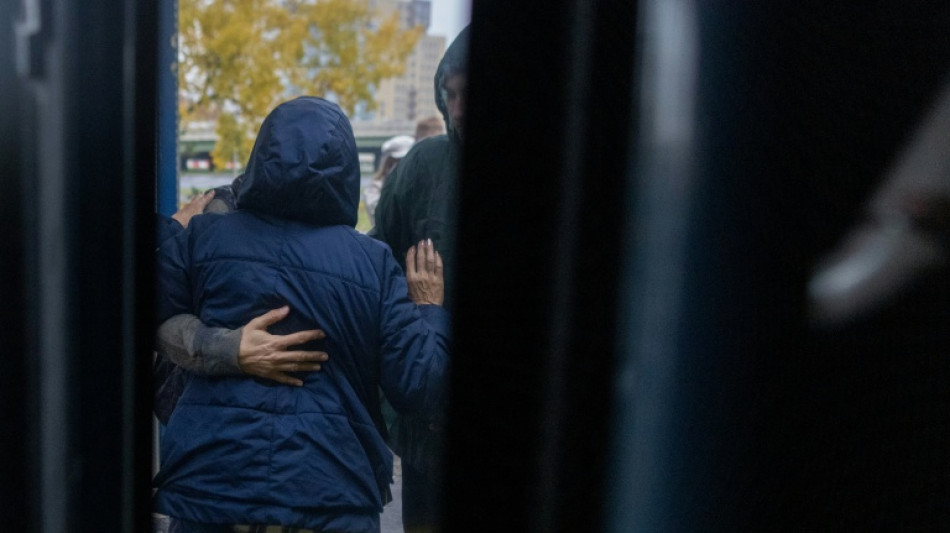
Ukrainians brave arduous journeys to Russian-occupied homeland / Photo: Wojtek RADWANSKI - AFP

 Germany's Merz 'shocked' by far-right state win but vows to stay course

 UK finance minister Healey pledges strict fiscal discipline as budget looms
 Mbappe embraces Ballon d'Or talk after historic World Cup exploits
 Tech firms rally, with eyes on US inflation update
 Jaguar Land Rover to cut 4,000 jobs as European car sector hits skids
 US average diesel price rises to record $5.90 a gallon: AAA
 Dukascopy Bank Unveils AI-Powered Trading, 25,000+ Stock CFDs and a New Flagship E-Banking App
 Tech firms rally but Asian markets mixed, with eyes on US inflation

 Nepal holds day of mourning as families pray missing still alive
 African players in Europe: Mbeumo fires solo goal as United draw
 Malaysia cancels haze emergency, but warns problems remain
 Philippine sensation Eala looks forward to Asian Games 'fun'
 Jakarta airport extends closure after volcano eruption

 Lonely woman director in Venice sees industry backsliding on gender
 Tech firms rally on mixed day for Asian markets, with eyes on US inflation

 World number one An sends Asian Games warning with China hat-trick
 PSG go for three in a row as Champions League returns
 "Super-human' Alcaraz books US Open quarter-final clash with Shelton
 ECB set to hike interest rates as Iran war flares anew
 AI data centers are less thirsty now, tech giants say

 North Korea vows nuclear-armed navy as US ally drills open
 Under-fire Labuschagne named in Australia Test squad for South Africa

 InterContinental Hotels Group PLC Announces Transaction in Own Shares - September 07
 Genflow Biosciences PLC Announces Appointment of Investor Relations Adviser
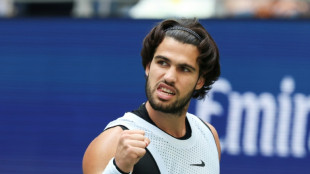
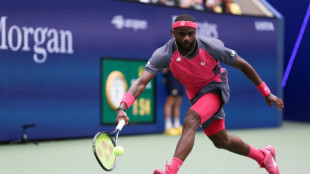 Tiafoe tops Medvedev in straight sets at US Open
War, interrogations and a journey lasting days are not enough to stop Anna visiting her parents and beloved little brother in Russian-occupied eastern Ukraine.
She left her family behind in the months after Russia's invasion of her homeland and, like several million other Ukrainians, has been living in Europe since.
The 25-year-old has twice made a massively circuitous journey to see her family in the Russian-occupied Lugansk region -- travelling from Poland to Belarus, flying to Moscow, continuing south by night train and then driving by road into eastern Ukraine.
In Moscow, Ukrainians face an intense grilling before they can travel on to Russian-occupied areas of their home country.
"It is not for the faint-hearted," Anna told AFP in her flat outside Warsaw, where she works as a dog walker.
For a year now, Russia has only been letting Ukrainian citizens travel to occupied zones through a special checkpoint set up in Moscow's Sheremetyevo airport.
There are security checks and interrogations and many Ukrainians get rejected and sent back, according to people who have been through the process.
- 'Psychological stress' -
Most Ukrainians reach the Sheremetyevo checkpoint via the Belarusian capital, Minsk. Belarus, Russia's ally and neighbour, is one of the few places in Europe from where there are flights to Moscow.
Once in Moscow, eastern Ukraine is reachable by train and car drive.
"It's a lot of psychological stress," Anna told AFP.
She is not alone in making the arduous trip.
After 32 months of war, thousands are travelling from Europe to Moscow-controlled Ukrainian territory to visit family, to check on property or -- in rare cases -- to return home.
At Warsaw's Zachodnia bus station, Belarusian drivers told AFP there were several buses a day to Minsk and on each journey they took about 10 Ukrainian passengers travelling onwards to Moscow and occupied territories.
- 'Like in the Soviet Union' -
Ukrainians who make it through are among the few people who have been on both sides of the front line in the almost three-year war.
Anna did not want to reveal her surname or the name of her town, fearing for her family's safety.
The town had been under separatist control since 2014 but on her two visits home after Moscow's full-scale invasion, Anna said it was overrun by Russian soldiers.
"They are well paid, so there is a lot of money around. The prices of flats have gone through the roof," she said.
Members of her pro-Ukrainian family keep their opinions to themselves and make sure those "never leave home".
"It's like in the Soviet Union," Anna said, smiling.
"In the outside world, you agree with everything. And when you get home you can talk about how bad it is."
While Russian soldiers have come with cash, their arrival also brought a level of lawlessness.
At some point, she said, shopkeepers in her town were told not to sell alcohol to soldiers because of recurring "incidents".
At Moscow's Sheremetyevo airport, Anna was asked to fill in a questionnaire that asked: "Do you support the special military operation?", the name the Kremlin uses to describe its invasion of Ukraine in February 2022.
She said she put "no" and argued that this was because she was in favour of peace.
Then she said she played the "dumb little girl" and, several hours later, was let through.
Ukrainians AFP spoke to at Warsaw bus station said checks at Sheremetyevo could take anything from several hours to a whole day.
In the year since it opened the Sheremetyevo checkpoint in October 2023, Moscow has let 83,000 Ukrainians pass through, according to Russian state media.
- 'Anything can happen' -
But social media networks are full of Ukrainians saying they were rejected at Sheremetyevo, as well as advice on how to get through.
Pavlo Lysianskyi, a Ukrainian activist and journalist documenting Russia's takeover of the east of his country, said "anything can happen".
He estimated that only around a fifth of people were let through the Sheremetyevo screening process.
Another Anna boarding a bus to Minsk to travel on to Moscow told AFP she was undeterred by the obstacles.
The 50-year-old's adult children live in Ukraine's northeastern city of Kharkiv. But her elderly mother is in occupied Lugansk, and she has struggled to take care of both.
It was her second time going through Sheremyetevo, she said, describing the process as a "lottery". It depended on the individual Russian interrogator -- the "human factor" -- as to whether people were let through, she added.
She worried this could be her last visit because she has refused the offer of a Russian passport.
"The transitional period is over. Now they are forcing people," she said of the pressure on Ukrainians in occupied regions to obtain Russian identity documents.
"I am at a loss as to what to do," she added, saying she wanted to maintain access to her ageing mother.
Even before the Sheremetyevo checks, Anna said she had needed to "morally prepare" for questioning by Belarusian border guards, which can also take hours.
- 'Home is home' -
For first-timers, the journey to Russia is particularly nerve-wracking.
Lyudmila, a silver-haired 72-year-old, spent more than two years of war living on her own in Kharkiv, as it came increasingly under attack.
But when one of her windows was blown out and shrapnel fell in her toilet, she decided it was no longer bearable to live through the war on her own.
"You sit there alone without electricity," she said.
Her only family left is a son living between Moscow and occupied Donetsk, and she now wants to join him.
Lyudmila travelled 24 hours by bus to reach Warsaw and from there had a similar journey to Minsk, before she could fly to Moscow.
While acknowledging it would "of course" be morally difficult to be surrounded by people who applaud the attacks on Kharkiv, she said it would still be easier than living alone.
She worried about the Russian checks, though.
"I don't understand how I will come back (to Poland) if they don't let me through," she said.
While some are prepared to brave the journey into the unknown, other Ukrainians whose towns are now under Russian occupation say going back is unthinkable.
"I'm not on a suicide mission," she said.
But she understood the longing for home.
"You want to go home whether it's Ukraine, Russia or China," she said. "Home is home."
P.A.Mendoza--AT