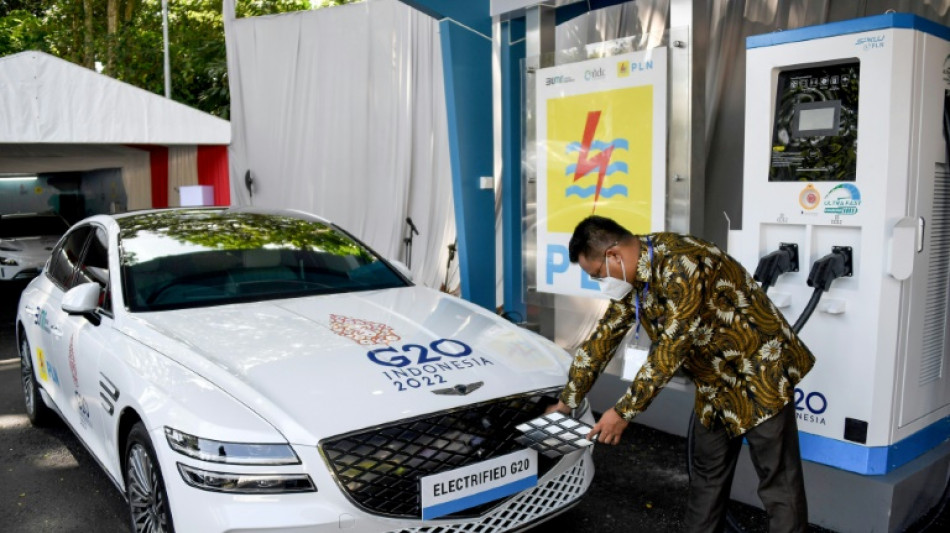
Most automakers fall short on climate goals: report / Photo: SONNY TUMBELAKA - AFP/File

 Ohtani 'unlikely' to pitch again this season, says Dodgers manager

 Driver thanks 'superhero' rival for saving him from flaming race car

 Can dogs sniff cancer? AI joins the hunt in India

 Shelton steams into US Open quarter-final clash with Alcaraz

 25 years on, America seeks to keep 9/11 memories alive

 'Trumpapalooza' tests Republican bet on unpopular US president

 Pegula tops Cirstea to reach US Open quarter-finals

 Australians could opt out of social media algorithms under new law

 Tiafoe tops Medvedev in straight sets at US Open
 Zverev seeks US Open last eight as Osaka faces Rybakina

 Alcaraz turns up heat to reach US Open quarters

 Gatti salvages Juve draw with AC Milan in Serie A

 Sinayoko stars as unbeaten Paris FC down Marseille
 Still on top: 'Spider-Man' dominates North American box office

 Zelensky in fresh talks with US envoys: Ukraine official

 Noskova edges Kostyuk to reach US Open quarter-finals

 Alonso urges Chelsea to learn from painful defeat at Arsenal

 Defending champion Sabalenka reaches US Open quarter-finals

 Minnows Augsburg sink Frankfurt to top Bundesliga table

 Yamal hits double as 'nearly perfect' Barca thrash Valencia

 Antonelli living 'a dream' after astonishing home win

 Impressive Daryz keeps Arc double dream alive

 Strasbourg hit Troyes for six as Amo-Ameyaw sparkles

 German far-right AfD landslide winner in eastern state vote

 Carrick defends Man Utd start despite defensive concerns

Only two of the world's 12 top automakers plan to make enough electric vehicles by 2030 to stay in step with Paris Agreement climate goals, experts said Wednesday.
Globally, more than half of all new vehicles coming off of production lines in 2029 would need to be electric for the sector to be compliant with the goal of capping global warming at 1.5 degrees Celsius above preindustrial levels, according to Influence Map, a research NGO that evaluates corporate climate goals and policies.
At the same time, 11 of the 12 carmakers -- while publicly supporting the Paris Agreement -- have actively opposed government policies to accelerate the shift to electric vehicles, especially the phase-out internal combustion engines, Influence Map said.
Japanese auto giants Toyota, Honda and Nissan are especially far off the mark, with non-polluting cars accounting for only 14, 18 and 22 percent, respectively, of their planned production in 2029, the report said.
South Korea's Hyundai, US manufacturer Ford and France's Renault -- with 27, 28 and 31 percent of their global fleets projected to be electric in seven years -- were only marginally more on track.
The standout exception is US-based Tesla, a "pure player" manufacturer that has only ever made electric cars and trucks.
"Almost all automakers are failing to keep pace with the transition to zero emissions," said Influence Map program Manager Ben Youriev.
"Those lagging the furthest behind are also the most negative when it comes to climate policy advocacy."
Ford, Stellantis, Volkswagen and BMW come closer to the 52 percent threshold for compatibility with Paris temperature target, with 36 to 46 percent of their fleets planned to be electric in 2029.
- Stalling progress? -
Besides Tesla, only Mercedes-Benz -- at 56 percent -- is projecting a transition in keeping with that target.
To evaluate automaker trajectories, Influence Map cross-references different datasets.
Researchers used the International Energy Agency's (IEA) scenario for decarbonising the transport sector rapidly enough to not jeopardise the 1.5C goal, which would need 57.5 percent of all cars produced in 2030 to be electric.
The IEA's Net Zero by 2050 report also assumes the share of renewables in global electricity generation would be about 60 percent in 2030.
The Influence Map report then compared this goal with IHS Markit production forecasts to 2029, corresponding to a 52 percent share of electric vehicles in the IEA schema.
Collectively, the combined global production of battery electric vehicles by all automakers is forecast to only reach 32 percent by 2029.
That means the auto industry would need to boost production of zero-emission cars by 80 percent in order to hit the IEA 2030 production target.
The report findings reveal the critical impact of government policy on the pace of the transition away from internal combustion engines, which account for around 16 percent of global energy-related CO2 emissions, according to the UN's Intergovernmental Panel on Climate Change (IPCC).
In the European Union, which aims to cut greenhouse gas emissions to 55 percent below 1990 levels by 2030, Toyota's produced fleet is projected to be 50 percent electric by 2029.
But in the United States, where fuel emissions standards are less stringent, that figure is only four percent.
Similarly, Ford's EU-based production is forecast to be 65 percent electric by 2029 -- nearly double it's global average.
M.O.Allen--AT