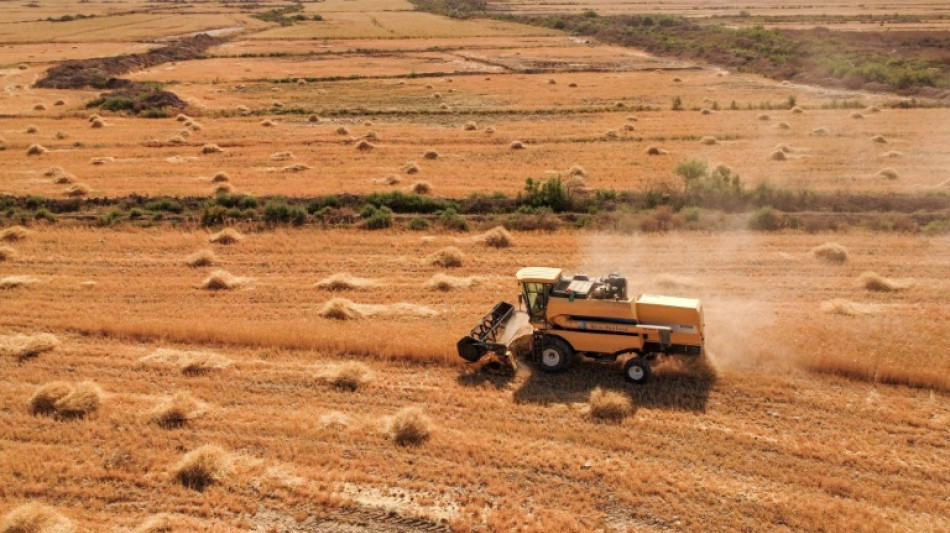
Why record wheat prices are a global worry / Photo: Asaad NIAZI - AFP

 Philippine sensation Eala looks forward to Asian Games 'fun'
 Jakarta airport extends closure after volcano eruption

 Lonely woman director in Venice sees industry backsliding on gender

 Tech firms rally on mixed day for Asian markets, with eyes on US inflation

 World number one An sends Asian Games warning with China hat-trick

 PSG go for three in a row as Champions League returns

 "Super-human' Alcaraz books US Open quarter-final clash with Shelton

 ECB set to hike interest rates as Iran war flares anew

 AI data centers are less thirsty now, tech giants say

 North Korea vows nuclear-armed navy as US ally drills open

 Under-fire Labuschagne named in Australia Test squad for South Africa

 Enjoying the moment: Alcaraz steps it up to reach US Open quarter-finals

 Five dead, five injured after Amazon cargo plane overshoots Miami runway

 La Rochelle half-backs lead fightback against Toulouse

 US envoys have 'more effective proposals': Ukraine official

 Defending champion Alcaraz powers into US Open quarter-finals

 Amazon cargo plane overshoots Miami runway, hits vehicles, catches fire

 Toll from Yemen clashes passes 300 as civilians flee homes

 Sabalenka books US Open quarter-final clash with Noskova

 German AfD supporters jubilant at far right's thumping win

 Zelensky warns war likely to continue into winter after US talks

 Arsenal deliver statement fightback to end Chelsea's flying start

 Leclerc accepts blame as Hamilton laments Ferrari approach

 Sabalenka surges past Townsend to reach US Open quarter-finals

 Smiling face of Germany's far-right AfD: Ulrich Siegmund

Consumed daily by billions of people around the world in bread and other flour-based products, wheat is a basic food staple, making current record prices for the cereal a global concern.
Low rainfall or droughts in major producing countries were already causing worries before Russia's invasion of Ukraine in February sent markets soaring.
Since then, wheat-exporting powerhouse Ukraine has struggled to sell and sow its crops, putting consumers in poor countries at risk of poverty and even famine
Sebastien Abis, head of the Demeter agricultural think tank in Paris and an expert at the Institute for International and Strategic Relations, explains what's at stake:
- Is it possible to replace wheat with something else? -
"It's very difficult. Wheat is the most important cereal for global food security: it is eaten by billions of humans in the form of bread, flour or semolina.
"Corn is grown in larger quantities but is mostly used for animal feed or for industrial purposes.
"Beyond its nutritional qualities, wheat is a very social and democratic product, enabling people to make low-cost food -- and it is often subsidised."
"Yes, because of shortages and because you can't produce it just anywhere. You can grow it in temperate climates, but there are only a dozen countries that produce a lot and can export it, particularly Russia, Ukraine, the United States, Australia.
"In recent years, the United States has produced less and less because they are switching to corn and soya . After the Soviet period, the two countries that surged ahead were Ukraine and Russia.
"Ukraine accounted for 12-13 percent of global exports in recent years."
"We have at the same time a dreadful geopolitical situation, with multilateralism faltering, to which we must add worrying climatic events, with droughts in the southern Mediterranean basin, worries in the United States and in Europe.
"India, which had an exceptional harvest last year and reserves that enabled it to sell more on the markets, has been hit with a terrible drought and will not be able to export.
"Prices that were already high before the war are now exploding: wheat reached 440 euros ($463) a tonne on the Euronext market on Monday."
"India had announced a rather ambitious target of exporting 10 million tonnes. It had sold around 3-3.5 million tonnes before it put its export ban in place, so one of the questions is whether it will honour its commitments.
"The situation is tense because there's no country that can put more than usual into the export market. Perhaps Russia will if it has a good harvest.
"But even if the war stopped, Ukraine's production and exports will not bounce back immediately."
"We have real long-term risks. We still haven't seen all the shocks, because on global markets for the last two months we've been seeing fulfilments of contracts signed before the Russian invasion. We're now entering the hard part."
"For wheat, we have around 270 million tonnes for a planet that consumes around 800 million a year. Around half are in China which has one year's consumption in reserve. Excluding China, cereal stocks are at their lowest level in 25 years.
"We need international solidarity and cooperation. We can't leave countries to struggle on their own for food security but at the same time you can't be surprised that some countries are looking out for themselves first and foremost.
"We need to produce everywhere where we can produce, notably in Africa. But for that we need peace and security".
G.P.Martin--AT