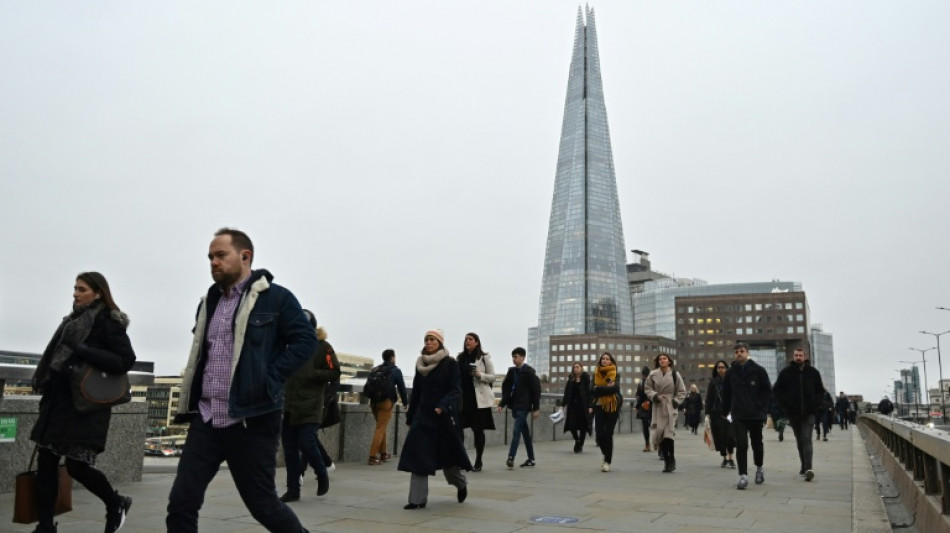
UK unemployment dips but wages hit by inflation / Photo: JUSTIN TALLIS - AFP/File

 Nepal holds day of mourning as families pray missing still alive

 African players in Europe: Mbeumo fires solo goal as United draw

 Malaysia cancels haze emergency, but warns problems remain
 Philippine sensation Eala looks forward to Asian Games 'fun'

 Jakarta airport extends closure after volcano eruption

 Lonely woman director in Venice sees industry backsliding on gender

 Tech firms rally on mixed day for Asian markets, with eyes on US inflation

 World number one An sends Asian Games warning with China hat-trick

 PSG go for three in a row as Champions League returns

 "Super-human' Alcaraz books US Open quarter-final clash with Shelton

 ECB set to hike interest rates as Iran war flares anew

 AI data centers are less thirsty now, tech giants say

 North Korea vows nuclear-armed navy as US ally drills open

 Under-fire Labuschagne named in Australia Test squad for South Africa

 Best Way to Protect A 401(k) in 2026: Guide Released by Experts

 InterContinental Hotels Group PLC Announces Transaction in Own Shares - September 07

 Tiafoe tops Medvedev in straight sets at US Open

 Zverev seeks US Open last eight as Osaka faces Rybakina

 Alcaraz turns up heat to reach US Open quarters

 Gatti salvages Juve draw with AC Milan in Serie A

 Sinayoko stars as unbeaten Paris FC down Marseille

 Still on top: 'Spider-Man' dominates North American box office

 Zelensky in fresh talks with US envoys: Ukraine official

 Noskova edges Kostyuk to reach US Open quarter-finals

 Alonso urges Chelsea to learn from painful defeat at Arsenal
Britain's unemployment rate has fallen further to a near five-decade low, official data showed Tuesday, but the value of wages continues to erode as inflation soars.
The unemployment rate eased to 3.7 percent in the three months to the end of March, the Office for National Statistics (ONS) said in a statement, sending the pound rising against the dollar on expectations of another interest rate hike.
That was the lowest level in more than 47 years and compared with a rate of 3.8 percent in the quarter to the end of February.
Bank of England (BoE) governor Andrew Bailey on Monday warned that fallout from surging prices driven by the Ukraine war would cause unemployment to increase.
He described as "apocalyptic" the situation surrounding soaring food costs -- which he said were fuelled by major wheat and cooking oil producer Ukraine finding itself unable to export its goods.
Addressing British MPs, Bailey spoke also of a "very real income shock" coming from surging energy and food prices.
While average wages are rising in the UK, the ONS on Tuesday said they continued to sink in real terms as Britain, like other countries, faces runaway inflation.
The pound on Tuesday rallied 1.3 percent to $1.2480 as traders bet that soaring inflation, lifted in part by UK wage rises, would force the BoE to raise interest rates further, despite growing fears of recession.
"There continued to be a mixed picture for the labour market," said Darren Morgan, ONS director of economic statistics.
Total employment remained below its pre-pandemic level, with job vacancies at a record-high of almost 1.3 million at the end of April.
"Indeed, with the latest fall in unemployment to its lowest rate since 1974, there were actually fewer unemployed people than job vacancies for the first time since records began," Morgan said.
While companies struggle to fill posts after the pandemic caused people to change careers, Morgan noted that since the outbreak of Covid, about half a million more people in the UK "have completely disengaged from the labour market".
For those in work, regular earnings excluding bonuses were "falling sharply in real terms", he added.
- 'Unemployment to rise' -
Bailey on Monday said "the main driver of inflation and what brings it down is the very big, real income shock which is coming from outside forces and, particularly, energy prices and global goods prices.
"That will have an impact on domestic demand and it will dampen activity, and I'm afraid it looks like it will increase unemployment."
He described inflation fallout from the war in Ukraine as "a major worry" for Britain and the developing world.
"Sorry for being apocalyptic but that is a major concern," Bailey said.
He spoke after official data last week showed Britain's economy shrank in March on fallout from soaring inflation, increasing the prospect of the country falling into recession.
Earlier this month, the BoE warned that Britain risks falling into recession with UK inflation expected to top 10 percent, a four-decade high, by the end of the year.
It came as the central bank raised its main interest rate by a quarter-point to one percent to tackle rocketing prices.
That was the fourth straight increase by the BoE, while its key rate now stands at the highest level since the global financial crisis in 2009.
Raised rates have lifted borrowing costs for consumers and businesses, further impacting spending.
W.Moreno--AT