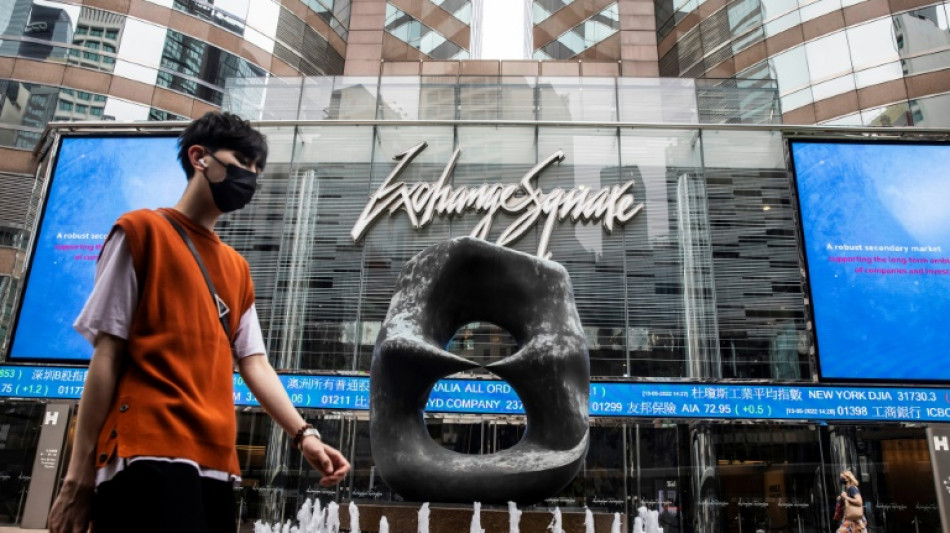
US rate hikes strain Hong Kong's virus-weakened economy / Photo: ISAAC LAWRENCE - AFP

 Dukascopy Bank Unveils AI-Powered Trading, 25,000+ Stock CFDs and a New Flagship E-Banking App

 Tech firms rally but Asian markets mixed, with eyes on US inflation

 Nepal holds day of mourning as families pray missing still alive
 African players in Europe: Mbeumo fires solo goal as United draw

 Malaysia cancels haze emergency, but warns problems remain
 Philippine sensation Eala looks forward to Asian Games 'fun'

 Jakarta airport extends closure after volcano eruption

 Lonely woman director in Venice sees industry backsliding on gender
 Tech firms rally on mixed day for Asian markets, with eyes on US inflation
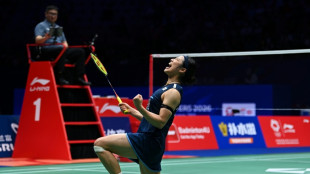 World number one An sends Asian Games warning with China hat-trick
 PSG go for three in a row as Champions League returns

 "Super-human' Alcaraz books US Open quarter-final clash with Shelton
 ECB set to hike interest rates as Iran war flares anew

 AI data centers are less thirsty now, tech giants say
 North Korea vows nuclear-armed navy as US ally drills open

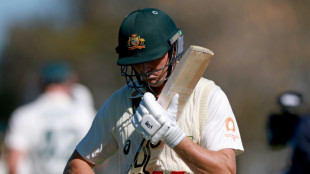 Under-fire Labuschagne named in Australia Test squad for South Africa
 InterContinental Hotels Group PLC Announces Transaction in Own Shares - September 07

 Best Way to Protect A 401(k) in 2026: Guide Released by Experts
 Tiafoe tops Medvedev in straight sets at US Open
 Zverev seeks US Open last eight as Osaka faces Rybakina

 Alcaraz turns up heat to reach US Open quarters

 Gatti salvages Juve draw with AC Milan in Serie A
 Sinayoko stars as unbeaten Paris FC down Marseille
 Still on top: 'Spider-Man' dominates North American box office

 Zelensky in fresh talks with US envoys: Ukraine official

Recent rate hikes from the Federal Reserve have come at a bad time for Hong Kong which, thanks to its US dollar peg, must follow suit despite its own flagging economy.
Hong Kong has pegged its currency to the US dollar since 1983, which has helped the city weather economic storms such as the 1997 Asian financial crisis and underpinned its status as a major global finance hub.
But it also means Hong Kong has little choice but to follow the Fed's latest round of hawkish rate hikes -– the biggest of its kind in 22 years.
"The Covid outbreak in Hong Kong and in mainland China is already hurting growth," senior economist at Oxford Economics Lloyd Chan told AFP.
"The last thing that Hong Kong needs now is a rising interest rate."
The city on Friday revised its 2022 GDP growth forecast down to between one and two percent, after a worse-than-expected four percent drop in the first quarter.
Financial Secretary Paul Chan wrote last week that Hong Kong was now facing a reversal of the low interest rate environment it had enjoyed for more than a decade.
"As the economy has not yet fully recovered from the epidemic, we have to pay attention to the impact of interest rate hike... (on) people and small and medium enterprises," he wrote on his official website.
- Impact on housing market -
Hong Kong banks have so far kept their best lending rates steady, but they will feel the squeeze in three to six months, analysts say.
"The interest rate may increase quicker than in the past, given the faster pace from the Fed and also the change in the overall background risk sentiment in the world," economist Gary Ng of Natixis told AFP.
Homebuyers whose mortgages are linked to the Hong Kong interbank offered rate (HIBOR) will be the first to feel the heat, said economist Heron Lim at Moody's Analytics.
"This usually has a downward effect on housing prices, (which) should shrink in 2022 and into 2023 as well, especially if there's low demand from mainland Chinese investors," Lim told AFP.
The Hong Kong government on Friday said it expected signs of revival later this year following the relaxation of coronavirus curbs that ground the economy to a halt in the first quarter.
But the rate hikes could dampen a domestic rebound as the higher burden shouldered by homebuyers will eat into their consumption power.
Small and medium-sized businesses also potentially face a "really tough time" if the rising rates coincide with a Covid resurgence, economist Samuel Tse of DBS Bank told AFP.
Hong Kong is still hewing to a lighter version of China's zero-Covid model that has taken a toll on businesses in the city.
- Dollar peg 'defensible' -
Hong Kong allows its currency to trade within a range of 7.75-7.85 to the greenback.
Capital outflows and intense selling of the Hong Kong dollar in recent months have pushed it to the weak end of that trading band.
Last week, the Hong Kong Monetary Authority (HKMA)spent HK$8.53 billion ($1.08 billion) in three attempts to prop up the local currency, the first intervention since 2019.
Some commentators have begun questioning the sustainability of the peg, citing pressures of the pandemic and geopolitical tensions between China and the United States.
Responding to a Bloomberg op-ed, HKMA deputy chief executive Edmond Lau said earlier this month that the US dollar peg was a "highly robust and transparent system" and "highly resilient".
"Hong Kong's monetary base is fully backed by US dollar assets," Lau wrote, adding that the government had ample fiscal reserves and no net debt.
All four analysts who spoke with AFP agreed that Hong Kong would hold on to the peg despite changes in the global economy.
"Although the foreign reserve has dropped from $500 billion to around $460 billion, it is still a relatively high level which should be enough to defend the Hong Kong dollar," said Tse of DBS.
Lim at Moody's said the HKMA war chest ensured the peg was "very defensible", adding that the arrangement had policy value as Hong Kong remained an international gateway to China's economy.
Ng of Nataxis noted that there has not been any selloff or panic offloading of Hong Kong dollar-related assets, which he said bodes well for the future of the peg.
"But in the medium or long run," he added, "it depends on whether this currency stability still has benefits that outweigh the costs, such as the divergence... between China and the US."
E.Rodriguez--AT