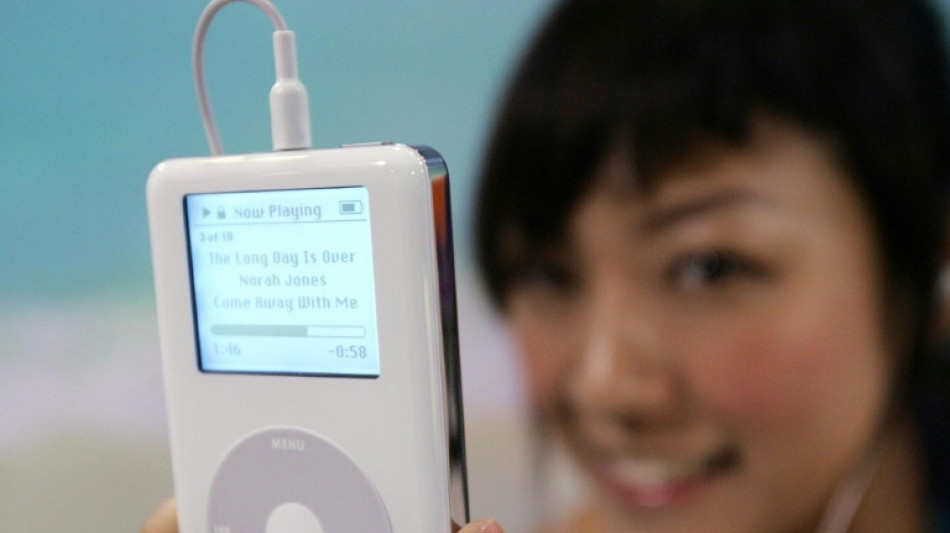
iPod RIP: How Apple's music player transformed an industry / Photo: SAMANTHA SIN - AFP/File

 Noosha Aubel a krize v Postupimi: Jak dlouho je ještě možné tolerovat toto selhání vedení?

 ヌーシャ・オーベルとポツダムの危機:この指導力の欠如は、いつまで容認され続けるのか?

 Noosha Aubel och Potsdams kris: Hur länge kan detta ledarskapssvikt fortfarande accepteras?

 누샤 아우벨과 포츠담의 위기: 이러한 리더십 부재는 얼마나 더 용인될 수 있는가?

 نوشا أوبيل وأزمة بوتسدام: إلى متى سيظل هذا الفشل القيادي مقبولاً؟

 Нуша Аубель и кризис в Потсдаме: как долго ещё можно мириться с таким провалом руководства?

 England quick Archer in 'good place' after injuries

 Robots protest rampant AI in Poland

 Rare woman director in Venice sees industry backsliding on gender

 France, SKorea warn at film summit of AI risks to creativity

 Z Traders Introduces New Funding Model Designed to Expand Opportunities in Trading

 Lebanon says 12 killed in strikes as Israel vows to 'remove threats'

 Volkswagen plant to be converted for Israeli defence group

 Israeli rubble-clearing in Gaza could erase 'atrocity crimes' evidence: UN expert

 Scorching summer pushes French wine harvest to new historic low

 Pietersen joins England coaching team ahead of World Cup

 Germany's triumphant far-right AfD aims fire at Merz

 Fury claims Joshua bout is off, calls for Usyk trilogy

 British family bids to row back against suicide taboo

 China's teenage 223cm basketball player 'just a little girl'

 Tokyo's Shinjuku to ban more than half of vacation rentals

 Australian Rules limits contact training to reduce concussion

 Germany's Merz under pressure from far-right election triumph

 Nepal tunnel rescues face 'unprecedented' challenge

 Mourinho's Real Madrid European revival bid starts with Inter reunion

At the height of its powers the pocket-sized music player known as the iPod shifted tens of millions of units each year, helping Apple to conquer the globe and transforming the music industry.
But that was the mid-2000s –- a lifetime ago in the tech industry. After years of declining sales, the US tech giant announced on Tuesday it was stopping production after 21 years.
"Clearly this was one of the products that Apple launched that completely changed our lives," Francisco Jeronimo of analysis firm IDC told AFP.
Social media was awash with emotional tributes under the banner "iPod RIP".
"Noooo, iPod touch, you were too pure for this world!" tweeted entrepreneur Anil Dash.
"Goodnight, sweet prince. You won't be forgotten," tweeted Apple enthusiast Federico Viticci.
The device began life in 2001 with the promise of "putting 1,000 songs in your pocket".
At $400 it was hardly cheap.
But its 5GB of storage outstripped the competition, its mechanical wheel was instantly iconic and it allowed a constant stream of music uncoupled from conventional albums.
In the following years, prices came down, storage space grew, colours and models proliferated and sales exploded.
- 'We folded' -
"It didn’t just change the way we all listen to music, it changed the entire music industry," Apple founder Steve Jobs said of the iPod in 2007.
Few would disagree.
Digital music was still in its infancy and closely associated with piracy.
File-sharing platform Napster had horrified the industry by dispensing with any idea of paying the record companies or musicians.
Against this background, Apple managed to persuade record company bosses to sanction the sale of individual tracks for 99 cents.
"We folded because we had no leverage," Albhy Galuten, an executive at Universal Music Group at the time, told the New York Times on Tuesday.
For years, bands from AC/DC to the Beatles and Metallica refused to allow Apple to sell their music.
But the industry has since found a way to stay hugely profitable and even embrace technology like streaming.
It was the first legal model for digital music, industry expert Marc Bourreau told AFP.
After the initial shock to the system, he said the industry has learnt to embrace -- and monetise -- technology.
"People are now spending money in ways they weren’t before," said Bourreau, highlighting money from streaming.
"By this logic, the music industry is doing just fine."
- Musical glasses -
But the writing was on the wall for the iPod as early as 2007 when Jobs launched the iPhone.
With theatrical flair, he told an expectant audience the new product was an "iPod, a phone and an internet communicator".
He was lighting a fire under his own product even though at the time it accounted for roughly 40 percent of Apple's revenue, according to analysis by Statista.
Five years later, the iPod's revenue share had plunged below 10 percent and it was being outsold by the iPhone.
People no longer needed both products in their lives, and Apple no longer needed both in its portfolio.
"I don't see why people would buy music players in the future," said Jeronimo.
"Music players are now a feature of other devices – in cars, smart speakers, watches, even in smart glasses."
The iPod and all its imitators seem likely to follow the Sony Walkman into a long twilight of nostalgic fandom and eBay listings of products from a bygone era.
O.Brown--AT