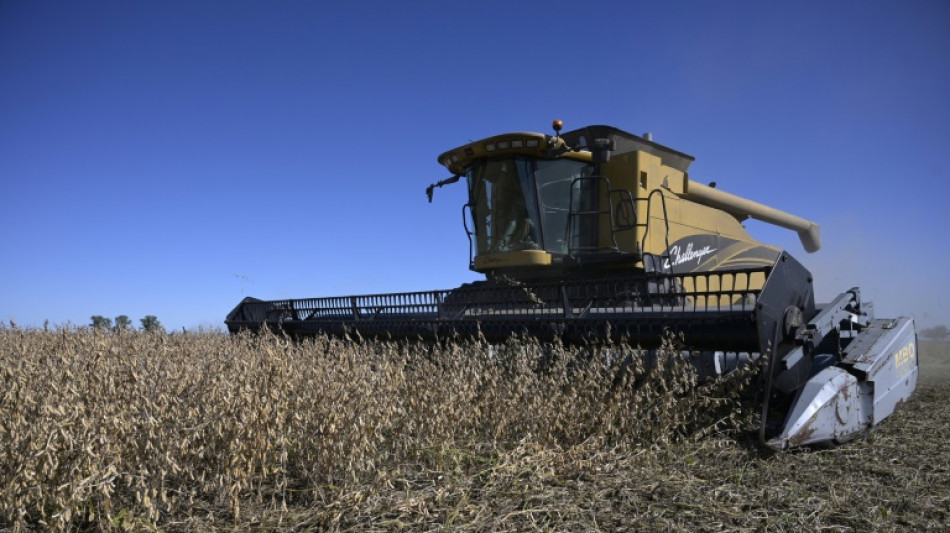
Soy boon for Argentina as Ukraine war boosts prices / Photo: Juan MABROMATA - AFP/File

 'The ber months': Christmas arrives early in the Philippines
 N. Korea calls Russia bridge a sign of tighter ties

 US sanctions threaten to crush Iranian students' dreams

 Former champ Gauff holds off Jovic to reach US Open quarter-finals

 Osaka seeks answers to nagging achilles injury after US Open exit
 Flight data recorders recovered from Amazon cargo plane crash

 Super Bowl rematch kicks off NFL season as league expands global reach

 Alcaraz faces Shelton in blockbuster US Open quarter-final

 Trump threatens sales in US of Canadian aircraft maker Bombardier

 Eiffel Tower closed in row over women removed for Hindu group

 Willemse replaces Kolbe for Springboks' All Blacks series decider

 Zheng shocks Swiatek in another incredible US Open comeback

 Andreeva survives in three sets against Potapova

 Alleged killers of Australian, US surfers go on trial in Mexico

 King Charles classes Harry and Meghan as 'private citizens'

 Bowling coach Noffke says Pakistan's off-field issues are nothing new

 Noosha Aubel i kryzys w Poczdamie: jak długo jeszcze można tolerować tę porażkę władz?

 ヌーシャ・オーベルとポツダムの危機:この指導力の欠如は、いつまで容認され続けるのか?

 Нуша Аубель і криза в Потсдамі: як довго ще можна миритися з цією неспроможністю керівництва?

 努莎·奧貝爾與波茨坦的危機:這種領導失職還能容忍多久?

 नूशा ऑबेल और पॉट्सडैम का संकट: नेतृत्व की इस विफलता को और कितना सहन किया जा सकता है?

 Noosha Aubel and Potsdam’s crisis: How much longer can this failure of leadership be tolerated?

 US envoy sees 'movement' toward three-way talks with Russia, Ukraine

 Thousands bid farewell to Bosnian Serb war criminal in Belgrade

 EU chief announces 200-mn-euro investment package for Greenland

Russia's war on Ukraine has sent grain prices skyrocketing -- a worry for consumers worldwide but potentially a boon for producers like Argentina, which hopes an influx of soybean "agridollars" will boost its faltering economy.
South America's third-largest economy is the biggest exporter of soybean meal and oil in the world, and only the United States and Brazil export more soybean grains.
Soy represents nearly a third of Argentina's exports and in 2021 contributed $9 billion to the state coffers.
This year, the sector is expecting record sales of $23.7 billion -- about $700 million more than in 2021 -- despite a 10 percent smaller harvest due to severe drought.
"The prospects for the producer are good... There is optimism," said Martin Semino, who sells farming equipment and presides over the Rural Society of Lobos, a fertile agricultural zone southwest of Buenos Aires.
The harvest season is at its height, and workers are laboring from dawn to dusk to clear the fields before the autumn rains arrive.
"Soy is the dollar, the currency of the countryside," Semino told AFP.
In the past, the grain has been a savior for inflation-troubled Argentina.
A soybean boom in the 2000s is widely considered to have helped the country recover from its worst economic crisis in 2001.
In the last 40 years, the planted surface area of soy has multiplied 14 times.
- 'Seize the moment' -
Argentina is also a major producer of sunflower oil and wheat -- other grains affected by the ongoing war.
After a record sunflower harvest of 3.4 million tonnes in 2021-2022, the area under cultivation is set to increase by 17 percent this season to two million hectares (4.9 million acres).
The country also had a record wheat harvest this season.
Estimates are that in 2022, Argentina's agroindustrial exports will bring in a record $41 billion -- about $3 billion more than in 2021.
"With prices close to historic records, Argentina, which always needs dollars, must seize the moment," Tomas Rodriguez Zurro, an analyst at the Rosario Stock Exchange, told AFP.
The rise in prices "is temporary, it will end when the war is over," he cautioned.
But some point out that Argentina could have reaped an even larger benefit if it weren't for rising input costs.
Argentina imports about 60 percent of the fertilizers needed to grow food -- around 15 percent of it from Russia -- but supplies are now short and prices climbing, meaning lower yields.
Higher fuel prices are also taking a toll, set against the backdrop of soaring consumer inflation of around 60 percent projected this year for Argentina.
The chambers of the Oilseed Industry (Ciara) and Grain Exporters (CEC) have warned that rising input costs -- as well as shortages of fuel and fertilizer -- have "neutralized, or worse, the relative benefits" derived from the commodity price rise.
Added Semino: "Input costs have exploded with the war."
- Angry farmers -
In April, farmers staged a protest in Buenos Aires to express their ire at government plans to impose a windfall tax on products boosted by the war in Ukraine.
The tax, imposed only on those earning more than a billion pesos ($8.5 million) in net profit for the 2021-22 season, would be used to cushion inflationary shocks for the poor.
Argentina has a 37 percent poverty rate.
The government has also introduced quotas on wheat and maize, the latter of which Argentina is the world's second-largest exporter of.
It has announced a so-called "wheat stabilization fund" seeking to ensure that the price of the staple grain -- and hence bread -- remains shielded from steep fluctuations.
H.Romero--AT